Apple Launches Open Source Project to Let Password Management Apps Create Strong Passwords

Apple today informed developers that it has launched a new open source project that's designed to let those who develop password management apps create strong passwords compatible with popular websites.
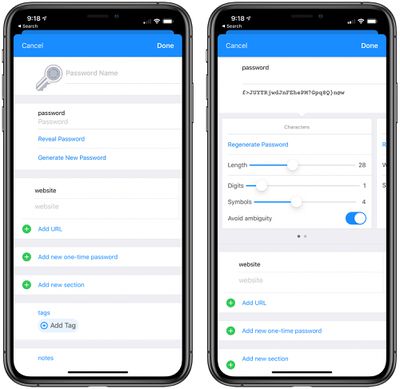
1passwordgenerate
The new Password Manager Resources open source project allows password management apps to integrate website-specific requirements used by the iCloud Keychain password manager to generate strong, unique passwords.

Many password managers generate strong, unique passwords for people, so that they aren't tempted to create their own passwords by hand, which leads to easily guessed and reused passwords. Every time a password manager generates a password that isn't actually compatible with a website, a person not only has a bad experience, but a reason to be tempted to create their own password. Compiling password rule quirks helps fewer people run into issues like these while also documenting that a service's password policy is too restrictive for people using password managers, which may incentivize the services to change.

The project also features a collection of websites known to share a sign-in system, links to website pages where users can change passwords, and more, with full details available on GitHub.

Apple says that having password managers collaborate on resources like password rules and change password URLs allows all password management apps to improve their quality with less work, plus it encourages websites to use standards or emerging standards to improve their compatibility with password managers.

Popular Stories

iPhone Top Left Hole Punch Face ID Feature Purple

iPhone 18 Pro Launching Later This Year With These 12 New Features

Thursday January 15, 2026 10:56 am PST by
While the iPhone 18 Pro and iPhone 18 Pro Max are not expected to launch for another eight months, there are already plenty of rumors about the devices. Below, we have recapped 12 features rumored for the iPhone 18 Pro models, as of January 2026: The same overall design is expected, with 6.3-inch and 6.9-inch display sizes, and a "plateau" housing three rear cameras Under-screen Face ID...
iPhone Top Left Hole Punch Face ID Feature Purple

New Leak Reveals iPhone 18 Pro Display Sizes, Under-Screen Face ID, and More

Wednesday January 14, 2026 7:09 am PST by
While the iPhone 18 Pro models are still around eight months away, a leaker has shared some alleged details about the devices. In a post on Chinese social media platform Weibo this week, the account Digital Chat Station said the iPhone 18 Pro and iPhone 18 Pro Max will have the same 6.3-inch and 6.9-inch display sizes as the iPhone 17 Pro and iPhone 17 Pro Max. Consistent with previous...
2024 iPhone Boxes Feature

Apple Adjusts Trade-In Values for iPhones, Macs, and More

Thursday January 15, 2026 11:19 am PST by
Apple today updated its trade-in values for select iPhone, iPad, Mac, and Apple Watch models. Trade-ins can be completed on Apple's website, or at an Apple Store. The charts below provide an overview of Apple's current and previous trade-in values in the United States, according to the company's website. Most of the values declined slightly, but some of the Mac values increased. iPhone ...
Verizon New

Verizon Offering $20 Credit After Major Outage, Here's How to Get It

Thursday January 15, 2026 7:37 am PST by
Verizon today announced it will be offering customers a $20 account credit after a major outage on Wednesday, and action is required to receive it. The carrier said affected customers can accept the credit by logging into the My Verizon app, but it might take some time before this option shows up in the app. Affected customers will receive a text message when the credit is available. On...
Apple MacBook Pro M4 hero

These 5 Apple Products Will Reportedly Be Upgraded With OLED Displays

Friday January 16, 2026 7:07 pm PST by
Apple plans to upgrade the iPad mini, MacBook Pro, iPad Air, iMac, and MacBook Air with OLED displays between 2026 and 2028, according to DigiTimes. Bloomberg's Mark Gurman previously reported that the iPad mini and MacBook Pro will receive an OLED display as early as this year, but he does not expect the MacBook Air to adopt the technology until 2028 at the earliest. A new iPad Air is...

Top Rated Comments

kop48 Avatar
73 months ago
Any reason why the article shows the password generator from 1Password without references? :)
Score: 21 Votes (Like | Disagree)
mnsportsgeek Avatar
73 months ago
The thing I’d really like to see is password generation in safari for 3rd party apps.

It’s a bit of a pain to create new accounts in 1Password with the proper url. You have to go back and forth between the app and 1Password a time or two. It’d be nice if it was more streamlined for 3rd party apps kind of like it is for keychain.
Score: 14 Votes (Like | Disagree)
TriBruin Avatar
73 months ago

there's still going to be (and are) plenty of websites that create their own stupid password rules that no password manager that generates strong passwords will be able to comply. People are still going to have to roll their own- kinda taking away the spark of this project. - But at least it's a step in the right direction.
From the way I read it, that is the goal of this project. Once enough password managers add this feature, it should not matter (from a password generation POV), what the requirements are. The password manager will know BEFORE it generates a password.

Take an example from one of the existing websites in the password-rules.json:

According to the JSON, bhphotovideo.com has a requirement of a password max length of 15 characters. Pretend you go to that website and attempt to create an account. You use the Password Generator in Safari (or any password manager), BEFORE the password generator attempts to create a complex password, it reads the JSON and finds the bhphotovideo.com URL. It then reads the requirements (Max length 15). It immediate creates a password that fits that requirement, regardless of what your defaults are. No action needed on your part to manually change the requirements (which may not be obvious on the webpage.)

The key is (a) the list of password requirements is kept up to date. Since this is published on GitHub, anyone can make a PULL request to update. I wonder what Apple's merge requirements are going to be.

(b) Password managers integrate this in to there workflow.
Score: 14 Votes (Like | Disagree)
NightFox Avatar
73 months ago

Any reason why the article shows the password generator from 1Password without references? :)
I'd guess that if they did reference it, people on here would be asking why they'd singled out 1Password to feature over other PWMs
Score: 13 Votes (Like | Disagree)
Stanfield Avatar
73 months ago

Sure. Give hackers the open source code to help people generate passwords. What can go wrong? :rolleyes:
Openness enables collaboration. Black boxes maintained by a single company aren't usually the best method for strong security. I want security that shows you exactly what its doing, has been vetted by a community of security experts, and dares the hackers to break it.
Score: 9 Votes (Like | Disagree)
bookofxero Avatar
73 months ago
It would be great if websites would have some consistency in their input validation and database schemas. I know one company that allows almost every special character but a comma - and the error message doesn't tell you which special character is the disallowed one. I used 1password and had to go through the generated password and remove each special character 1-by-1 to figure out which one was problematic.
"Hrm, octothorp? Nope. Modulus? Nope. Pipe? Nope. Asterisk? Nope. Greater than symbol? Nope. That just leaves the comma. What?! Seriously?"
It really is an awful experience and I can see why other users would resort to weak and/or reused passwords.
I've see other sites with very specific character length guidelines and other weird combinations. One site, which has since updated to something more secure, even once required 8-15 characters, letters and numbers only. If I were trying to brute force or guess a potentially weak password, wouldn't that make the dictionary size much smaller and thus easier to crack?
Score: 7 Votes (Like | Disagree)