Apple in the third iOS 13.5 beta introduced support for the Exposure Notification API it's developing with Google along with a toggle to enable it, and in the fourth beta of iOS 13.5 introduced today, Apple has tweaked the interface to make it more clear how exposure notification logging works.
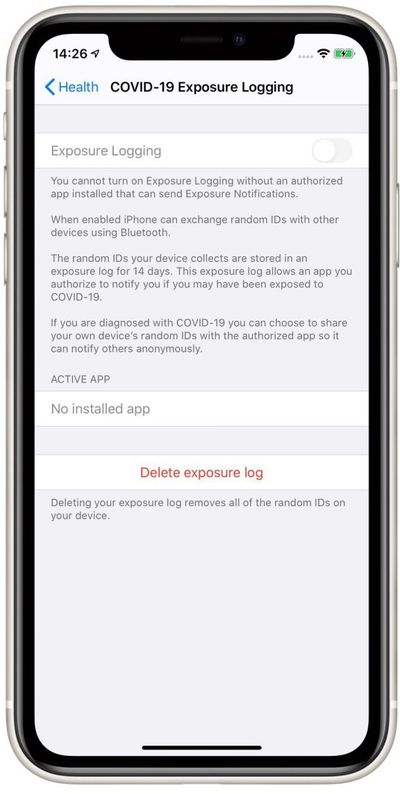
In this beta, when accessing the Exposure Notification toggle located in the Health section of the Privacy part of the Settings app, Apple now makes it clear that the exposure notification logging feature can't be turned out without an accompanying app installed.
In a country where exposure notification is available, the new Exposure Logging toggle is grayed out and cannot be activated without an authorized app installed, as seen in the screenshot above.
You cannot turn on Exposure Logging without an authorized app installed that can send Exposure Notifications.
When enabled iPhone can exchange random IDs with other devices using Bluetooth.
The random IDs your device collects are stored in an exposure log for 14 days. This exposure log allows an app you authorize to notify you if you may have been exposed to COVID-19.
If you are diagnosed with COVID-19 you can choose to share your own device's random IDs with the authorized app so it can notify others anonymously.
In a country where there are no apps that take advantage of Exposure Notification, there's different wording letting you know the feature is not available and no toggle to turn on at all.
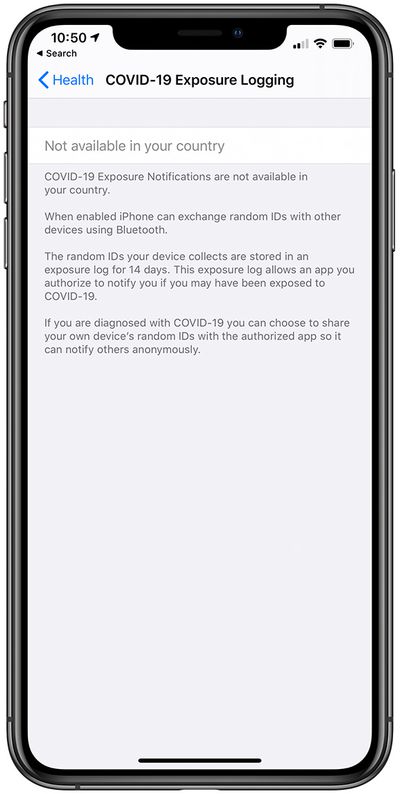
Beta users in the United States and other countries will see the warning about Exposure Notification not being available in the country as of yet because there are no apps that take advantage of Exposure Notification that can be downloaded at this time.
When health apps that use the Exposure Notification API are released, the Privacy section of the Settings app will also list the active Exposure Notification app that's installed.
Thursday January 29, 2026 10:07 am PST by Joe Rossignol
Apple today confirmed to Reuters that it has acquired Q.ai, an Israeli startup that is working on artificial intelligence technology for audio.
Apple paid close to $2 billion for Q.ai, according to sources cited by the Financial Times. That would make this Apple's second-biggest acquisition ever, after it paid $3 billion for the popular headphone and audio brand Beats in 2014.
Q.ai has...
Saturday January 31, 2026 10:51 am PST by Joe Rossignol
Apple recently updated its online store with a new ordering process for Macs, including the MacBook Air, MacBook Pro, iMac, Mac mini, Mac Studio, and Mac Pro.
There used to be a handful of standard configurations available for each Mac, but now you must configure a Mac entirely from scratch on a feature-by-feature basis. In other words, ordering a new Mac now works much like ordering an...
Sunday February 1, 2026 10:08 am PST by Joe Rossignol
Last year, Apple launched CarPlay Ultra, the long-awaited next-generation version of its CarPlay software system for vehicles. Nearly nine months later, CarPlay Ultra is still limited to Aston Martin's latest luxury vehicles, but that should change fairly soon.
In May 2025, Apple said many other vehicle brands planned to offer CarPlay Ultra, including Hyundai, Kia, and Genesis. At the time,...
A newly surfaced resale operation is seemingly offering Apple Store–exclusive display accessories to the public for the first time, potentially giving consumers access to Apple-designed hardware that the company has historically kept confined to its retail environments.
Apple designs a range of premium MagSafe charging stands, display trays, and hardware systems exclusively for displays in ...
Monday January 26, 2026 1:55 pm PST by Joe Rossignol
Apple today introduced its first two physical products of 2026: a second-generation AirTag and the Black Unity Connection Braided Solo Loop for the Apple Watch.
Read our coverage of each announcement to learn more:Apple Unveils New AirTag With Longer Range, Louder Speaker, and More
Apple Introduces New Black Unity Apple Watch BandBoth the new AirTag and the Black Unity Connection Braided...
Will never work. People will will toggle that they are infected (for a laugh or maliciously) and set off a ripple effect. You just KNOW that will happen.
You need a code from a testing center to kick off the "I tested positive" aspect of the tracing.
Will never work. People will will toggle that they are infected (for a laugh or maliciously) and set off a ripple effect. You just KNOW that will happen.
If you are potentially infected and/or asymptomatic, you wouldn’t report that you have COVID, so therefore the existence of the contact-tracing schema in your scenario is utterly pointless.
Completely and totally missing the point of all of this.
[LIST=1] * Someone gets tested and confirmed sick. * They send out the alert to others that they’ve been in contact with through a contact tracing app. * Those people that receive the alert might not know they could be sick and highly contagious, because they aren’t symptomatic (yet). * Those people then get tested. * If they find out that they are sick, they can isolate themselves until they are well, instead of continuing to unknowingly spread the disease.
Nice that they clarified how it works in the Settings app itself. There’s a lot of misinformation regarding Exposure Notifications. (A lot of people haven’t read the specification but insist they know everything about it.)
Will never work. People will will toggle that they are infected (for a laugh or maliciously) and set off a ripple effect. You just KNOW that will happen.
Nope. Can't happen. As an aside, that's quite a projection on your part!
Well some of you got your wish, this only works if you have an app installed, worried that really cripples the functionality. You have to opt in before you ever know you're sick. And judging from the responses I've seen here, I worry a large portion of the population is never going to do that.