New Study Aims to Determine Whether iPhone and Apple Watch Can Detect Early Signs of Dementia

Apple has partnered with pharmaceutical company Eli Lilly and health startup Evidation to determine whether data collected from the iPhone and Apple Watch can be used to detect early signs of dementia.

A research paper published this week and shared by CNBC lists researchers from Eli Lilly, Apple, and Evidation Health. The paper, called "Developing Measures of Cognitive Impairment in the Real World from Consumer-Grade Multimodal Sensor Streams," explores whether sensor data and activity info from smart watch devices can be mined for "physiological and behavior signatures of cognitive impairment."
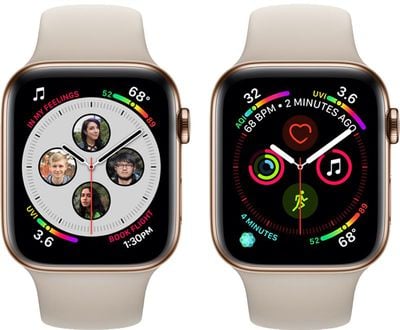
applewatchseries4watchfaces

The ubiquity and remarkable technological progress of wearable consumer devices and mobile-computing platforms (smart phone, smart watch, tablet), along with the multitude of sensor modalities available, have enabled continuous monitoring of patients and their daily activities. Such rich, longitudinal information can be mined for physiological and behavioral signatures of cognitive impairment and provide new avenues for detecting MCI in a timely and cost-effective manner.

In this work, we present a platform for remote and unobtrusive monitoring of symptoms related to cognitive impairment using several consumer-grade smart devices. We demonstrate how the platform has been used to collect a total of 16TB of data during the Lilly Exploratory Digital Assessment Study, a 12-week feasibility study which monitored 31 people with cognitive impairment and 82 without cognitive impairment in free living conditions. We describe how careful data unification, time-alignment, and imputation techniques can handle missing data rates inherent in real-world settings and ultimately show utility of these disparate data in differentiating symptomatics from healthy controls based on features computed purely from device data.

According to the abstract, 31 people with cognitive impairment and 82 without cognitive impairment were monitored over a 12-week period, with 16TB of data collected. The study claims that the data was able to be used to differentiate people with early signs of cognitive impairment from those who were healthy.

People who had symptoms of cognitive decline typed more slowly, typed less regularly, relied more heavily on support apps, and sent fewer text messages. The study did not reach long-term conclusions as more analysis is needed.

In a statement to CNBC, Evidation co-founder Christine Lemke said that data collected from the ‌iPhone‌, Apple Watch, and Beddit sleep monitors was used for the study. Apple acquired the company behind the Beddit sleep monitor back in 2017.

"With this research, we looked at how everyday behavior data, such as those captured by iPhones, Apple Watches, and Beddit sleep monitors, may be effective in differentiating between individuals with mild cognitive impairment and early Alzheimer's disease, and those without symptoms."

Early detection of dementia is important because an early diagnosis can allow for better management of symptoms and quality of life improvements even though the progression of the disease can't be stopped. According to the World Health Organization, 50 million people around the world have dementia, with close to 10 million new cases surfacing every year.
Popular Stories

m5 macbook pro deal

Why You Shouldn't Buy the Next MacBook Pro

Tuesday February 10, 2026 4:27 pm PST by
Apple is planning to launch new MacBook Pro models as soon as early March, but if you can, this is one generation you should skip because there's something much better in the works. We're waiting on 14-inch and 16-inch MacBook Pro models with M5 Pro and M5 Max chips, with few changes other than the processor upgrade. There won't be any tweaks to the design or the display, but later this...
iOS 26

Apple Releases iOS 26.3 and iPadOS 26.3

Wednesday February 11, 2026 10:07 am PST by
Apple today released iOS 26.3 and iPadOS 26.3, the latest updates to the iOS 26 and iPadOS 26 operating systems that came out in September. The new software comes almost two months after Apple released iOS 26.2 and iPadOS 26.2. The new software can be downloaded on eligible iPhones and iPads over-the-air by going to Settings > General > Software Update. According to Apple's release notes, ...
Apple Logo Zoomed

Apple Expected to Launch These 10+ Products Over the Coming Months

Tuesday February 10, 2026 6:33 am PST by
It has been a slow start to 2026 for Apple product launches, with only a new AirTag and a special Apple Watch band released so far. We are still waiting for MacBook Pro models with M5 Pro and M5 Max chips, the iPhone 17e, a lower-cost MacBook with an iPhone chip, long-rumored updates to the Apple TV and HomePod mini, and much more. Apple is expected to release/update the following products...

iPhone 16e Bottom Crop

Apple Reportedly Unveiling a New iPhone Next Week

Tuesday February 10, 2026 1:51 pm PST by
Apple plans to announce the iPhone 17e on Thursday, February 19, according to Macwelt, the German equivalent of Macworld. The report said the iPhone 17e will be announced in a press release on the Apple Newsroom website, so do not expect an event for this device specifically. The iPhone 17e will be a spec-bumped successor to the iPhone 16e. Rumors claim the device will have four key...
Apple Logo Black

Apple Acquires New Database App

Wednesday February 11, 2026 6:44 am PST by
Apple acquired Canadian graph database company Kuzu last year, it has emerged. The acquisition, spotted by AppleInsider, was completed in October 2025 for an undisclosed sum. The company's website was subsequently taken down and its Github repository was archived, as is commonplace for Apple acquisitions. Kuzu was "an embedded graph database built for query speed, scalability, and easy of ...

Top Rated Comments

85 months ago
Crazy. I mean, to see the advancements that technology is making in the wearables sector is incredible (Which also explains it’s growth). EKG, fall detection, wheelchair capabilities on the Apple Watch and possibly detecting dementia, this is what’s making the future for wearables a ‘must have’ versus what once started primarily as a notification device.
Score: 21 Votes (Like | Disagree)
85 months ago
One way to detect dementia is by counting the number of times an owner uses the 'Find My Phone/Watch' feature every week :)
Score: 12 Votes (Like | Disagree)
85 months ago
Boy. Talk about a slippy slope. Ring the right algorithm bell and be in front of the death panel the next day.
Score: 6 Votes (Like | Disagree)
85 months ago
My mother had dementia and it is a weird disease. They can be perfectly normal one minute then think my wife has of 30 years was my girlfriend, my mother thought I was my Father. She stormed away angry that I had a “girlfriend”.
So, as an oldster now, I worry that I might get dementia. There are moments when I find myself thinking about the past. Will I get dementia? I will never know but my family will. Godspeed to the scientists and medical professionals for trying to root out this affliction that effects so many.
Score: 5 Votes (Like | Disagree)
Naraxus Avatar
85 months ago
This would be amazing. Dementia is a horrible horrible disease that takes every last bit of dignity from you. The earlier the detection, the earlier the planning can begin or even cure it.
Score: 4 Votes (Like | Disagree)
Suttree Avatar
85 months ago
I know nothing about medicine and have zero medical training and knowledge, yet even I know this study is bunk. My mom asked me why am I still living at home, depriving this world of my sage knowledge and skillset when I can be goodly remunerated and leave a positive impact rather than merely armchair quarterbacking. But it is obvious this study is plain bunk with only 31 subjects. Common sense. Simple as that.
Score: 4 Votes (Like | Disagree)