

Approximately 18 million iOS users in the United States have turned on Apple's "Limit Ad Tracking" feature in settings, effectively preventing advertisements within apps from being targeted directly at them and their browsing habits. Based on a recent report from Adjust (via Advertising Age), that's now 20 percent of total iOS users in the United States who have LAT turned on.
Although it's been available for users since iOS 6 in 2012, a tweak to the feature in iOS 10 lets users completely avoid what's referred to as an "Identifier for Advertising," which pinpoints devices with a unique ID number to serve up targeted advertisements. With LAT turned on, users now become ghosts to IDFA requests from ad networks, making tracking the behavior of an iOS user "significantly more complicated."
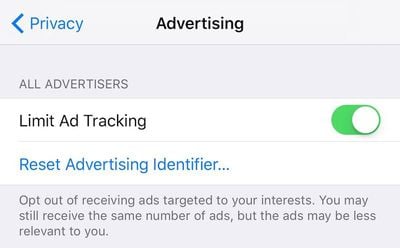
Despite Apple's bolstering of the feature in iOS 10, Adjust's report noted that "on a global level, there's no evidence of an upward trend" of users becoming aware of LAT, which is somewhat hidden in the Privacy sub-menu of Settings.
"If people were more interested in reducing the number of retargeted ads, and if they were aware of the effects of the Limit Ad Tracking settings, we would expect a steadily rising trend throughout the last month as adoption of iOS 10 rises and people become aware of the changes. So far, on a global level, there's no evidence of an upward trend - the global rates are stagnant, at around 18%.
In spite of global stagnation, Adjust mentioned that in certain places -- particularly the United States -- LAT is beginning to become more well-known among consumers. Specifically, following the launch of iOS 10 in September, 2 million people activated LAT for the first time in the U.S.
Among other countries, Germany follows the U.S. in total iOS users with LAT activated (19.3 percent), followed by territories including the United Kingdom (16.5 percent), and Canada (14.4 percent). Places like the Netherlands, with 22 percent, beat out the United States. Countries where privacy concerns are raised see a higher percentage of users opting out of targeted advertising, but as Adjust said, "it’s not evenly distributed across countries, and it’s additionally not evenly distributed among target audiences."
With the growth of public knowledge surrounding such ad-blocking features, co-founder of Adjust Paul Muller noted that, "this is trending in a direction where it's not just the tech-savvy, ad-allergic crowd any more. Marketers will face a large, distributed and worst of all 'unknown' segment of users, especially in places like Germany and the U.S."





































![Apple Pulls Keynote, Pages and Numbers From App Store [Update: Back]](https://images.macrumors.com/t/Okb7kitB_gNr6qe5Pex9nQIysD8=/112x112/article-new/2026/01/Apple-Creator-Studio-iWork-suite.jpg)

Top Rated Comments
It's just something I noticed, that's why I mention it. I actually block all those requests, on macOS with LittleSnitch and on iOS with Weblock. Works perfectly (for me).
As a web designer/developer, Google Analytics is one of those things that is super, super handy for me, as it allows me to see how my sites are performing across different demographics. If there's a certain area where my website is not performing as well, that data makes it possible for me to find ways to make the user experience better.
Now, I've never developed apps before, but I can imagine that app developers can use that same Google Analytics data in much the same way. Disabling it on your end because of some paranoid "privacy" concern only hurts developers who simply want to see how their creations are performing, and have intentions of making them better.
Three things I still have an issue with:
1) Loads of iOS and macOS apps use (Google) Analytics in their apps for app analytics. There's no way to disable those requests, there is no mention in Apple's app guidelines and these requests infringe on user privacy.
2) Apps that set their own (generated) ID or cookie. Take for example the Youtube app. You have to remove the app and reinstall it if you want to get rid of the 'recommended' video's it serves. Resetting LAT has no effect so it has to use a different beacon.
3) Since iOS 8 the Wifi and BT MAC addresses are randomized when an in store beacon tries to track a user. Sadly, the entropy of these generated addresses is pretty low, so tracking is now only hampered instead of fully ommitted.
I hope these items will get 'fixed' soon!
The same with Youtube: it keeps presenting you videos that you've already watched... So annoying!