AT&T, Verizon Using 'Perma-Cookies' to Track Customer Web Activity
Both Verizon and AT&T appear to be engaging in some unsavory customer tracking techniques, using unique identifying numbers to deliver targeted advertisements to customers in what's called "Relevant Advertising." As outlined by Wired, Verizon is altering the web traffic of its customers by inserting a Unique Identifier Header or UIDH, a temporary serial number that lets advertisers identify Verizon users on the web.
According to Jacob Hoffman-Andrews of the Electronic Frontier Foundation, the UIDH serves as a "perma-cookie" that can be read by any web server to "build a profile" of internet habits. Verizon users cannot turn off the UIDH, but opting out of the Relevant Mobile Advertising Program prevents the information from being used to create targeted ads.
Verizon has been using Relevant Advertising techniques for two years, but the tracking has gone largely unnoticed until recently, when extra data from Verizon customers was noticed. AT&T appears to be engaging in similar tracking activities, and is testing its own Relevant Advertising system.
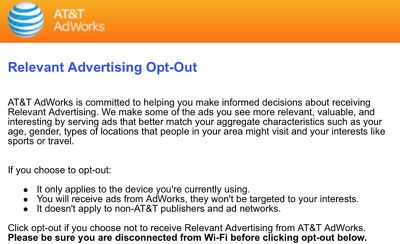
According to Forbes, AT&T is testing a similar code insertion program that will allow websites to track AT&T customers. Like Verizon, AT&T has plans to make the tracking codes temporary as a "privacy-protective measure," but according to one of the researchers that discovered the tracking, Kenneth White, the codes that AT&T is sending to some customers are persistent.
AT&T does not currently have a mobile Relevant Advertising program. We are considering such a program, and any program we would offer would maintain our fundamental commitment to customer privacy," read a statement from AT&T. "For instance, we are testing a numeric code that changes every 24 hours on mobile devices to use in programs where we serve ads to the mobile device. This daily rotation on the numeric code would help protect the privacy of our customers. Customers also could opt out of any future AT&T program that might use this numeric code."
Unlike Verizon, AT&T will not include the unique identifier code in the IP packets of customers who have opted out of the company's Relevant Advertising program.
Both Verizon and AT&T customers can check whether their devices are sending identifying codes by visiting a website created by aforementioned security researcher Kenneth White. Verizon customers appear to be unable to opt out entirely, but AT&T customers can visit the following website on their mobile devices (while connected to the AT&T network) to turn off Relevant Advertising: http://205.234.28.93/mobileoptout/.
Popular Stories
Apple hasn't updated the Apple TV 4K since 2022, and 2025 was supposed to be the year that we got a refresh. There were rumors suggesting Apple would release the new Apple TV before the end of 2025, but it looks like that's not going to happen now.
Subscribe to the MacRumors YouTube channel for more videos.
Bloomberg's Mark Gurman said several times across 2024 and 2025 that Apple would...
You'd think things would be slowing down heading into the holidays, but this week saw a whirlwind of Apple leaks and rumors while Apple started its next cycle of betas following last week's release of iOS 26.2 and related updates.
This week also saw the release of a new Apple Music integration with ChatGPT, so read on below for all the details on this week's biggest stories!
Top Stories
i...
The European Commission today praised the interoperability changes that Apple is introducing in iOS 26.3, once again crediting the Digital Markets Act (DMA) with bringing "new opportunities" to European users and developers.
The Digital Markets Act requires Apple to provide third-party accessories with the same capabilities and access to device features that Apple's own products get. In iOS...
Earlier this month, Apple released iOS 26.2, following more than a month of beta testing. It is a big update, with many new features and changes for iPhones.
iOS 26.2 adds a Liquid Glass slider for the Lock Screen's clock, offline lyrics in Apple Music, and more. Below, we have highlighted a total of eight new features.
Liquid Glass Slider on Lock Screen
A new slider in the Lock...
While the iPhone 18 Pro and iPhone 18 Pro Max are not expected to launch for another nine months, there are already plenty of rumors about the devices.
Below, we have recapped 12 features rumored for the iPhone 18 Pro models.
The same overall design is expected, with 6.3-inch and 6.9-inch display sizes, and a "plateau" housing three rear cameras
Under-screen Face ID
Front camera in...
Next year's iPhone 18 Pro and iPhone 18 Pro Max will be equipped with under-screen Face ID, and the front camera will be moved to the top-left corner of the screen, according to a new report from The Information's Wayne Ma and Qianer Liu.
As a result of these changes, the report said the iPhone 18 Pro models will not have a pill-shaped Dynamic Island cutout at the top of the screen....
Apple is significantly increasing its reliance on Samsung for iPhone memory as component prices surge, according to The Korea Economic Daily.
Apple is said to be expanding the share of iPhone memory it sources from Samsung due to rapidly rising memory prices. The shift is expected to result in Samsung supplying roughly 60% to 70% of the low-power DRAM used in the iPhone 17, compared with a...
Apple's first foldable iPhone, rumored for release next year, may turn out to be smaller than most people imagine, if a recent report is anything to go by. According to The Information, the outer display on the book-style device will measure just 5.3 inches – that's smaller than the 5.4-inch screen on the iPhone mini, a line Apple discontinued in 2022 due to poor sales. The report has led ...