iPad Mini and Fourth-Generation iPad Have Most Responsive Tablet Touch Screens
The iPad mini and the fourth-generation iPad have the most responsive touch screens, according to a new set of TouchMark benchmarks from cloud streaming company Agawi.
In its latest TouchMark test, Agawi tested the screen latencies of several different tablets, including the iPads, the Microsoft Surface RT, the Kindle Fire HD, the Nexus 7, the Galaxy Tab 3, and the Nvidia SHIELD.
Apple's iPad mini had the lowest Minimum App Response Time (MART), coming in at 75 milliseconds. The fourth-generation iPad came in second at 81, and the fastest Android tablet was the NVIDIA Shield at 92. Samsung's Galaxy Tab 3 had the worst response time, at 168 milliseconds.
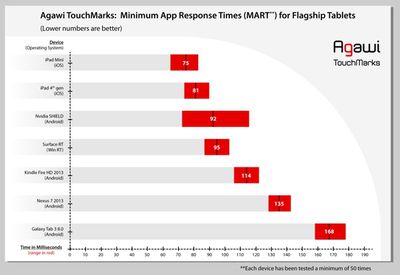
In a result that's perhaps now unsurprising, the iOS devices are more responsive than its competitors. Interestingly, the iPad mini – with its smaller screen and 1024×768 resolution – performs similarly to the larger fourth generation iPad and its 2048×1536 resolution, suggesting that responsiveness is not reduced by the larger screen size or resolution.
Our previous speculations continue to apply – more responsive devices may process touches earlier in the stack, poll for touches more frequently or have touchscreens optimized or calibrated to be more responsive. In our latest review of our test apps, we discovered an optimization that suggests that the GPU or GPU drivers in the devices might also add significant latency.
To obtain MART scores for each of the tablets, Agawi used a 240fps high frame rate camera along with a custom-built device called a Touchscope. The MART is the latency experienced between the time that a user touches the device display to the device's on-screen response time.
Previously, Agawi measured the response time of Apple's iPhone 5 compared to several other Android and Windows smartphones, with the iPhone 5 demonstrating a MART time of 55 milliseconds, which is significantly faster than even its own iPads.
Popular Stories
Apple is planning to launch new MacBook Pro models as soon as early March, but if you can, this is one generation you should skip because there's something much better in the works.
We're waiting on 14-inch and 16-inch MacBook Pro models with M5 Pro and M5 Max chips, with few changes other than the processor upgrade. There won't be any tweaks to the design or the display, but later this...
Wednesday February 11, 2026 10:07 am PST by
Juli CloverApple today released iOS 26.3 and iPadOS 26.3, the latest updates to the iOS 26 and iPadOS 26 operating systems that came out in September. The new software comes almost two months after Apple released iOS 26.2 and iPadOS 26.2.
The new software can be downloaded on eligible iPhones and iPads over-the-air by going to Settings > General > Software Update.
According to Apple's release notes, ...
It has been a slow start to 2026 for Apple product launches, with only a new AirTag and a special Apple Watch band released so far. We are still waiting for MacBook Pro models with M5 Pro and M5 Max chips, the iPhone 17e, a lower-cost MacBook with an iPhone chip, long-rumored updates to the Apple TV and HomePod mini, and much more.
Apple is expected to release/update the following products...
Apple plans to announce the iPhone 17e on Thursday, February 19, according to Macwelt, the German equivalent of Macworld.
The report said the iPhone 17e will be announced in a press release on the Apple Newsroom website, so do not expect an event for this device specifically.
The iPhone 17e will be a spec-bumped successor to the iPhone 16e. Rumors claim the device will have four key...
Apple acquired Canadian graph database company Kuzu last year, it has emerged.
The acquisition, spotted by AppleInsider, was completed in October 2025 for an undisclosed sum. The company's website was subsequently taken down and its Github repository was archived, as is commonplace for Apple acquisitions.
Kuzu was "an embedded graph database built for query speed, scalability, and easy of ...