MacRumors

A few other interesting tidbits have emerged from Apple's shareholder conference with regard to the iPhone software development kit, the possibility of Flash and more.

iPhone Atlas relays these tidbits:

- Regarding iPhone applications, Jobs claims "You'll see a lot of apps out there this summer" based on the upcoming iPhone Software Development Kit (SDK).
- Claims that Adobe Flash won't be coming to the iPhone anytime soon, despite recent rumors that a Flash update was imminent.
- More details from The Wall Street Journal:

As Jobs put it Tuesday during the company's annual shareholder meeting, Apple's iPhone, with all its cutting-edge mobile Internet trickery, needs something much better than the current Flash player that Adobe makes for cellphones. The Flash Player option that fits the bill is made for devices like laptops that are larger than the iPhone; as a consequence, it performs too slowly on the iPhone, he said.

Appleinsider's notes reveal the following:

- Jobs indicated that the SDK would open the market for new gaming opportunities.
- In answering a question about an iPhone blogging application "if Apple does not address it", Jobs recommended that the individual learn Cocoa and write an iPhone blogger application himself.
- Jobs seemed to pause when questioned about the possibility of an Xserve mini to provider consumers server functionality.
- When asked if ad-supported free content for the Apple TV seemed like a good idea, Jobs said "yes" before saying that they don't comment on future products.
Related Forum: iPhone

Apple held their annual shareholder meeting today. MercuryNews provides some notes on the meeting. Investors passed a proposal asking the company to allow investors to have an advisory vote on executive compensation.

"It's a great vote," said Scott Adams, a research coordinator at the American Federation of State, County and Municipal Employees, a member of the AFL-CIO, which sponsored the proposal. Even though Apple is "a great company, shareholders still want a say on pay," he added.

The board can choose to accept or ignore the proposal. In general the mood seems to have been positive, with a few common questions being addressed:

- Jobs and executives, of course, would not comment on future products or plans.
- Jobs confirmed that they were expecting to sell 10 million iPhones in 2008.
- Apple does plan on offering the iPhone in China and India "one day".
- Jobs stated he is "not happy about" the fact that they were unable to meet the 1000 movies on iTunes goal by the end of February. Jobs blamed the delay on movie studios getting the necessary approvals from various rights holders of each film.
- No plans to offer dividends or buy back stock.
- Regarding Steve Jobs' successor, he sees many possible candidates amongst Apple's current executives.

"We've got great talent, and I think the board would have a few really good choices," said Jobs, 53. "We talk about that a lot." Candidates include Cook and Chief Financial Officer Peter Oppenheimer, he said.

Related Forum: Mac Apps

Analyst predictions of a 3G iPhone are nothing new, but a new report points to specific sources knowledgeable about this anticipated update. After meeting with Taiwanese electronics companies Citigroups Richard Gardner claims that his sources have confirmed that the 3G iPhone will be released in 2nd Quarter calendar year. If correct, this would pinpoint the release between April-June 2008.

3G is the next generation wireless data that promises much faster speeds over the EDGE technology in existing iPhones. Apple's Steve Jobs has said that existing 3G chipsets drew too much power for them to be used in the original iPhone. Recent advances in wireless chipset technology have reportedly addressed these power consumption issues. Coincidentally, AT&T recently announced that they are expanding their 3G network to nearly 350 U.S. markets by the end of 2008.

Plans for a 3G iPhone have been well publicized, with comments by Steve Jobs and AT&T's CEO suggesting the 3G iPhone is coming in 2008.

Related Forum: iPhone

In a press release, Nike details upcoming plans for the Nike + iPod partnership with Apple. Nike and Apple are partnering with several fitness equipment manufacturers, including Life Fitness, Precor, Star Trac and Technogym, to allow Nike + iPod users to connect their iPod nanos to cardio machines and track their workouts.

The equipment, including treadmills, ellipticals, stationary bikes and stair climbers, will be available at participating gyms such as 24 Hour Fitness in the United States and Virgin Active Health Clubs internationally.

"The Nike + iPod experience revolutionized running. Now were revolutionizing the gym cardio experience, said Trevor Edwards, Nikes Vice President of Global Brand and Category Management. Were enabling people who go to the gym an opportunity to set goals, track progress, and compete in challenges with their friends and with other members of nikeplus.com. Its a groundbreaking tool for people who want to maximize their workouts.

The existing Nike+ site will provide the online component of the expansion, allowing users to track their own workouts and personal trainers to monitor their clients' progress.

Related Forum: iPod touch and iPod

The New York Times reports on a growing trend for book publishers to move away from content protected by Digital Rights Management (DRM). Instead, Random House and Penguin Group, the two largest U.S. publishers, will begin offering audio book content in unprotected MP3 formats.

The recent move by the recording industry towards DRM-free content was part of the movtivation behind the move.

Publishers had traditionally looked to DRM to help combat illegal copying of their content, however, a recent experiement by Random House disproves this notion that DRM necessarily prevents widespread piracy. In a trial run, Random House released watermarked DRM-free audio books on eMusic and monitored file sharing networks. They found that the pirated copies of their audiobooks primarily came from Audio CDs or DRM-decoded sources, and not from the DRM-free sources.

As a result, Random House's Madeline McIntosh said, "Our feeling is that D.R.M. is not actually doing anything to prevent piracy".

The New York Times' John Markoff reveals that the iPhone began life as a "Safari Pad":

Apples multitouch technology began life not as a cellphone, but as a notepad-sized skunkworks project internally dubbed Safari Pad, run by Tim Bucher, then Apples head of Macintosh hardware. To his credit, Mr. Jobs seized on the technology and morphed it into the iPhone.

This adds a bit of information to a revealing Wired article which reported that Apple engineers had spent about a year working on a Tablet PC before being redirected to the iPhone project.

When Markoff asked Jobs directly about the possibility of a larger iPod Touch tablet, he said "I can't talk about unannounced products."

Recent rumors have suggested that Apple may be reviving a mini-tablet project with a device 1.5 times the size of the current iPhone/Touch. The rumored Apple device is expected to also incorporate Apple's touch OS X that currently powers the iPhone. Adding to our expectations, Apple executives have described their mobile devices as the first "mainstream Wi-Fi mobile platform" with a belief that the new Software Development Kit (SDK) will broaden this platform even more.

Related Forum: iPhone

Apple released a small update to Aperture 2 today. The 44MB update "addresses issues related to performance and overall stability. It also fixes a number of other minor issues." A list of fixes are detailed:

Aperture 2.0.1 addresses issues related to the performance and overall stability of Aperture 2. The update includes fixes that impact the following areas:

- Publishing .Mac Web Gallery albums
- Preview generation and deletion
- Creating and ordering books
- AppleScript support
- Keyboard shortcut customization
- Appearance of metadata overlays in the Browser, Filmstrip, and on light tables
- Watermarking of emailed photos
- Highlight Hot and Cold Areas

It also fixes a number of other minor issues, some involving the following areas:

- Loupe
- Smart Albums
- All Projects View
- Straighten Tool
- Filmstrip
- Drag and drop import
- Thumbnail generation
- Import window
- Export plug-in reliability

The Aperture 2.0.1 Update is recommended for all Aperture users. The update should be available via Mac OS X's Software Update or from Apple's site.

As noted by ArsTechnica, Apple's MacBook Air appears to be running in short supply both at Apple Stores and major retailers.

After a full month of being on the market, the MacBook Air is still a difficult commodity to obtain in some markets (not all), and Apple is still quoting a 5-7 business day minimum shipping time even for the most standard models ordered from its web site.

Meanwhile, Amazon won't be shipping orders until March 16 now, and many customers who run to a Best Buy thinking they'll find one hiding out there will be surprised: there aren't many to go around. One Best Buy source (not a retail floor worker) told me that Apple has kept them pretty thin on stock.

The cause of the short supply is currently unknown: whether it be short supply of components or high demand for the diminutive notebook, however Ars notes that stores that do receive stock often sell out within a day.

See Also: Apple Store MacBook Air Availability Tool

Related Roundup: MacBook Air
Related Forum: MacBook Air

Apple's co-founder, Steve Wozniak, spoke at a broadband conference in Australia. In a Q&A session with journalists, Wozniak spent some time relating his thoughts about some of Apple's newest products.

In general, he had similar thoughts and concerns as many readers have had on Apple's iPhone and MacBook Air. Specifically, Woz found that lack of 3G on the iPhone to be surprising:

I dont understand why it would be a battery issue. I get as much life on my 3G phones as I do on my non-3G phones. Maybe Im wrong, maybe Im not paying close enough attention. But I dont think thats it though.

On the MacBook Air, while he likes the design, he remains uncertain if it will fit into his lifestyle:

The MacBook Air actually I like it. At first, I thought, its so feature-missing, and I use I burn DVDs a lot to pass files to other people. I watch movies on airplanes. I need one that will go an entire flight and switch batteries, when theres sometimes no power on the plane.

Ironically, Woz also relates how his comments on Apple may get taken out of context:

[Jobs] calls me and he says he doesnt like something that I was reputed to have said. But he gets it out of context. A reporters seized on a comment and strung along with that. Im very positive on Apple, but Ill also point out things that could be better, or arent the way Id like them to be.

To that point, several journalists have picked up this story with a very negative slant:

- Wozniak slams iPhone, MacBook Air
- Woz finds flaws in Apple's latest offerings
- Wozniak 'disappointed' by Apple iPhone
- Former Apple founder vents over iPhone's pitfalls

A Computerworld.com blog reports on an interesting comment by Apple COO Tim Cook during last week's Goldman Sachs Investment Symposium. Cook revealed that Apple has edged past Dell and is now the #1 laptop supplier in higher education:

"We just received word on Monday that Apple surpassed Dell as the number one supplier of portables to US higher education for 2007," Cook claimed. "The ceiling for the Macs is nowhere in sight. Even if the market itself isn't growing, for us, switching Windows users is an enormous opportunity," Cook also added.

This finding corroborates an increasing number of anecdotal reports that Apple's popularity has been booming in Universities settings. Apple's success is even more striking when compared to 2006 numbers. At that time, a survey across 100 college campuses showed that 40% of students were planning on buying a Dell laptop, while only 21% were planning on buying an Apple laptop.

Apple has also started efforts to integrate the iPhone into university settings with pilot programs expected to start shortly.

Anandtech posts a lengthy review of the new Penryn-based MacBook Pros. Their review provides some objective data on the new laptops, as compared to the previous generation.

As described before, the biggest change in the new MacBook Pros is the use of a 45-nm Penryn CPU as opposed to the older 65-nm Merom CPU. Despite some differences in L2 cache, Anandtech found benchmark performance to be neck and neck:

Overall, the performance differential ends up being a wash - there are some cases where Penryn is faster at lower clock speeds, while others where Merom manages a win - much as we expected.

One measurable advantage of the new processors, however, is an extension of battery life, with improvements ranging from 7-15% longer than its predecessor, with an absolute increase in battery life of 37-67 minutes in their web browsing test.

It looks like Penryn is good for a 7 - 15% increase in battery life over similarly configured Merom systems. The improvement alone isn't enough to warrant an upgrade but it's a nice improvement over the previous systems given that you get it at no additional cost. Ah, the beauty of innovation.

Related Roundup: MacBook Pro

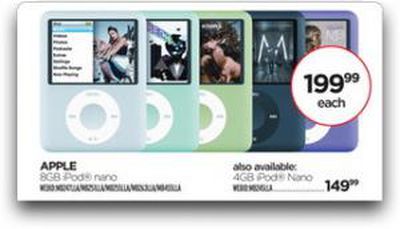
Readers report that this week's Circuit City Ad (page 20) is advertising a purple iPod nano.

223630 Safari004 300

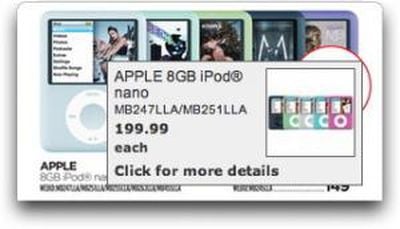
Apple's current line of iPod nanos come in silver, blue, green, black, pink, and (PRODUCT) RED. The obvious suggestion is that Apple is set to release a purple iPod nano. However, note that mousing over the photo reveals the current iPod nano lineup, increasing the possibility that the advert simply has profound mistakes. The photo also appears extremely similar to Apple's stock gallery imagery.

223630 Safari005 300

The addition of a purple option to the iPod nano would make the iPod Shuffle lineup a complete subset of the iPod nano colors. Currently, the purple depicted in the ad is available on the iPod Shuffle but not available on the iPod nano, whereas the iPod nano has the additional options of black and pink (recently added) that are not available on the iPod shuffle.

Related Forum: iPod touch and iPod
211536 atom rgb 78

Intel announced today that they are officially branding their upcoming ultra-mobile processor family as 'Atom'. Formerly known as Silverthorne, the new family of low-power processors are specifically designed for mobile internet devices (MIDs).

"This is our smallest processor built with the world's smallest transistors," said Intel Executive Vice President and Chief Sales and Marketing Officer Sean Maloney. "This small wonder is a fundamental new shift in design, small yet powerful enough to enable a big Internet experience on these new devices. We believe it will unleash new innovation across the industry."

'Atom' offers very low-power consumption (0.6-2.5 watt) over Intel's laptop-class processors (35 watt) yet preserves the Core 2 Duo instruction set. In theory, this means that Mac software could run unmodified on the new low-power processors. Intel envisions the use of these processors to introduce a new class of internet capable devices.

Rumors have placed 'Atom' processors in upcoming mobile devices from Apple -- either the rumored Apple tablet/PDA or the next generation iPhone.

BoyGeniusReports claims that they have seen an internal AT&T memo referencing refurbished iPhones for only $199 (4GB) and $249 (8GB). These are to be unadvertised specials, however, and only in special regions:

Refurbished iPhones will only be available to purchase in select COR stores across the Northeast Region and will be available while supplies last. Please reach out to customers that have recently purchased an iPhone to see if they are interested in activating an additional iPhone at a discounted equipment cost. Please note no in-store sales materials should be created. This is to be sold as a closing tool only.

So, it may be difficult to find out where these deals might be.

BoyGeniusReport's track record on rumors has been mixed (Jay Z at Macworld), though we have no reason to doubt the authenticity of this memo.

Confirmed: Several readers report they were able to get these refurbished phones.

Related Forum: iPhone

MacRumors reader IntrinsicMac has noticed from teardown photos of Apple's Time Capsule that Apple is not using "server-class" hard drives as advertised, but rather Hitachi Deskstar drives which are typically considered consumer-grade.

When introduced, Apple described the 500 or 1 TB drive being used within Time Capsule as "server grade", and indeed continues to tout it as such today on its website.

Time Capsule is your one place for backing up everything. Its massive 500GB or 1TB server-grade hard drive gives you all the capacity and safety you need. So whether you have 250 songs or 250,000 songs to back up, room is the last thing youll run out of. And considering all that storage and protection come packaged in a high-speed Wi-Fi base station starting at $299, data isnt the only thing youre saving.

While it is unclear what practical impact the use of consumer drives will have on users, the advertising discrepancy has been alarming to some users.

Update: According to TidBITS, Apple has clarified that their assertion of "server-grade" is related to mean time between failure.

Chulani clarified that the "server-grade" drives in a Time Capsule are the same 7200 rpm drives used for Apple's Xserve servers, and that they have a higher mean time between failure (MTBF) rating than consumer drives. The MTBF for server-grade drives is often 1 million hours (114 years), which is a measure of probability; in this case, that out of a set of drives with similar properties, an extremely high percentage will still be fully functional after several years.

According to sources Apple has released a Safari seed to developers that promises a "significant" amount of bug and performance fixes regarding the following areas:

- large plaintext pastes
- photo uploading to auction websites
- Handling of "unsafe" Javascript
- Writing direction shortcuts

The seed build numbers are 9B4021 for Leopard, 8S4021 for Tiger, and 31A15 for Windows.

Evidence has recently been surfacing that Apple is planning to bring a host of performance improvements to Safari. An earlier Safari beta appears to have incorporated recent rendering improvements to WebKit.

Rumors earlier today from iLounge suggested that Apple would act as a gatekeeper for iPhone and iPod Touch applications based on their upcoming Software Development Kit (SDK). As gatekeeper, Apple would individually review new applications by 3rd party developers to decide whether or not they are allowed for inclusion in the Apple iTunes Store. The exact criteria for this rumored approval is unknown, but some have expressed concerns that this practice could seriously restrict application development on the iPhone.

Electronista, however, now claims that Apple plans on only imposing those restrictions on commercial applications for sale through iTunes and will not try to restrict free programs in any way

...the new contact claims that free applications are not subject to the same rules that will guide paid software downloads. In this model, free software is unlikely to be subject to much if any scrutiny by Apple

Such a tiered system could appease those concerned that an Apple approval system would arbitrarily restrict an otherwise thriving developer community. Meanwhile, commercial iPhone applications sold through the iTunes store would benefit from the existing infrastructure and customer base of the iTunes store, but in exchange would have to meet some set of predefined criteria.

It is still too early to draw too many conclusions about Apple's SDK plans. Apple has announced very little publicly about their plans, though Apple's COO has recently made comments claiming that with the SDK, the only limit would be people's imaginations.

Apple is hosting a media event on Thursday, March 6th to detail their SDK roadmap.

Related Forums: iPhone, iPod touch and iPod