MacRumors

Dozens of Apple patent applications were published today revealing research that Apple had done in 2007 on many topics encompassing future versions of Mac OS X. The most intriguing is a series of patent applications which describe a "Multidimensional" user interface. Apple has essentially been working on true 3D desktop environments.

Disclosed herein are systems, aparatus and methods, including a multidimensional desktop graphical user interface.

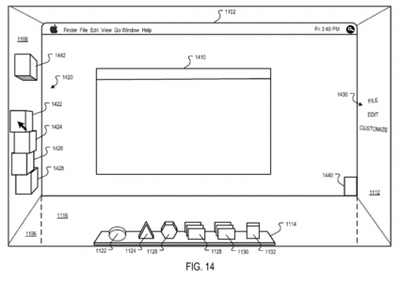
In one titled Multidimensional Desktop, Apple includes a number of diagrams depicting what such a desktop might look like and how it would work.
061036 pat2 425

This figure (above) shows a multidimensional desktop environment alongside what Apple describes as a multidimensional application environment. Along the side are a number of three-dimensional "function" icons that may trigger certain commands on each surface. These icons can be manipulated in 3D with a physics model so the icons can appropriately "fall" if displaced.
061037 pat3 425

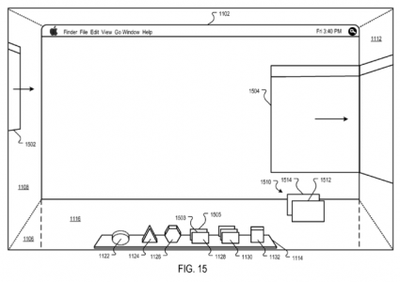
This figure (above) shows that windows could be dragged or displaced across multiple surfaces. Each surface could have its own characteristics and cause icons or windows to display different information:

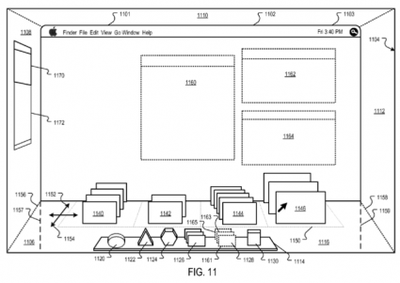
For example, on the bottom surface, icons and other system object representations can be displayed according to a large scale; on the side surface, icons and system object representations can be displayed according to small scale; on the back surface, icons and other system object representations can be displayed in a list format
061036 pat1 425

It's not clear when and if Apple will decide to implement these design ideas into a future version of Mac OS X. Apple's next major version of Mac OS X (10.6) is due in the first quarter of 2009 and will primarily focus on "under the hood" changes to boost performance. Apple has not been the only one working on 3D desktops. One popular YouTube video demos a 3D desktop in action. Sun's Project Looking Glass also demonstrates a currently functional 3D desktop for linux and Solaris x86.
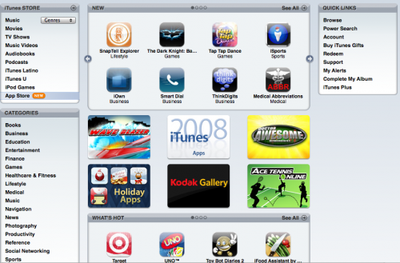

175528 top100 500

Apple has removed the Top 100 Paid and Free App Store listings from the App Store this afternoon for unclear reasons. Some speculate that Apple could be reformulating the listings based on recent criticism. It's also possible that it is simply at temporary technical error.

A recent listing of the Top 100 Paid and Free apps are available at AppShopper.com.

Thanks to TwoPixels/OldBooth

Update: It appears to be back, and looks the same as before, so may have just been a technical error.

Related Forum: iPhone

Apple today released a number of firmware updates for the "Late 2008" MacBook, MacBook Pro, and MacBook Air. Each model requires two separate firmware updates.

EFI Firmware Updates: The Extensible Firmware Interface (EFI) specifies the interface between a computer's firmware and the operating system. These updates address several issues related to system stability. Further information and installation instructions can be found on Apple's support page.

SMC Firmware Updates: The System Management Controller (SMC) controls various power-related functions. According to Apple, these updates address the "sensing and accuracy of the MagSafe Power Adapter indicator light, and the battery charge indicator lights." General information and installation instructions for SMC updates can be found on Apple's support page.

MacBook EFI Firmware Update 1.3 (1.8 MB)
MacBook SMC Firmware Update 1.2 (556 KB)

MacBook Pro EFI Firmware Update 1.6 (1.9 MB)
MacBook Pro 15-inch SMC Firmware Update 1.2 (559 KB)

MacBook Air EFI Firmware Update 1.1 (2.4 MB)
MacBook Air SMC Firmware Update 1.1 (556 KB)

Related Roundups: MacBook Air, MacBook Pro
Related Forums: MacBook, MacBook Air

While the iTunes App Store has been a huge success in terms of iPhone app distribution, there have been lingering complaints that the current structure encourages a "race to the bottom" with massive competition dropping the price of apps towards $0.99. The most vocal complaint about the current system comes from Craig Hockenberry who published an open letter to Steve Jobs on the issue:

As an iPhone developer who's been in the App Store since its launch, I'm starting to see a trend that concerns me: developers are lowering prices to the lowest possible level in order to get favorable placement in iTunes. This proliferation of 99 cent "ringtone apps" is affecting our product development.

Hockenberry claims that these $0.99 "ringtone apps" prevent developers from working on more substantial and creative applications, instead trying to cash in on the latest fad.

Jesse Farmer of 20bits, however, disagrees with Hokenberry's letter and distinguishes that while the App Store is a very good distribution channel, developers should not rely on it as their only marketing channel.

Distribution and marketing aren't one and the same, and this tension is why developers are feeling pinched.

Distribution is the "how," as in, how do you get your product to your customer? .... Marketing is the "why," as in, why do your customers want to buy your product?

Farmer suggests that developers should look for creative ways outside the app store itself to stimulate demand. He points out that lower prices aren't what convinces people to buy Beyonce's album, but instead the multi-million dollar marketing campaigns surrounding the brand.

Related Forum: iPhone

CNet explains the reason behind a Macworld report last week that several movies had disappeared from the iTunes Store.

Frequent Macworld contributor Kirk McElhearn noticed something interesting when he went to grab a movie from the iTunes Store. Of the 15 films he had bookmarked for later viewing, an astounding nine were no longer available for purchase. Or rental. Nor, for that matter, did they seem to exist anywhere on the iTunes Store at all.

CNet explains that this is due to licensing agreements between the movie studios and Apple.

Typically, movies have set distribution windows that are followed in order: theaters, DVDs, pay-per-view (and iTunes) and finally, broadcast TV. As movies cross over into broadcast TV distribution, they are being removed from Apple (and Netflix) distribution.

Normally, release windows don't affect retailers or video-rental services after they've begun selling or renting films. Warner Bros. doesn't go into Best Buy and pull DVDs off the shelf when Comcast airs Casablanca. The corner Mom and Pop video store doesn't surrender copies of Gladiator to Universal Studios when the film appears on ABC. But Internet stores are being treated differently. What this means for iTunes and Netflix customers is that movies will pop in and out of the services.

Those who have already purchased these films will, of course, be able to continue to watch them.

Related Forum: Mac Apps

On Monday, Mozilla released the latest beta version of Firefox 3.1. This "Beta 2" version of the popular web browser adds a number of new features across all supported platforms including:

- Private Browsing Mode
- Faster JavaScript engine
- Improved rendering
- Support for new web technologies.

But one feature unique to the Mac build is support for Apple's multi-touch trackpad which has been shipping in notebooks since January of this year. While Apple's Safari supports multi-touch gestures for common web browsing tasks (back, forward, resize text), support had been absent from Firefox. Experimental Firefox support for the multi-touch trackpad was first introduced in a pre-Beta build back in October by Mozilla's Edward Lee. The changes have since made it into the official Beta 2 released on Monday and is expected to be released with the final 3.1 version of Firefox.

Supported gestures are even more robust than Safari's support and include ("Swipe" refers to 3-finger Swipe):

- Swipe Left: Go back in history (hold Cmd to open it in a tab)
- Swipe Right: Go forward in history
- Swipe Up: Go to the top of the page
- Swipe Down: Go to the end of the page
- Pinch Together: Zoom out
- Pinch Apart: Zoom in
- Twist Right: Next tab
- Twist Left: Previous tab

Mozilla warns that the beta version of Firefox is intended for testing use only. There's no known release date for the final release of Firefox 3.1.

Related Roundups: MacBook Air, MacBook Pro
Related Forums: MacBook, MacBook Air

A SongFacts interview with The Asteroids Galaxy Tour who had their song Around The Bend featured in a recent iPod Touch ad. In asking how they were chosen, the band revealed that Steve Jobs personally made the decision. The article has since been edited but AppleInsider has the original quote:

While listening to some of the songs suggested by Synch, the Apple co-founder reportedly slammed on the brakes during a sample of "Around The Bend," declaring, "This is it, this is the new track for the iPod Touch."

"Apparently he just loved that track, but we never saw it as one of our singles," Iversen said. "We have some other songs that we thought would be great singles, and that would work cool on for the radio, but he really loved that song."

The song was used in this iPod Touch "funnest iPod ever" ad:

Related Forum: iPod touch and iPod

The Inquirer presents evidence that they believe the current 15" MacBook Pro may continue to suffer from faulty graphics chips. NVIDIA previously reported manufacturing defects in July that were later found to affect some MacBook Pros. The issue was thought to have been resolved.

In a seemingly thorough analysis, however, The Inquirer claims that NVIDIA 9600 graphics chips found in an off-the-shelf 15" MacBook Pro also contains similar defects.

So, what does this all mean? It suggests that there are 15-inch Macbook Pros being sold with 'bad bumps', the same materials that brought down so many HP, Dell and Apple parts, both laptop and desktop. For some odd reason, Nvidia really does not want you to know this.

NVIDIA's Mike Hara, however, denied the association and had the following comment:

The GeForce 9600 GPU in the MacBook Pro does not have bad bumps. The material set (combination of underfill and bump) that is being used is similar to the material set that has been shipped in 100s of millions of chipsets by the world's largest semiconductor company."

The article suggests that the problem could be related to the "black screen of death" issue that some MacBook Pro users have seen during gaming sessions.

Related Roundup: MacBook Pro

Microsoft today released updates for both Office 2008 (12.1.5) and Office 2004 (11.5.3). The updates provide a number of security, stability, and performance-related fixes.

Microsoft Office 2008 for Mac 12.1.5 Update weighs in at 103.6 MB and addresses security vulnerabilities and increases stability and reliability throughout the suite of Office applications. The update also provides specific performance improvements for Word, Excel, PowerPoint, and Entourage. A full list of improvements is included on Microsoft's update description page.

Microsoft Office 2004 for Mac 11.5.3 Update weighs in at 15.1 MB and addresses stability issues when opening and closing documents in Word and Excel. The update also provides updated time zone information for Entourage. Microsoft's update description page details these improvements and provides additional information about the update.

Finally, Microsoft released Open XML File Format Converter for Mac 1.0.2, which fixes security vulnerabilities in Microsoft's conversion software that enables Office 2004 and v. X to open documents saved in the Open XML format used by Office 2008. The update weighs in at 44.8 MB, and additional details on the update can be found on Microsoft's update description page.

The Khronos group announced the ratification and public release of the OpenCL 1.0 specification described as the first open, royalty-free standard for cross-platform, parallel programming of modern processors found in personal computers, servers and handheld/embedded devices.

023502 opencl

OpenCL provides programmers tools to speed up a wide variety of applications by taking advantage of untapped GPU processors and multi-core processors found in modern computers. Apple originally proposed OpenCL as part of their upcoming Snow Leopard operating system, and their release deadline helped accelerate the adoption of the specification. OpenCL has been developed and ratified by a number of industry companies including Apple, NVIDIA, ARM, Intel, and many others.

We are excited about the industry-wide support for OpenCL, said Bertrand Serlet, Apple's senior vice president of Software Engineering. Apple developed OpenCL so that any application in Snow Leopard, the next major version of Mac OS X, can harness an amazing amount of computing power previously available only to graphics applications.

For the end user, this should allow developers to more easily take advantage of existing hardware (GPUs, CPUs) to deliver faster software performance.

Apple's Snow Leopard operating system (Mac OS X 10.6) is due for release in 2009 with recent hints pointing to the 1st quarter.

A couple of speculative reports have come out about what plans Apple might have for its ARM-based processors in the coming year. Apple is rumored to be a major architectual licensee for ARM. This would offer Apple an added level of control and ownership over its processors. Apple presently uses the ARM processor in the iPhone and iPod Touch. Additional evidence has pointed to the fact that Apple acquired P.A. Semi specifically for their expertise in low-power processor development.

Computerworld blogger Seth Weintraub recently spoke with Bob Morris, director of platform enablement for ARM's mobile processor group, and believes that Apple will incorporate ARM processors in future netbooks and/or tablets. The newest ARM processors are said to have equal performance to Intel's Atom processors but dramatically lower power consumption:

We are talking Apples and Oranges here. Not double, but an order of magnitude better for ARM. Some ARM chips routinely use 10-20 times less power than Intel for similar operations. Battery usage with ARM chips in prospective netbooks could be measured in days, not hours much like smartphones.

Meanwhile, Global Equities Research analyst takes it a step further by claiming that Apple will launch "a completely new device category" in the second half of 2009 based on chips produced by P.A. Semiconductor. Unfortunately, the credibility of the report is somewhat marred by the seemingly nonsensical statement that the new processors "will have the Objective-C instruction set built into the chip".

Regardless, Apple seems to have made some major moves in terms of custom processor development in 2008. While it's been assumed that these investments have been directed at the iPhone and iPod Touch, it's conceivable the technology will trickle to future devices.

Last week Apple seeded developers with Build 9G52 of Mac OS X 10.5.6. The latest seeds ask developers to continue testing Mobile Me syncing and Mail character sets and continues to list a number of fixes from previous versions. Apple is expected to release Mac OS X 10.5.6 in the near future.

HMBT.org also publishes seed notes from the latest Snow Leopard build (10A222) which was also released to developers last week. The newest seed offers new additions to Grand Central, which provides developers an easier way to harness the power of multiple processor cores.

Separately, we've heard that the newest version of Snow Leopard makes Rosetta an optional installation. Rosetta is Apple's PowerPC emulator for their Intel Macs, allowing Intel Mac owners to run legacy software that has not been upgraded for the Intel platform. This news comes shortly after an announcement that IBM had purchased Transitive, the company behind Rosetta's technology. The final release of Snow Leopard is also rumored to require an Intel Mac, thereby being the first version of Mac OS X to drop PowerPC support.

Apple first announced its transition from PowerPC to Intel processors in June, 2005.

050834 photo 425

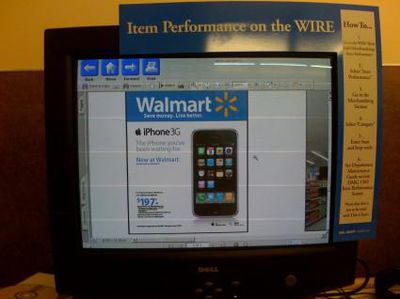
Last week, Boy Genius Report cited an unconfirmed source that Wal-Mart may begin selling a 4GB iPhone for only $99. Based on available Wal-Mart training materials and advertising (pictured above) we've received, however, it seems that this rumor is unlikely. The advertising shown only lists 8GB iPhones for sale at $197, without any hints of a cheaper model. The iPhone will go on sale at Wal-Mart beginning on December 28th.

This information also correlates with MacBlogz' AT&T sources who claim the 4GB rumors were untrue.

Related Forum: iPhone

Last week, Ars Technica had reported that the latest iPhone 2.2 SDK included an new undocumented framework that allows iPhone/iPod touch applications to output to a television rather than to the native screen.

The MPTVOutWindow class allows your iPhone to send its video to a connected TV rather than to the built-in screen. Intended to be used with movies, the unpublished class creates a live video feed that is sent out through the iPhone's connector port. End-users will need to buy a video adapter or cable to use this functionality.

While a couple of interesting demos had been thrown together, Ars then asked Freeverse about adding the functionality to a version of their Moto Chaser [App Store] game. The result is an impressive (though unsupported) demo:


Outputting to video-out resulted in a performance hit, so the TV version of the game can only reach approximately 20 frames per second. The game normally runs at 26 fps on the native screen. Freeverse notes that this was all thrown together in a few hours, so there is room for improvement. It's not clear if and when Apple might allow developers to officially release Apps using this new functionality.

Related Forum: iPhone


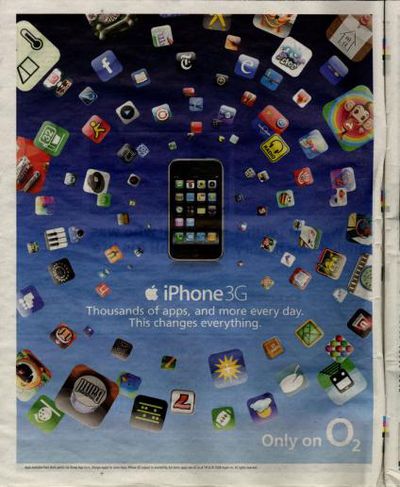
Both Apple and O2 have started advertising the App Store in print media today. O2 posted a copy of this ad which appears in The Metro. Meanwhile, Macworld reports that Apple has placed ads in The Wall Street Journal and the New York Times.

In the U.S. print ads (not pictured), Apple reports that 300 million apps have been downloaded and confirms that the App Store now carries over 10,000 applications. The App Store crossed over the 10,000 app point on Wednesday and the current App count is 10,353 apps according to AppShopper.

Apple last reported that they had exceeded 200 million App Store downloads in late October.

Update: Macworld has published a photo of the U.S. ad.

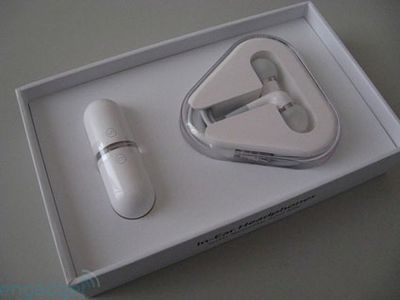
102117 buds
Image from Engadget

After months of delay, Apple's In-Ear headphones have started arriving to customers. Here are some early first impressions of the $79 headphones:

Gizmodo - "After a history of offering lackluster earbuds, Apple has come through with a product that sounds really good and is reasonably priced, all things considered. The balanced sound and dual drivers makes all the difference in the quality factor."

Engadget - "Imagine our surprise, then, at the discovery that they not only sound really, really good (warm lows and crisp highs, a distinct lack of that modern, pushy mid-range), but they do work with the iPhone (the 3G we've got here, at least). "

CNet - "They don't quite have the crisp, high frequency detail of the Etymotic HF2 headphones I had at my desk, but they blow away Apple's stock earbuds (not too difficult a feat) with a buttery low end and pleasant mids and highs."

AppleInsider claims that following Adobe's withdrawl from exhibiting at Macworld San Francisco, both Belkin and Seagate will also not be exhibiting. Belkin historically has been one of Macworld's biggest exhibitors.

The move is deemed especially surprising for Belkin, which has not only been one of Macworld Expo's largest exhibitors in the past but is believed to have already paid for its booth space this year, people aware of the situation say.

Meanwhile, Google is said to be downsizing their booth size as well as a couple of other unnamed vendors.

While the worsening economy is cited as the likely reason, much of the cost for the spaces have reportedly already been collected. Regardless, as a result, they expect Macworld 2009 to be a smaller show than last year. MacRumors, of course, will be present to provide coverage of the show. Apple is expected to introduce new products at the event which kicks off on January 5th, 2009.

A few times a year, MacRumors partners with MacUpdate to promote their Mac application bundle deal. Their latest bundle delivers up to 10 Mac applications for $49.99 (a $447.96 value if all purchased separately) including:

- Drive Genius 2 ($99): diagnoses and repairs problems with your hard drive, optimizes your system, and more.
- RapidWeaver 4 ($79): Create professional-looking Web sites quickly and easily.
- DefaultFolder X 4 ($34.95): Fly through Open & Save dialog boxes at lightning speed.
- VirusBarrier X 10.5 ($69.95): Fast, simple, and non-intrusive anti-virus software.
- MacGourmet Deluxe ($44.95): Like iTunes for food, track recipes, plan meals, manage wines, and more.
- LittleSnitch 2 ($29.95): Monitors your network connection to make sure your Mac only sends out what you want it to.
- KeyCue 4 ($27): Displays full keyboard shortcuts for all your applications
- MacPilot 3 ($19.95): Access hundreds of hidden features to customize and improve your Mac OS X experience.
- WhatSize 4 ($12.99): Identify files that are hogging disk space.
- iVolume 3 ($29.95): Ensures all your iTunes tracks play back at the same volume level.

Unlike in past promotions, there appears to be no unlocking requirement and all apps are available from day one. The sale lasts for two weeks.

MacRumors is a promotional partner with MacUpdate. Bundle sales through these links benefit MacRumors financially, and provide a way for readers to directly support this site.