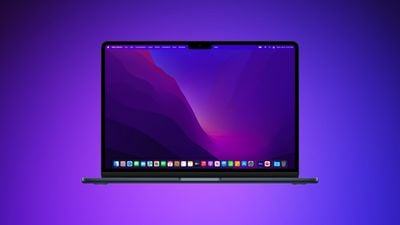
The first embargoed reviews of the new MacBook Air with the M2 chip have now been published. One notable detail confirmed by The Verge is that the $1,199 base model equipped with 256GB of storage has a single NAND chip, which will lead to slower SSD speeds in benchmark testing, but real-world performance may vary.
Last month, it was discovered that the 256GB model of the 13-inch MacBook Pro with the M2 chip has up to 50% slower SSD read speeds and up to 30% slower SSD write speeds compared to the equivalent previous-generation model in benchmarks.
The dilemma arises from the fact that Apple switched to using a single 256GB flash storage chip instead of two 128GB chips in the base models of the new MacBook Air and 13-inch MacBook Pro. Configurations equipped with 512GB of storage or more are equipped with multiple NAND chips, allowing for faster speeds in parallel.
In a statement issued to The Verge, Apple said that while benchmarks of the new MacBook Air and 13-inch MacBook Pro with 256GB of storage "may show a difference" compared to previous-generation models, real-world performance is "even faster":
Thanks to the performance increases of M2, the new MacBook Air and the 13-inch MacBook Pro are incredibly fast, even compared to Mac laptops with the powerful M1 chip. These new systems use a new higher density NAND that delivers 256GB storage using a single chip. While benchmarks of the 256GB SSD may show a difference compared to the previous generation, the performance of these M2 based systems for real world activities are even faster.
It's unclear if Apple's statement refers explicitly to real-world SSD performance or overall system performance. Some tests of the base model 13-inch MacBook Pro with the M2 chip showed that SSD speeds were slower even in real-world usage, but results have been mixed. Overall, if the fastest SSD speeds are important to you, we recommend configuring the new MacBook Air with at least 512GB of storage to avoid any potential impact.


































![Apple Watch Ultra 3 Hits New Low Price With Amazon's $299 Discount [Updated]](https://images.macrumors.com/t/BXKI27vT0hWfumJQpYzf41rH3Mw=/112x112/article-new/2026/10/apple-watch-ultra-3-milanese.jpeg)