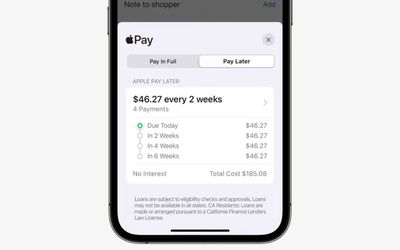
Later this fall, Apple Pay Later will let customers in the United States pay for online and in-app purchases through a six-week installment plan with no interest or fees.
Previewed at WWDC, Apple Pay Later will let customers split a purchase into four equal payments paid over the course of six weeks. Apple Pay Later will include zero interest and no fees and will be available "everywhere Apple Pay is accepted," according to Apple.
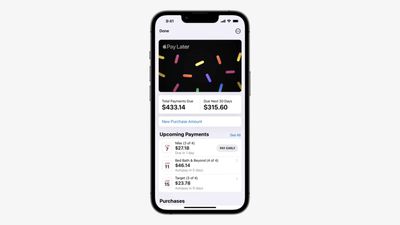
Inside the Wallet app, users will see a new overview of all of their upcoming payments and how much they owe and can set a personal budget. Apple says that Apple Pay Later will only be available to qualifying applicants, but no further details have been shared.
Thursday September 17, 2026 4:17 am PDT by Tim Hardwick
In iOS 27, available now, CarPlay gets its biggest update in years, but some features depend on what type of car you have rather than your iPhone model. Some of the biggest additions won't do anything in the vast majority of vehicles on the road today. Here's how the new features pan out.
Works in Any CarPlay Vehicle
Custom widgets: In iOS 27, CarPlay is no longer limited to Apple's handful ...
Wednesday September 16, 2026 8:53 am PDT by Joe Rossignol
The new Apple Watch Series 12 and Apple Watch Ultra 4 have hardware changes that allow for faster charging, but you will need to use the new version of the Apple Watch Magnetic Fast Charger included in the box in order to achieve this boost. If you need extra ones for your own charging stands or travel or so forth, Apple released the new version of the charger on its online store last week, with...
Wednesday September 16, 2026 1:32 pm PDT by Juli Clover
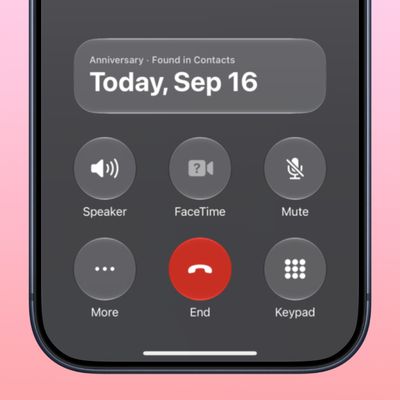
The iOS 27.2 beta that Apple released today adds a feature that reminds you it's your anniversary when you call someone, as long as you've added the date in the Contacts app.
On the date of your anniversary, when you go to call the person, you'll see a reminder that it's an important day so you don't forget to say something. The anniversary alert uses Call Context, a feature Apple added in...
I find the 3 x fortnightly payment thing a bit strange. The use case for this would normally be to spread the cost across salary payments which, in the UK, normally happen monthly. I appreciate this is US only, so perhaps the payment frequency is different in the US?
US workers generally get paid fortnightly, and this is a US-only feature for now. Here in the UK it is common to have a credit card where, if you pay back your debt monthly with direct debit, you end up having ~1.5 month interest-free (I have that with my Amex). PS autocorrect wrote that US workers get laid fortnightly, does Apple know something I don’t?
Well that would be the fiscally responsible thing to do... but so many people lack the discipline to do that.
(those with such discipline, as well as not spending everything they make, typically don't use buy-now-pay-later financing...)
Paying cash when you can get an interest-free loan is not smart, financially speaking.
I can afford to buy anything that Apple currently sells in online store, but given the choice between paying all upfront, or paying over time, I would choose paying over time, every time, and I do.
Now, if there was a discount for cash, that would be a totally different story.
For more info about Buy Now, Pay Later (BNPL), CNBC ('https://www.cnbc.com/2022/05/13/buy-now-pay-later-is-not-a-boom-its-a-bubble-harvard-fellow-says-.html') has some good articles. Search for "BNPL"- this is still a new 'product' in the US, "without much regulatory oversight, the BNPL market currently exists in “a legal gray space,” according to Lux."
The merchants / stores are able to ring up higher purchase totals; the banks loaning out the money are making their money through late fees, etc.
Good point...I was thinking about the money they make if the customer pays on time...the banks stand to make even more money on late fees, etc if the customer pays late. They only lose in a complete default which is probably relatively rare given the short terms and relatively low amounts of the funding.
Bleagh, now that it's clear what this product really is, it feels pretty unsavory for Apple to be getting involved with it.
Apple's first foldable iPhone, with a book-style design featuring a 5.5-inch outer display and a 7.6-inch inner display with a minimal crease down the middle.