Qualcomm is preparing for the launch of Apple's own modem chips, which will cut into Qualcomm's modem business starting in 2023. At today's Investor Day event, Qualcomm CFO Akash Palkhiwala said that Qualcomm expects to supply just 20 percent of Apple's modem chips in 2023.
If that's an accurate estimate, it means that 2022 will be the last year that Qualcomm enjoys a modem monopoly in iPhone devices. Apple has been working on in-house modem chips for years now, and prior rumors have indeed suggested that Apple's chips will be ready to launch in 2023.
Back in May, Apple analyst Ming-Chi Kuo said that Apple's 5G baseband chips could debut in the 2023 iPhone models, which is in line with Qualcomm's expectations. Should this occur, Apple will likely use its own chips in most regions, but rely on Qualcomm for chips in certain areas. Qualcomm said that this is just a "planning assumption for forecast purposes," but it appears the company is counting on a 2023 launch.
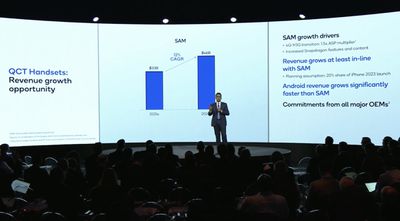
The assumption we use for this forecast is that for Apple 2023 launch, our share is down to 20%. This is a planning assumption for the forecast purposes. Just to be clear, there is no new data point that makes us do this forecast versus our discussions in the past. We just wanted to set a base for this forecast, and so we've used that as a planning assumption.
Apple tried to transition away from Qualcomm chips once before following a heated legal battle between the two companies. Apple wanted Intel to supply its 5G chips for the iPhone 12 models, but Intel could not meet Apple's expectations.
In 2019, Apple and Qualcomm settled their legal issues and Apple agreed to a multi-year partnership because it had no other place to get the appropriate chips it needed for its devices. Apple also began work on its own in-house modem chips with the aim of eventually getting away from Qualcomm, with Apple purchasing Intel's modem chip business to get a head start.
Monday January 26, 2026 1:55 pm PST by Joe Rossignol
Apple today introduced its first two physical products of 2026: a second-generation AirTag and the Black Unity Connection Braided Solo Loop for the Apple Watch.
Read our coverage of each announcement to learn more:Apple Unveils New AirTag With Longer Range, Louder Speaker, and More
Apple Introduces New Black Unity Apple Watch BandBoth the new AirTag and the Black Unity Connection Braided...
Monday January 26, 2026 3:56 pm PST by Juli Clover
Alongside iOS 26.2.1, Apple today released an updated version of iOS 12 for devices that are still running that operating system update, eight years after the software was first released.
iOS 12.5.8 is available for the iPhone 5s and the iPhone 6, meaning Apple is continuing to support these devices for 13 and 12 years after launch, respectively. The iPhone 5s came out in September 2013,...
Monday January 26, 2026 6:07 am PST by Joe Rossignol
Apple today introduced the second-generation AirTag, with key features including longer range for tracking items and a louder speaker.
For those who are not familiar, the AirTag is a small accessory that you can attach to your backpack, keys, or other items. Then, you can track the location of those items in the Find My app on the iPhone, iPad, Mac, Apple Watch, and iCloud.com.
The new...
Sunday January 25, 2026 6:02 pm PST by Joe Rossignol
2026 promises to be yet another busy year for Apple, with the company rumored to be planning more than 20 product announcements over the coming months.
Beyond the usual updates to iPhones, iPads, Macs, and Apple Watches, Apple is expected to release its all-new smart home hub, which was reportedly delayed until the more personalized version of Siri is ready. Other unique products rumored for ...
Sunday January 25, 2026 11:46 am PST by Joe Rossignol
Apple plans to release new MacBook Pro, MacBook Air, Mac Studio, and Studio Display models in the first half of this year, according to Bloomberg's Mark Gurman.
In his Power On newsletter today, Gurman added that redesigned MacBook Pro models with an OLED touch screen "should be hitting toward the end of 2026," meaning that the MacBook Pro line would be upgraded twice this year.
First up...
Remember they bought a part of Intel, which used to be Infineon/Siemens, so they are not starting from scratch with cellular modems. Yes, RF is tricky, but you if you (still) have the right people.
PS: why would Qualcomm still supply 20% ? I see no technical reasons. TD-SCDMA in China is R.I.P., same for CDMA2000 in the US.
Legacy iPhone models are still being produced as per the contracts that they hold. That should warrant the 20 %.