Skip to Content

Google Play Will Let Developers Use Alternative Billing Systems in South Korea, While Apple Has Yet to Make Changes

The South Korean government recently passed a law that bans Apple and Google from requiring developers to use their in-app purchase systems in the App Store and Google Play respectively, and Google has now announced changes to comply with the law.
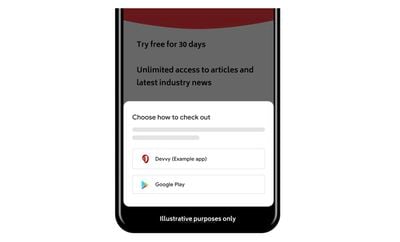
google play alternative billing
In a blog post, Google said it will be giving developers the option to add an alternative in-app billing system alongside the Play Store's billing system for Android smartphone and tablet users in South Korea. Google said the users will be able to choose which billing system to use at checkout, as seen in the example image above, and the company plans to provide developers with more details "in the coming weeks and months."

Google still plans to charge a service fee on in-app purchases completed through an alternative billing system, but it will reduce the fee by four percentage points. For the "vast majority" of developers, this means the fee will drop from 15% for transactions through Google Play's billing system to 11% for transactions through an alternate billing system.

"Like any business, we need to have a sustainable model to continue to improve our products while maintaining important user protections," said Google, in explaining why it charges a service fee on the Google Play store. "Just as it costs developers money to build an app, it costs us money to build and maintain an operating system and app store that makes those apps easily and safely accessible by consumers."

Google also warned that alternative billing systems may not offer the same security and privacy protections as Google Play's billing system.

Apple meanwhile has yet to make any changes to App Store billing in South Korea. The company previously said the law "will put users who purchase digital goods from other sources at risk of fraud, undermine their privacy protections, [and] make it difficult to manage their purchases," while making parental controls less effective.

In October, Apple told the South Korean government that it was "already in compliance with the new law and did not need to change its app store policy," according to Reuters. We've reached out to Apple for comment and we'll update this story if we hear back.

Popular Stories

Apple Event Logo

Apple Released Seven New Products Today

Wednesday March 11, 2026 7:05 am PDT by
Starting today, the seven new Apple products that were announced last week are available at Apple Stores and beginning to arrive to customers. The colorful MacBook Neo and all of the other new products are on display at most Apple Store locations around the world starting today. Apple Stores have inventory of the new products for both walk-in customers and Apple Store pickup, but...

iOS 27 Mock Quick

10+ New Features Coming in iOS 27

Friday March 13, 2026 2:13 pm PDT by
We're only three months away from Apple's WWDC 2026 event, which will see the company unveil iOS 27. With the fully revamped version of Siri possibly delayed until September, iOS 27 is shaping up to be the update we wanted iOS 26 to be. There will be new Apple Intelligence features, updates for the iPhone Fold, and more, with the latest rumors summarized below. Foldable iPhone Features...
3D Printed iPhone Fold Thumb 2

iPhone Fold: 5 Things We Learned This Week About Apple's Foldable

Friday March 13, 2026 6:24 am PDT by
It's been a big week for foldable iPhone rumors. In case you missed any of them, here are five developments that we've covered over the last few days. Apple is expected to launch the iPhone Fold this September. For everything else we know, be sure to check out our dedicated roundup. Display Crease Early reports suggested Apple had solved the crease problem that has plagued many...

Top Rated Comments

btrach144 Avatar
57 months ago
“In October, Apple told the South Korean government that it was "already in compliance with the new law and did not need to change its app store policy”

Isn’t that a straight up lie?
Score: 14 Votes (Like | Disagree)
TheYayAreaLiving 🎗️ Avatar
57 months ago
Hopefully Apple will follow Google. It’s just a matter of time.
Score: 7 Votes (Like | Disagree)
57 months ago
If Google charges a fee of their choosing, I don't see how this accomplishes anything. Apple should do the same thing but charge the same 15% they always do. Technically, they will have multiple payment systems that follows the law. The only difference is that you pay more to use something else. lol. I think these laws are nonsense. These are Googles and Apples store and OS, they have the right to charge what they want and people have the right to buy their devices or not. Governments should stay out of the market place.

With Google' solution, their 11% plus the other payment provider mark up will generally be the same cost as just using Google's payment method. Anyone that would take the risk of using the other payment methods without saving any money is crazy.
Score: 7 Votes (Like | Disagree)
57 months ago

“In October, Apple told the South Korean government that it was "already in compliance with the new law and did not need to change its app store policy”

Isn’t that a straight up lie?
That's why the "we follow local laws" excuse is terrible. Yes, when it comes to remove dissident apps or the Quran, not when it affects profits
Score: 5 Votes (Like | Disagree)
Michael Scrip Avatar
57 months ago

Apple and Google have created a situation where they are a duopoly.
Apple and Google didn't create a situation. In fact... they were LATE to the smartphone game.

There were PLENTY of platforms before them. Big ones, too. Symbian, Palm, Blackberry, Windows Mobile, etc.

But those other guys couldn't survive.

You could say it was those other guys' FAILURES that created a duopoly.
Score: 4 Votes (Like | Disagree)
dwaite Avatar
57 months ago

Saying go do your payments, but we are still going to charge you 11%....even though we did nothing as a middle man in the transaction, goes against the spirit of the laws and regulations being passed and discussed.... I can only see this backfiring and causing more strict regulation.
A transaction that was initiated because of an application built on top of Google Play services, being sold under an agreement with Google Play which includes an agreement around proceeds on initial app sale and on subscriptions and one-time purchases made within the app.

The "no middleman" alternative is to not use Google Play services, not list on Google Play, and do your own marketing/listing to convince users to side-load your app.

The reality is that 'small developers' are going to get little direct value from going outside the Play store. What you'll see is:

* alternative stores with varying degrees of success and varying fee structures
* large companies pushing to side-load apps both to realize more of the revenue and to work around any business restrictions in the store agreement.
Score: 4 Votes (Like | Disagree)