Belkin Announces Boost Charge TrueFreedom Pro Wireless Charger and Boost Charge UV Sanitizer - MacRumors
Skip to Content

Belkin Announces Boost Charge TrueFreedom Pro Wireless Charger and Boost Charge UV Sanitizer

Belkin today announced the Boost Charge TrueFreedom Pro Wireless Charger and the Boost Charge UV Sanitizer and Wireless Charger.
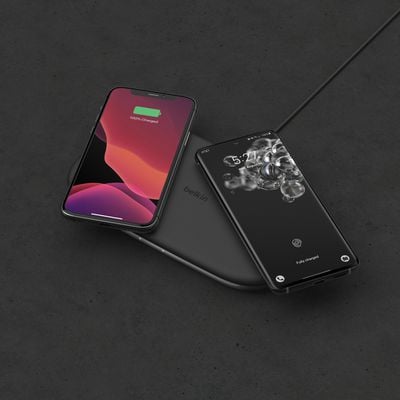
belkin wireless charger pro

The Boost Charge TrueFreedom Pro Wireless Charger is the latest addition to Belkin's portfolio of Qi-certified wireless charging solutions. The TrueFreedom Pro offers full-surface charging, allowing users to place up to two Qi-enabled devices anywhere on the charging pad to receive 10W of power for each device simultaneously.

The charger contains 16 individual charging coils to intelligently provide consistent power to devices anywhere on the pad. This means that users need not align the devices exactly, as with many other wireless chargers, to begin charging. It also has two LED lights to indicate charging status, silver chrome accents, and a leather-like finish.
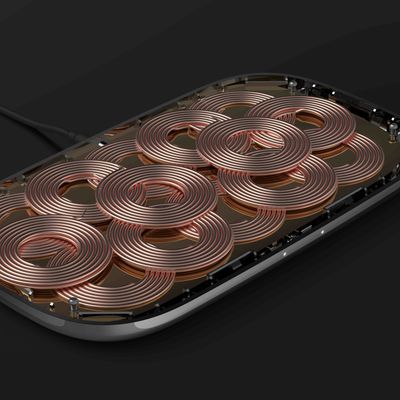
belkin wireless charger pro coils

Belkin also unveiled the Boost Charge UV Sanitizer and Wireless Charger, which it claims reduces up to 99.99% of bacteria with two internal UV-C LED lights. Phones and other small, nonporous items can be safely sanitized by placing them inside the compact device. Belkin has also added a 10W wireless charger on the top of the UV sanitizer to power devices.
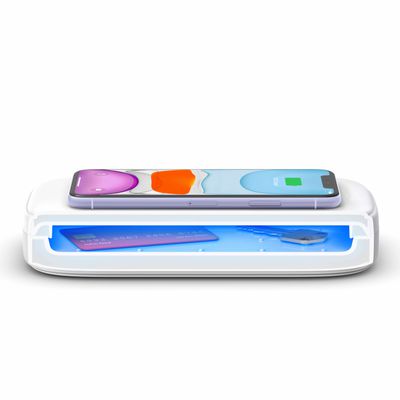
belkin uv sanitizer

The TrueFreedom Pro appears to be Belkin's answer to other full-surface wireless chargers such as the Nomad Base Station, while the Boost Charge UV Sanitizer seems to be positioned as a rival to the PhoneSoap sanitizer.

The Belkin Boost Charge TrueFreedom Pro Wireless Charger is now available for purchase at select retailers and coming soon to Belkin's online store for $129.99. The Boost Charge UV Sanitizer and Wireless Charger is available now at select retailers and Belkin's online store for $79.99.

Top Rated Comments

70 months ago

Does anyone here have an intelligent, informed, insightful answer to why Apple couldn’t pull off AirPower, which supposedly was this (minus the sanitizer thingy). It’s a tall order for these forms in general, but maybe somebody has an answer. Anonymous Apple lurker, you’re up.

Simply because they needed support for the Apple Watch too. It is using a modified non-standard Qi solution. :)
Score: 9 Votes (Like | Disagree)
IIGS User Avatar
70 months ago
It kills bacteria.

Does it kill viruses? We're all kinda worried about viruses right now...
Score: 5 Votes (Like | Disagree)
Iconoclysm Avatar
70 months ago

Does anyone here have an intelligent, informed, insightful answer to why Apple couldn’t pull off AirPower, which supposedly was this (minus the sanitizer thingy). It’s a tall order for these forms in general, but maybe somebody has an answer. Anonymous Apple lurker, you’re up.
This is about half of what Airpower is/was. Also, it's not that Apple couldn't do it, it's that they did and they felt it wasn't up to their standards.
Score: 4 Votes (Like | Disagree)
70 months ago

Thank you, but what does that mean? Either a wireless charging solution is Qi-certified or it isn’t. According to the press releases, the TrueFreedon PRO is. Do you mean that AW is not Qi-compliant? Because that’s true.
Sorry, I’ve might have oversimplified my answer a bit. My argument is that since AW was/is not Qi-certified (although technically almost identically), it was one of the biggest reasons why AirPower failed. At least, I can’t name a free placement Qi mat on the market that can charge an AW? So still today, it’s like comparing Apples and Pears (no pun intended).

Put differently, Apple sought to achieve a free placement thin charging pad that could charge an iPhone, AW and AirPods simultaneously. This while communicating charging data with your iPhone. This requires a lot of processing power (remember those leaks showing the insane amount of chips within a prototype?), while the multi-coil architecture also creates heat.
Essentially, thermal restrictions killed the Airpower - largely because they needed proprietary controllers for the AW. :)
Score: 2 Votes (Like | Disagree)
itsmeaustend Avatar
70 months ago

It kills bacteria.

Does it kill viruses? We're all kinda worried about viruses right now...
not many things can survive prolonged exposure to UV-C. That’s why hospitals use it.
Score: 2 Votes (Like | Disagree)
70 months ago
Belkin why don’t your release your 3/1 Magsafe charger first, before announcing something else. Why would I want this charger, when your Magsafe Charger is better, unless I did not have phones that did not have Magsafe.
Score: 2 Votes (Like | Disagree)