Apple's Notarization Process Repeatedly Approved Malware for Mac
Apple mistakenly approved and notarized a common kind of malware for macOS on at least two occasions, reports TechCrunch.
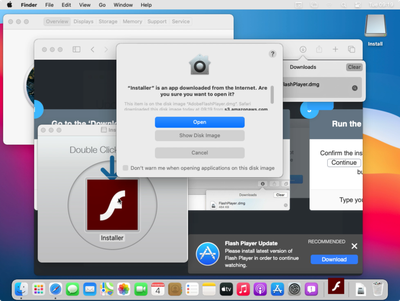
Apple requires developers to submit their apps for security checks to run on macOS in a process called "notarization." Notarization was required from the launch of macOS Catalina. If software has not been notarized, it will be blocked by default in macOS.
Peter Dantini and security researcher Patrick Wardle at Objective-See report that they have found the first malware for Mac that has been successfully notarized by Apple, even for the latest beta version of macOS Big Sur. The notarized malware was disguised as an Adobe Flash installer, which is an oft-used technique to convince unknowing users to install a trojan.
It contained "Shlayer" malware, which is said to be the "most common threat" to Macs in 2019. Shlayer is a kind of adware that intercepts encrypted web traffic, even from securely-encrypted HTTPS-enabled websites, and replaces it with its own ads to raise fraudulent ad revenue.
The researchers believe that Apple cannot have detected the malicious code when it was submitted for approval. The discovery is particularly surprising, given that the malware and its vehicle are extremely common. Upon notification from the researchers, Apple revoked the notarization.
"Malicious software constantly changes, and Apple's notarization system helps us keep malware off the Mac and allow us to respond quickly when it's discovered. Upon learning of this adware, we revoked the identified variant, disabled the developer account, and revoked the associated certificates. We thank the researchers for their assistance in keeping our users safe," an Apple spokesperson told TechCrunch.
In spite of Apple's statement, the researchers reported that the bad actors were able to get yet another malware trojan notarized soon after. The second notarized payloads were still approved by Apple as of yesterday.
Earlier this month, a new kind of Mac malware was discovered that infects via Xcode and supposedly can infiltrate the Mac App Store, undetected by Apple.
Popular Stories
In select U.S. states, residents can add their driver's license or state ID to the Apple Wallet app on the iPhone and Apple Watch, and then use it to display proof of identity or age at select airports and businesses, and in select apps.
The feature is currently available in 13 U.S. states and Puerto Rico, and it is expected to launch in at least seven more in the future.
To set up the...
Apple hasn't updated the Apple TV 4K since 2022, and 2025 was supposed to be the year that we got a refresh. There were rumors suggesting Apple would release the new Apple TV before the end of 2025, but it looks like that's not going to happen now.
Subscribe to the MacRumors YouTube channel for more videos.
Bloomberg's Mark Gurman said several times across 2024 and 2025 that Apple would...
While the iPhone 18 Pro and iPhone 18 Pro Max are not expected to launch for another nine months, there are already plenty of rumors about the devices.
Below, we have recapped 12 features rumored for the iPhone 18 Pro models.
The same overall design is expected, with 6.3-inch and 6.9-inch display sizes, and a "plateau" housing three rear cameras
Under-screen Face ID
Front camera in...
Earlier this month, Apple released iOS 26.2, following more than a month of beta testing. It is a big update, with many new features and changes for iPhones.
iOS 26.2 adds a Liquid Glass slider for the Lock Screen's clock, offline lyrics in Apple Music, and more. Below, we have highlighted a total of eight new features.
Liquid Glass Slider on Lock Screen
A new slider in the Lock...
The European Commission today praised the interoperability changes that Apple is introducing in iOS 26.3, once again crediting the Digital Markets Act (DMA) with bringing "new opportunities" to European users and developers.
The Digital Markets Act requires Apple to provide third-party accessories with the same capabilities and access to device features that Apple's own products get. In iOS...
Apple's first foldable iPhone, rumored for release next year, may turn out to be smaller than most people imagine, if a recent report is anything to go by. According to The Information, the outer display on the book-style device will measure just 5.3 inches – that's smaller than the 5.4-inch screen on the iPhone mini, a line Apple discontinued in 2022 due to poor sales. The report has led ...
Apple is significantly increasing its reliance on Samsung for iPhone memory as component prices surge, according to The Korea Economic Daily.
Apple is said to be expanding the share of iPhone memory it sources from Samsung due to rapidly rising memory prices. The shift is expected to result in Samsung supplying roughly 60% to 70% of the low-power DRAM used in the iPhone 17, compared with a...
2026 is almost upon us, and a new year is a good time to try out some new apps. We've rounded up 10 excellent Mac apps that are worth checking out.
Subscribe to the MacRumors YouTube channel for more videos.
Alt-Tab (Free) - Alt-Tab brings a Windows-style alt + tab thumbnail preview option to the Mac. You can see a full window preview of open apps and app windows.
One Thing (Free) -...
Samsung is working on a new foldable smartphone that's wider and shorter than the models that it's released before, according to Korean news site ETNews. The "Wide Fold" will compete with Apple's iPhone Fold that's set to launch in September 2026.
Samsung's existing Galaxy Z Fold7 display is 6.5 inches when closed, and 8 inches when open, with a 21:9 aspect ratio when folded and a 20:18...