New Study Aims to Determine Whether iPhone and Apple Watch Can Detect Early Signs of Dementia - MacRumors
Skip to Content

New Study Aims to Determine Whether iPhone and Apple Watch Can Detect Early Signs of Dementia

Apple has partnered with pharmaceutical company Eli Lilly and health startup Evidation to determine whether data collected from the iPhone and Apple Watch can be used to detect early signs of dementia.

A research paper published this week and shared by CNBC lists researchers from Eli Lilly, Apple, and Evidation Health. The paper, called "Developing Measures of Cognitive Impairment in the Real World from Consumer-Grade Multimodal Sensor Streams," explores whether sensor data and activity info from smart watch devices can be mined for "physiological and behavior signatures of cognitive impairment."
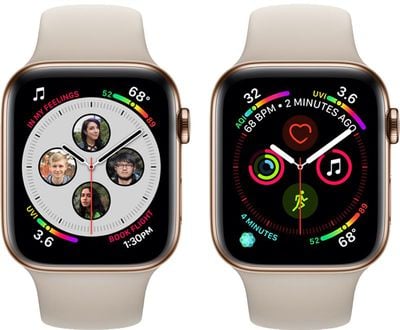
applewatchseries4watchfaces

The ubiquity and remarkable technological progress of wearable consumer devices and mobile-computing platforms (smart phone, smart watch, tablet), along with the multitude of sensor modalities available, have enabled continuous monitoring of patients and their daily activities. Such rich, longitudinal information can be mined for physiological and behavioral signatures of cognitive impairment and provide new avenues for detecting MCI in a timely and cost-effective manner.

In this work, we present a platform for remote and unobtrusive monitoring of symptoms related to cognitive impairment using several consumer-grade smart devices. We demonstrate how the platform has been used to collect a total of 16TB of data during the Lilly Exploratory Digital Assessment Study, a 12-week feasibility study which monitored 31 people with cognitive impairment and 82 without cognitive impairment in free living conditions. We describe how careful data unification, time-alignment, and imputation techniques can handle missing data rates inherent in real-world settings and ultimately show utility of these disparate data in differentiating symptomatics from healthy controls based on features computed purely from device data.

According to the abstract, 31 people with cognitive impairment and 82 without cognitive impairment were monitored over a 12-week period, with 16TB of data collected. The study claims that the data was able to be used to differentiate people with early signs of cognitive impairment from those who were healthy.

People who had symptoms of cognitive decline typed more slowly, typed less regularly, relied more heavily on support apps, and sent fewer text messages. The study did not reach long-term conclusions as more analysis is needed.

In a statement to CNBC, Evidation co-founder Christine Lemke said that data collected from the iPhone, Apple Watch, and Beddit sleep monitors was used for the study. Apple acquired the company behind the Beddit sleep monitor back in 2017.

"With this research, we looked at how everyday behavior data, such as those captured by iPhones, Apple Watches, and Beddit sleep monitors, may be effective in differentiating between individuals with mild cognitive impairment and early Alzheimer's disease, and those without symptoms."

Early detection of dementia is important because an early diagnosis can allow for better management of symptoms and quality of life improvements even though the progression of the disease can't be stopped. According to the World Health Organization, 50 million people around the world have dementia, with close to 10 million new cases surfacing every year.
Popular Stories

Apple Event Logo

Apple's Next Era Begins September 1

Thursday May 7, 2026 10:36 am PDT by
Apple recently announced that Tim Cook will be stepping down as CEO later this year, after 15 years of leading the company. Effective September 1, Apple's hardware engineering chief John Ternus will become the company's next CEO, while Cook will become executive chairman of Apple's board of directors. In his new role, Apple said Cook will assist with "certain aspects" of the company,...
Four iPhone 18 Pro Colors Mock Feature

iPhone 18 Pro Launching in September With These 10 New Features

Saturday May 9, 2026 6:03 am PDT by
While the iPhone 18 Pro and iPhone 18 Pro Max are not launching until September, there are already plenty of rumors about the devices. It was initially reported that the iPhone 18 Pro models would have fully under-screen Face ID, with only a front camera visible in the top-left corner of the screen. However, the latest rumors indicate that only one Face ID component will be moved under the...
MacBook Pro Low Angle Wide Lens

macOS 27: Two More Changes Leaked Ahead of WWDC Next Month

Sunday May 10, 2026 9:45 am PDT by
macOS 27 will have a "slight redesign" compared to macOS Tahoe, according to the latest word from Bloomberg's Mark Gurman. In his Power On newsletter today, Gurman said the design changes will help to improve the readability of macOS Tahoe's Liquid Glass interface:If you've used Tahoe, you're likely familiar with some of the quirks — particularly the transparency effects and shadows that...

Top Rated Comments

88 months ago
Crazy. I mean, to see the advancements that technology is making in the wearables sector is incredible (Which also explains it’s growth). EKG, fall detection, wheelchair capabilities on the Apple Watch and possibly detecting dementia, this is what’s making the future for wearables a ‘must have’ versus what once started primarily as a notification device.
Score: 21 Votes (Like | Disagree)
88 months ago
One way to detect dementia is by counting the number of times an owner uses the 'Find My Phone/Watch' feature every week :)
Score: 12 Votes (Like | Disagree)
88 months ago
Boy. Talk about a slippy slope. Ring the right algorithm bell and be in front of the death panel the next day.
Score: 6 Votes (Like | Disagree)
88 months ago
My mother had dementia and it is a weird disease. They can be perfectly normal one minute then think my wife has of 30 years was my girlfriend, my mother thought I was my Father. She stormed away angry that I had a “girlfriend”.


So, as an oldster now, I worry that I might get dementia. There are moments when I find myself thinking about the past. Will I get dementia? I will never know but my family will. Godspeed to the scientists and medical professionals for trying to root out this affliction that effects so many.
Score: 5 Votes (Like | Disagree)
Suttree Avatar
88 months ago
I know nothing about medicine and have zero medical training and knowledge, yet even I know this study is bunk. My mom asked me why am I still living at home, depriving this world of my sage knowledge and skillset when I can be goodly remunerated and leave a positive impact rather than merely armchair quarterbacking. But it is obvious this study is plain bunk with only 31 subjects. Common sense. Simple as that.
Score: 4 Votes (Like | Disagree)
Naraxus Avatar
88 months ago
This would be amazing. Dementia is a horrible horrible disease that takes every last bit of dignity from you. The earlier the detection, the earlier the planning can begin or even cure it.
Score: 4 Votes (Like | Disagree)