Skip to Content

Apple Announces New $300 Million Clean Energy Fund in China

Apple today announced the launch of a $300 million investment fund in China which is designed to connect Apple's suppliers with renewable energy sources.

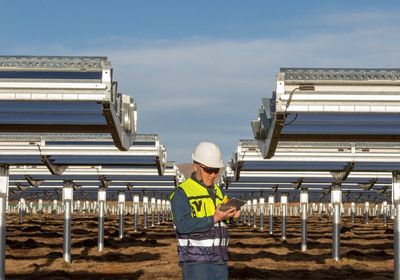
Apple, along with 10 initial suppliers, is investing $300 million into the China Clean Energy Fund over the course of the next four years. Apple says the fund will invest in and develop clean energy projects totaling more than 1 gigawatt of renewable energy in China, which is equivalent to powering close to 1 million homes.
chinacleanenergyfundapple
Apple's new fund will be managed by DWS Group, a company that specializes in sustainable investments. DWS also plans to invest in the fund.

"At Apple, we are proud to join with companies that are stepping up to address the climate challenge," said Lisa Jackson, Apple's vice president of Environment, Policy and Social Initiatives. "We're thrilled so many of our suppliers are participating in the fund and hope this model can be replicated globally to help businesses of all sizes make a significant positive impact on our planet."

According to Apple, the China Clean Energy Fund will provide participates with the advantage of greater purchasing power and the ability to attain "more attractive and diverse" clean energy solutions.

Participating suppliers include Catcher Technology, Compal Electronics, Corning Incorporated, Golden Arrow, Jabil, Luxshare-ICT, Pegatron, Solway, Sunway Communication, and Wistron.

Apple earlier this year announced that all of its facilities around the world are powered by 100 percent renewable energy, a milestone achievement for the company.

To hit that goal, Apple invested in and constructed renewable energy facilities around the world, including solar arrays, wind farms, biogas fuel cells, micro-hydration generation systems, and other energy storage technologies.

Since the launch of its Supplier Clean Energy Program in 2015, 23 manufacturing partners across 10 countries have committed to powering their Apple production lines with 100 percent clean energy.

Popular Stories

MacBook Neo Feature Pastel 1

First MacBook Neo Benchmarks Are In: Here's How It Compares to the M1 MacBook Air

Thursday March 5, 2026 4:07 pm PST by
Benchmarks for the new MacBook Neo surfaced today, and unsurprisingly, CPU performance is almost identical to the iPhone 16 Pro. The MacBook Neo uses the same 6-core A18 Pro chip that was first introduced in the iPhone 16 Pro, but it has one fewer GPU core. The MacBook Neo earned a single-core score of 3461 and a multi-core score of 8668, along with a Metal score of 31286. Here's how the...
MacBook Neo Feature Pastel 1

Apple Announces $599 'MacBook Neo' With A18 Pro Chip

Wednesday March 4, 2026 6:15 am PST by
Apple today announced the "MacBook Neo," an all-new kind of low-cost Mac featuring the A18 Pro chip for $599. The MacBook Neo is the first Mac to be powered by an iPhone chip; the A18 Pro debuted in 2024's iPhone 16 Pro models. Apple says it is up to 50% faster for everyday tasks than the bestselling PC with the latest shipping Intel Core Ultra 5, up to 3x faster for on-device AI workloads,...
Multicolored Low Cost A18 Pro MacBook Feature

Apple Accidentally Leaks 'MacBook Neo'

Tuesday March 3, 2026 7:00 am PST by
Apple appears to have prematurely revealed the name of its rumored lower-cost MacBook model, which is expected to be announced this Wednesday. A regulatory document for a "MacBook Neo" (Model A3404) has appeared on Apple's website. Unfortunately, there are no further details or images available yet. While the PDF file does not contain the "MacBook Neo" name, it briefly appeared in a link...

Top Rated Comments

Kaibelf Avatar
100 months ago
Wow! China is not exactly known for being environmentally friendly. Their pollution is one of the worst, if not the worst, in the world. I'm sure it took great "courage" to convince them to even entertain this type of project.
Actually, China is known for aggressively pushing for renewable more than almost anyone to fix the very pollution issue you mentioned. It’s been the case for many years now and that’s why they are far ahead of the US in their embrace of renewables already.
Score: 14 Votes (Like | Disagree)
JPack Avatar
100 months ago
A single city in China has more electric buses than fossil buses from all U.S. cities combined. They have the largest solar farm in the world. Also the largest market for plug-in vehicles.

This $300MM fund is just a drop in the bucket.
Score: 8 Votes (Like | Disagree)
100 months ago
Too bad the USA are more focused on clean coal. This would have been a great investment.
Score: 7 Votes (Like | Disagree)
cote32mt Avatar
100 months ago
A single city in China has more electric buses than all U.S. cities combined. They have the largest solar farm in the world. Also the largest market for plug-in vehicles.

This $300MM fund is just a drop in the bucket.
That is certainly something for us all to think seriously about.
Score: 3 Votes (Like | Disagree)
Kabeyun Avatar
100 months ago
Too bad the USA are more focused on clean coal. This would have been a great investment.
Quotes added for clarity.

Wow! China is not exactly known for being environmentally friendly. Their pollution is one of the worst, if not the worst, in the world. I'm sure it took great "courage" to convince them to even entertain this type of project.
China is shaming everyone with their clean energy investments, including, for example they’re aiming for an entirely electric car fleet by 2030. Can America, with our current administration, and our oil drilling expansion, and our removing mountains for coal, say that?
Score: 3 Votes (Like | Disagree)
Kaibelf Avatar
100 months ago
I look forward to China (the country with advancements in renewables) donating money to the US to help with pollution and clean energy.
We don’t need (or frankly deserve) it. If we want clean energy, it’s our responsibility to vote accordingly either in elections or with our money.
[doublepost=1531445694][/doublepost]
They’re very often one and the same in China.
And everywhere else. Exhibits A, B and C are Monsanto, Boeing, and Lockheed.
Score: 2 Votes (Like | Disagree)