Supreme Court Rules Police Need Warrants to Obtain a User's Smartphone Location Data - MacRumors
Skip to Content

Supreme Court Rules Police Need Warrants to Obtain a User's Smartphone Location Data

The United States Supreme Court today ruled that the government "is required" to obtain a warrant if it wants to gain access to data found on a civilian's smartphone, but only when it's related to the user's location data (via The New York Times).
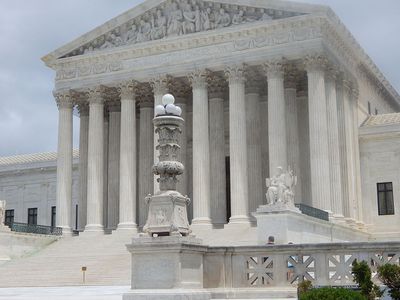
United States Supreme Court Building


The decision is expected to have major implications for digital privacy moving forward as it pertains to legal cases, and could cause ripples in unlawful search and seizure cases that involve personal information held by companies like emails, texts, internet searches, bank records, and more.

In a major statement on privacy in the digital age, the Supreme Court ruled on Friday that the government generally needs a warrant to collect troves of location data about the customers of cellphone companies.

But Chief Justice John G. Roberts Jr., writing for the majority, said the decision was limited. “We hold only that a warrant is required in the rare case where the suspect has a legitimate privacy interest in records held by a third party,” the chief justice wrote. The court’s four more liberal justices joined his opinion.

Today's vote in the case Carpenter v. United States came down to a 5-4 ruling, and originally emerged from armed robberies of Radio Shacks and other stores in Detroit dating back to 2010.

In the case, prosecutors relied on "months of records" obtained from smartphone makers to help prove their case, ultimately showing communication between Timothy Ivory Carpenter outside of a robbery location -- with his smartphone nearby -- and his accomplices inside of the location. The companies reportedly turned over 127 days' worth of Carpenter's records, with information as specific as whether or not he slept at home on any given night or if he went to church on Sunday mornings.

This led to the question by the Supreme Court justices as to whether the prosecutors violated the Fourth Amendment in discovering so much data on Carpenter's movements. Now, police will have to receive a warrant issued by the court in order to obtain any smartphone data as it relates to the owner's location data.

As the case continued, Apple and other technology companies filed a brief in August 2017 arguing against "rigid analog-era" Fourth Amendment rules. The brief deliberately stayed neutral on the topic of choosing sides, but urged the Supreme Court to continue bringing the Fourth Amendment law into the modern era. The companies stated that customers should not be "forced to relinquish Fourth Amendment protections" against intrusion by the government, simply because they choose to use modern technology.

Note: Due to the political nature of the discussion regarding this topic, the discussion thread is located in our Politics, Religion, Social Issues forum. All forum members and site visitors are welcome to read and follow the thread, but posting is limited to forum members with at least 100 posts.
Popular Stories

iPhone 18 Pro Dark Cherry Feature

iPhone 18 Pro Reportedly Starts With 256GB of Storage

Thursday September 3, 2026 9:22 am PDT by
While the iPhone 17 Pro has double the base storage compared to the iPhone 16 Pro, there will apparently be no further increase this year. Taiwanese research firm TrendForce today again reported that the iPhone 18 Pro models will start with 256GB of storage, like the iPhone 17 Pro models. Minimum storage capacities by model:iPhone 16 Pro: 128GB iPhone 17 Pro: 256GB iPhone 18 Pro...
Dynamic Island iPhone 18 Pro Feature

iPhone 18 Pro Prices Estimated Ahead of Apple Event Next Week

Thursday September 3, 2026 3:41 am PDT by
Less than a week before Apple debuts new iPhone 18 Pro models, research firm TrendForce has estimated the prices of the devices based on the latest hardware cost environment. TrendForce's price estimates compared to last year's models look like this: Model Starting Price Model Starting Price Change iPhone 17 Pro $1,099 iPhone 18 Pro $...
iPhone Handoff Feature

iOS 27 Introduces New 'iPhone Handoff' Feature

Wednesday September 2, 2026 12:35 pm PDT by
Apple has added a new "iPhone Handoff" feature to iOS 27 that will allow you to switch between two iPhones while using the same phone number on each device. This functionality was briefly mentioned during the WWDC 2026 keynote in June, on a slide that listed hundreds of new features coming in iOS 27 and corresponding software updates, but Apple never shared any further details at the time. ...

Top Rated Comments

107 months ago
I'm shocked this isn't a 9-0 slam dunk with a poster for it... how can we be so vocal about the 2nd Amendment, or the 1st... and not be equally as loud for the 4th? "The right of the people to be secure in their persons, houses, papers, and effects, against unreasonable searches and seizures, shall not be violated"........... come on now.
Score: 34 Votes (Like | Disagree)
slimtastic Avatar
107 months ago
From the start, this should have ALWAYS required a warrant.
Score: 20 Votes (Like | Disagree)
107 months ago
Another 'liberal' case where Roberts sided for.

The Court could soon take a liberal turn if Roberts continues on his current trajectory, unless a liberal justice retires during Trump's presidency.
How is this a liberal decision? Generally curious.
Score: 17 Votes (Like | Disagree)
107 months ago
I wonder how long before Apple offers the ability to delete your location data, using a method similar to how you can clear your browser history.
Score: 14 Votes (Like | Disagree)
ssgbryan Avatar
107 months ago
Because conservatives really don’t democracy.
Score: 11 Votes (Like | Disagree)
izyreal Avatar
107 months ago
Another 'liberal' case where Roberts sided for.

The Court could soon take a liberal turn if Roberts continues on his current trajectory, unless a liberal justice retires during Trump's presidency.
I disagree with your proposition that this was a liberal decision. As a fairly conservative guy, I believe that the decision represented a clear victory for the 4th amendment. I do not think that the supreme court can or should make decisions that conflict with the constitution. If you don't like what the constitution says, there is a process to amend it.

IMHO, the 4th amendment is black and white clear in this case:
"The right of the people to be secure in their persons, houses, papers, and effects, against unreasonable searches and seizures, shall not be violated, and no Warrants shall issue, but upon probable cause, supported by Oath or affirmation, and particularly describing the place to be searched, and the persons or things to be seized."

My phone is one of my "effects" that is constitutionally protected. The data within my phone (or that is generated by use of my phone) is also protected as it is an integral part of my effect (my phone).
Score: 8 Votes (Like | Disagree)