Skip to Content

Qualcomm's 3D Sensing Technology Two Years Behind Apple's

by

Apple's progress in 3D sensing design and mass production is 1.5 to 2 years ahead of Qualcomm's, according to a new investor's note released today by KGI Securities analyst Ming-Chi Kuo.

Kuo believes that Qualcomm is behind in both software and hardware development for 3D sensing, and won't be able to ship the technology until 2019. As Qualcomm is the "most engaged" company when it comes to 3D sensing components for Android devices, Android smartphones could lag behind Apple devices for some time.
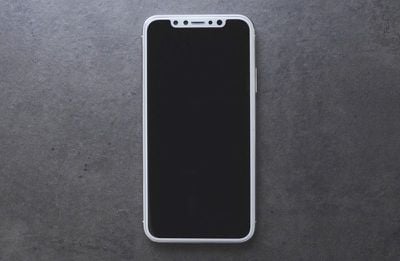
iphone8dummymodeldesign

An iPhone 8 dummy depicting the location of the front-facing camera and 3D sensors

While Qualcomm has excelled in designing advanced application processors and baseband solutions, it lags behind in other crucial aspects of smartphone applications like dual-camera (many Android phones have instead adopted solutions used to simulate optical zoom from third-party vendors such as Arcsoft (US)) and ultrasonic fingerprint scanner (while a new reference design has been released, there is no visibility on mass production). So while Qualcomm is the most engaged company in the R&D of 3D sensing for the Android camp, we are conservative as regards progress toward significant shipments and don't see it happening until 2019F.

According to Kuo, Qualcomm is dealing with immature algorithms and an unfavorable hardware reference design for smartphones due to form factor design and thermal issues. Qualcomm may also be impacted by Apple's choice of suppliers. Many key component suppliers have already allocated resources to Apple, so Qualcomm has to find different suppliers in order to obtain sufficient resources. Kuo also outlines the suppliers each company is using:
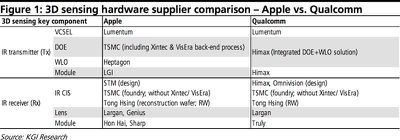
applequalcomm3dsensinghardwarecomparison
In general, Kuo says the "Android camp" appears to be taking a wait-and-see approach to 3D sensing, which also does not bode well for Qualcomm's 3D sensing technology. Android manufacturers are said to be waiting to see how Apple will use 3D sensing and whether it will offer an "innovative user experience" with features like facial recognition.

Xiaomi's 2018 flagship device is said to be the only potential adopter of Qualcomm's 3D sensing technology, and if the OLED iPhone doesn't see positive feedback following launch, Kuo believes Xiaomi may drop the project.

Apple is rumored to be introducing a front-facing camera with 3D sensing functionality that will enable a new facial recognition system to replace Touch ID, which the company could not build under the display of the device due to production issues. Apple's "iPhone 8" with 3D sensors is expected to debut in just a couple of weeks.

Related Forum: iPhone

Top Rated Comments

111 months ago
Same story as Touch ID: the competition is behind.

But then again, Apple is behind in a lot of stuff as well.
In other words: Competition is great.
Score: 9 Votes (Like | Disagree)
filmantopia Avatar
111 months ago
It's going to be great. Once we get Face ID, we won't be looking back.
Score: 7 Votes (Like | Disagree)
111 months ago
I’m still not convinced this will replace Touch ID, and I haven’t seen this question asked. How the hells am I supposed to use this feature when it’s pitched black in my room at night?
Really? You haven't seen that question asked? It's probably the most-asked question about FaceID here on MR.

But to answer your question: infrared. Doesn't matter how pitch black it is, infrared will be able to detect your face. Some smartphones/laptops already have this I believe.
Score: 3 Votes (Like | Disagree)
111 months ago
I'm sure Samsung is not behind.... they will have it next year although they were first to introduce some type of facial detection anyways.

I still feel Iris scanning is more secure in combo with fingerprint reader.

Why would you think Samsung isn't behind when just a few years ago, Apple leapfrogged everyone's fingerprint sensors by 2-3 years. Just because a crude form of face detection is available today, doesn't mean they have a secure, user-friendly, reliable version right around the corner.

I'm not saying you're wrong since no one knows for sure, but your logic is definitely flawed... especially since Samsung has a poor track record with security; their iris scanner was recently hacked, for example, and their face detection was hacked almost immediately.
Score: 3 Votes (Like | Disagree)
McFlyOz Avatar
111 months ago
It's going to be great. Once we get Face ID, we won't be looking back.
Until we get BackID and then we’ll have to do that.
Score: 3 Votes (Like | Disagree)
Piggie Avatar
111 months ago
By definition, infrared light is invisible to human eye. That's why it's called "Infra" (lower-than) "red". So no it won't be visible to you even in the dark.

You shouldn't think of it in terms of a "night vision camera", it will more than likely won't work like that.

Everything points to the FaceID tech being equivalent to a miniaturized Kinect. Apple bought PrimeSense (makers of the first Xbox Kinect) several years ago, and the HomePod firmware contains references to an IR projector.

The Kinect works by projecting an infrared pattern of seemingly random dots. An infrared camera captures an image of the projected dot pattern, which is deformed by the shape of the object(s) it's projected on. An algorithm then analyzes the deformations vs. the expected pattern and recreates a depth map where each point has a depth value.

So FaceID will likely work by analyzing your face topology, which should work exactly the same in the dark.
I will be interesting to see how much of your face it needs to have a clear shot of to work.
Clothing covering part of your face.
Hair covering part of your face.
Various types of glasses/sun glasses.
Facial jewelry being there or not.

Of course it won't work at all if you have some kind of halloween costume / makeup on.

Going to be interesting to see.

It's got to be both:

Lax enough not to be a pain and keep rejecting things YOU do.
Yet secure enough to not pass someone/something that looks like you.

That's a tricky combination to pull off.
Score: 2 Votes (Like | Disagree)

Popular Stories

imac video apple feature

Apple Unveils Two New Products

Monday March 2, 2026 7:49 am PST by
Apple today introduced two new devices, including the iPhone 17e and an updated iPad Air. iPhone 17e features the same overall design as the iPhone 16e, but it gains Apple's A19 chip, MagSafe for magnetic wireless charging and magnetic accessories, Apple's second-generation C1X modem for faster 5G, and a doubled 256GB of base storage. In the U.S., the iPhone 17e starts at $599, just like the ...
Apple iPhone 17e feature

Apple Announces iPhone 17e With A19 Chip, MagSafe, and More

Monday March 2, 2026 6:07 am PST by
Apple today announced the iPhone 17e, featuring the A19 chip, MagSafe connectivity, faster charging, and more. The iPhone 17e contains the A19 chip introduced in iPhone 17. It features a 6-core GPU and a 4-core GPU. Apple pointed out that this makes it up to 2x faster than the iPhone 11. The new 16-core Neural Engine is optimized for large generative models. The iPhone 17e also contains...
iPad Air M4 Chip 1

Apple Unveils iPad Air With M4 Chip, Increased RAM, Wi-Fi 7, and More

Monday March 2, 2026 6:05 am PST by
Apple today introduced a new iPad Air, with key upgrades including Apple's M4 chip for faster performance, an increased 12GB of RAM, Apple's N1 wireless networking chip with Wi-Fi 7 support, and Apple's custom C1X modem in cellular models. The new iPad Air has the same overall design as the previous-generation model, which is equipped with the M3 chip, 8GB of RAM, and Wi-Fi 6E support....