New Mac Malware Discovered on Dark Web as Security Experts Remind Mac Users Not to Be 'Overconfident' - MacRumors
Skip to Content

New Mac Malware Discovered on Dark Web as Security Experts Remind Mac Users Not to Be 'Overconfident'

by

Two new pieces of malicious software aimed at Mac computers have been discovered on the Dark Web, offered through Malware-as-a-Service (MaaS) and Ransomware-as-a-Service (RaaS) portals and estimated to have been up for around the past three weeks, beginning May 25. Originally spotted by Bleeping Computer, the two portals offer software called "MacSpy" and "MacRansom" as services for potential buyers, as well as any future support that may be needed for the malware (via Motherboard).

Both portals are the work of the same malware developer, but security firms Fortinet and AlienVault described the person behind the scheme as an "inexperienced coder," pointing towards issues like the lack of digitally signed files, meaning the security measures on a standard installation of macOS would still be alerted to the malware. The researchers called MacSpy the "better-coded tool," but said MacRansom was more dangerous since it "has the potential to permanently wreck user files," if users of malicious intent ever wielded it.
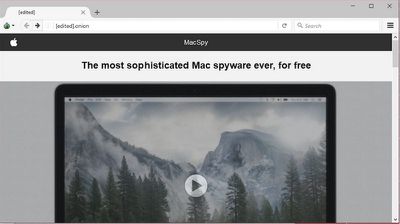
macspy malware

Thankfully, the process by which crooks would have to go about getting either MacSpy or MacRansom will likely prevent either piece of malware from spreading. Both portals are described as "closed" offerings, meaning anyone wanting to actually purchase the services off the Dark Web would have to contact the author to receive demo packages, and then directly negotiate payment. As such, "none of these two appear to be part of any active distribution campaigns."

All the same, as Mac-focused security researcher Patrick Wardle told Motherboard, the increasing intent of cyber criminals to infect Apple's computers is "kind of a milestone." Security reporter Ruben Dodge said that macOS and iOS have so many "less technical people" using the software that it's simply too "ripe" of a target for criminals not to take notice. Although MacRansom and MacSpy aren't expected to take off in that way, Dodge said "it's only a matter of time" before another piece of malware or ransomware does.

Ruben Dodge: "There's an ideological shift for Mac and iPhone as being seen as the more friendly OS for older people. [...] It is a market that will be targeted. There are too many less technical people using it not to make it a 'ripe' target for threat actors."

Patrick Wardle: "Apple continues to improve the security of them," Wardle said. "But Mac users should just be cautions, should not be not be overconfident, and should not assume that just because they're using a Mac they're inherently safe."


Malware attacks on Mac computers were up 744 percent in 2016, although that percentage was largely weighted due to adware bundling in software on MacBooks and iMacs, which is far less alarming than any potential wide-scale malware purchased by a criminal on the Dark Web. Still, Bleeping Computer pointed out in its report that Mac ransomware in particular -- which holds user data ransom until a fee is paid -- has been steadily growing over the past year.

The number of Macs has grown, and so has the number of Mac-targeting malware. The launch of MaaS portals, even if hard to use and engage with as MacSpy and MacRansom, will drive more crooks towards the Mac userbase, and will lower the entry bar for some individuals and groups that had no previous experience with creating Mac malware.

As a rule of thumb, in order to stay safe users should only download apps and programs from Apple's own Mac App Store, and if an app is available only on a third-party website the developer behind the software should be trusted. Although Apple has long advertised the Mac as a truly anti-virus and anti-malware machine, Wardle reminds Apple fans to remain vigilant online: "Mac users...should not be overconfident, and should not assume that just because they're using a Mac they're inherently safe."
Tag: Malware

Top Rated Comments

118 months ago
As a rule of thumb, in order to stay safe users should only download apps and programs from Apple's own Mac App Store, and if an app is available only on a third-party website the developer behind the software should be trusted.
Nope. I check every Mac app I buy to see if it's available directly from the developer so they take 100% of the profits. Let's not use malware as an excuse to make sure the Mac is a walled ecosystem like iOS.
Score: 18 Votes (Like | Disagree)
118 months ago
I’ve seen it here before. Seen it most commonly on the official Apple forums though I must admit. When a new Mac virus pops up, an apologist comes along and says, "No actually it’s a Trojan Horse”. There is a difference of course I know that, but I also know it isn’t the point being made.
Well, it exactly is. If you can't get your terminology right, someone is going to correct you.
You could avoid that annoyance by not being wrong and not sounding like you don't know what you're talking about.
Score: 15 Votes (Like | Disagree)
118 months ago
Never, all they’ll tell you is that this is a worm and Macs still don’t get viruses. Or similar.
You seem to be under the misconception that there is no difference. That the mechanisms, vectors and payloads are indistinguishable or irrelevant.
There very much is, to the extent that the very people who research and combat these things coined the terms.
If you have a problem with the correct use of the terminology - as opposed to deliberately misusing it for sensationalism sake - then perhaps take it up with them.
Score: 7 Votes (Like | Disagree)
Fall Under Cerulean Kites Avatar
118 months ago
A piece of trojan software that can destroy files, but that is unsigned and requires manual intervention in order to not just install, but run, is not something I’m going to get excited about.
Score: 5 Votes (Like | Disagree)
iDento Avatar
118 months ago
Dear Apple,

I'd happily get all my apps from the MacAppStore when you give a damn, like how you redesigned the iOS AppStore for instance.
Score: 3 Votes (Like | Disagree)
118 months ago
Sometimes the software direct from a devs site has more features not allowed on store. And I saw one piece of software that the Mac store version was subscription based but their version bought from website was one time buy.
This. Kind of frustrating.
Score: 2 Votes (Like | Disagree)

Popular Stories

Apple Lists 250 Changes Across iOS 27 and More Feature

Apple Shares List of 250 Changes Across iOS 27, macOS Golden Gate, and More

Wednesday June 10, 2026 1:34 pm PDT by
During its WWDC 2026 keynote on Monday, Apple briefly showed a slide with hundreds of new features and enhancements coming across iOS 27, macOS 27 Golden Gate, watchOS 27, tvOS 27, and visionOS 27. All of the software updates are currently available as developer betas, and they are expected to be released to all users in September. We already highlighted some of the key new features from the ...
Apple Event Logo

Apple to Release These 15 New Products Later This Year

Friday June 12, 2026 7:45 am PDT by
Apple's annual WWDC developers conference is drawing to a close, but there is still a lot to look forward to in the second half of the year. Apple is expected to release at least 15 more products later this year. Now that the more intelligent and personal version of Siri has finally arrived in beta, a full two years after Apple first previewed it at WWDC 2024, we should begin to see some new ...
iCloud iPhone 17 Pro

iPhone Users Who Pay for iCloud Storage Get Two New Perks on iOS 27

Tuesday June 9, 2026 11:29 am PDT by
If you pay for extra iCloud storage on your iPhone, beyond the 5GB included for free, you might receive two more perks on iOS 27 at no additional cost. First, Apple said there will be daily usage limits for some of the new and enhanced Apple Intelligence features on iOS 27, including image generation. However, the company noted that "increased access" is available with "most" iCloud+ storage ...