Skip to Content

Report Reveals In-App Purchase Scams in the App Store

An investigation into App Store developer pay-outs has uncovered a scamming trend in which apps advertising fake services are making thousands of dollars a month from in-app purchases.

In a Medium article titled How to Make $80,000 Per Month on the Apple App Store, Johnny Lin describes how he discovered the practice, which works by manipulating search ads to promote dubious apps in the App Store and then preys on unsuspecting users via the in-app purchase mechanism.
scam apps

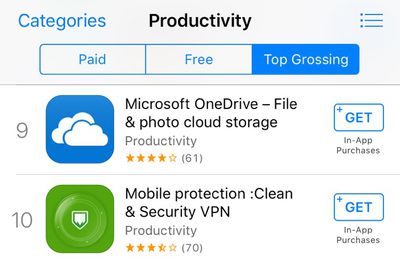
I scrolled down the list in the Productivity category and saw apps from well-known companies like Dropbox, Evernote, and Microsoft. That was to be expected. But what's this? The #10 Top Grossing Productivity app (as of June 7th, 2017) was an app called "Mobile protection :Clean & Security VPN".

Given the terrible title of this app (inconsistent capitalization, misplaced colon, and grammatically nonsensical "Clean & Security VPN?"), I was sure this was a bug in the rankings algorithm. So I check Sensor Tower for an estimate of the app's revenue, which showed… $80,000 per month?? That couldn't possibly be right. Now I was really curious.

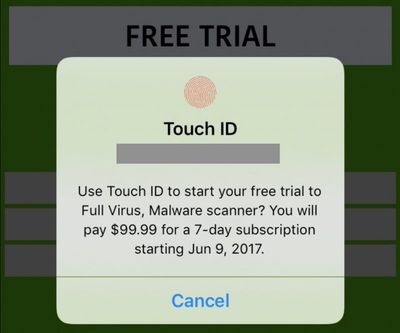
To learn how this could be, Lin installed and ran the app, and was soon prompted to start a "free trial" for an "anti-virus scanner" (iOS does not need anti-virus software thanks to Apple's sandboxing rules for individual apps). Tapping on the trial offer then threw up a Touch ID authentication prompt containing the text "You will pay $99.99 for a 7-day subscription starting Jun 9, 2017".
scam apps 1
Lin was one touch away from paying $400 a month for a non-existent service offered by a scammer.

It suddenly made a lot of sense how this app generates $80,000 a month. At $400/month per subscriber, it only needs to scam 200 people to make $80,000/month, or $960,000 a year. Of that amount, Apple takes 30%, or $288,000 — from just this one app.

Lin went on to explain how dishonorable developers are able to take advantage of Apple's App Store search ads product because there's no filtering or approval process involved. Not only that, ads look almost indistinguishable from real results in the store, while some ads take up the entire search result's first page.

Lin dug deeper and found several other similar apps making money off the same scam, suggesting a wider disturbing trend, with scam apps regularly showing up in the App Store's top grossing lists.

It's unclear at this point how these apps managed to make it onto the App Store in the first place given Apple's usually stringent approval process, or whether changes to the search ads system in iOS 11 will prevent this immoral practice from occurring in future. We'll be sure to update this article if we hear more from Apple.

In the meantime, users can contact Apple if they have concerns about an app they've already purchased, or report scam apps if they see them, by using the iTunes Connect Contact Us form. (Select "Feedback and Concerns" and "Report a Fraud Concern".) It's also worth informing less savvy friends of this scamming trend until something is done to eradicate it.


Popular Stories

MacBook Neo Feature Pastel 1

First MacBook Neo Benchmarks Are In: Here's How It Compares to the M1 MacBook Air

Thursday March 5, 2026 4:07 pm PST by
Benchmarks for the new MacBook Neo surfaced today, and unsurprisingly, CPU performance is almost identical to the iPhone 16 Pro. The MacBook Neo uses the same 6-core A18 Pro chip that was first introduced in the iPhone 16 Pro, but it has one fewer GPU core. The MacBook Neo earned a single-core score of 3461 and a multi-core score of 8668, along with a Metal score of 31286. Here's how the...
HomePod mini and Apple TV Sage

New Apple TV and HomePod Mini Are Still Missing, Here's Why

Thursday March 5, 2026 6:11 am PST by
Apple this week unveiled seven products, ranging from the iPhone 17e to the MacBook Neo, but new Apple TV and HomePod mini models were not among them. Given that there have been rumors about the next-generation Apple TV and HomePod mini since all the way back in late 2024, some customers are wondering why the devices have yet to launch, and the answer likely relates to Siri. In September, ...
MacBook Neo Feature Pastel 1

Apple Announces $599 'MacBook Neo' With A18 Pro Chip

Wednesday March 4, 2026 6:15 am PST by
Apple today announced the "MacBook Neo," an all-new kind of low-cost Mac featuring the A18 Pro chip for $599. The MacBook Neo is the first Mac to be powered by an iPhone chip; the A18 Pro debuted in 2024's iPhone 16 Pro models. Apple says it is up to 50% faster for everyday tasks than the bestselling PC with the latest shipping Intel Core Ultra 5, up to 3x faster for on-device AI workloads,...

Top Rated Comments

djcerla Avatar
114 months ago
A fool and his money are soon parted.

But an antivirus should not be in the App Store to begin with.
Score: 20 Votes (Like | Disagree)
Phil A. Avatar
114 months ago
Reading the linked article, it seems the scammers are (ab)using the new advertising within the App Store to promote their "apps" and making thousands and thousands of dollars doing so.
Doesn't really reflect well on Apple IMO - the whole purpose of the walled garden is that it's safer than the wild west approach of Google and that should include protecting people from getting scammed
Score: 19 Votes (Like | Disagree)
114 months ago
I can't remember the last time I even downloaded an app from the App Store never mind paying for any in app purchases.

Hope people wise up to this.
There's plenty of useful paid apps, and plenty of quality fun paid games, even with IAPs. your generalization is quite pointless.
Score: 16 Votes (Like | Disagree)
miknos Avatar
114 months ago
Like MacKeeper for macOS.
Score: 15 Votes (Like | Disagree)
114 months ago
With Apple, Inc. taking 33% of App revenue, hosting criminal apps under their brand, bragging about their security, and not immediately stopping this activity.....there must be a bunch of class action lawyers jumping for joy.
Score: 12 Votes (Like | Disagree)
WarHeadz Avatar
114 months ago
No doubt more can and should be done by Apple when it comes to policing such scams, but shouldn't the victims bear some degree of the blame as well? The terms and conditions are right there in front of them, and nobody is twisting their arm into making a purchase.
You might have a point if a legitimate service was being offered here. In this case, the service being advertised is non-existant. It's fraud.


Score: 12 Votes (Like | Disagree)