U.S. Music Fans Continue Shift to Streaming Services as Apple Readies Beats Revamp
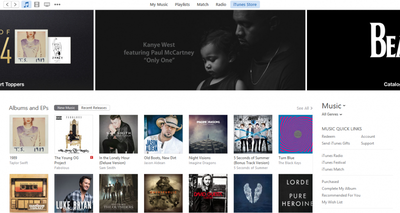
Paid music downloads, which have dominated the digital music market for years thanks in large part to Apple's iTunes Store, showed accelerating weakness in the United States last year as music streaming services like Spotify and a resurgence of vinyl record sales exploded in popularity.
According to Nielsen SoundScan (via The Wall Street Journal), streaming music grew a remarkable 54 percent in 2014, moving from 106 billion songs in 2013 to 164 billion in 2014. That growth contrasts with traditional song downloads that dropped off significantly from 2013. Paid downloads for full music albums declined 9 percent in 2014, with individual song downloads seeing an even larger 12 percent drop-off. Overall, according to SoundScan, Americans bought 257 million albums in 2014, 106.5 million of which were downloaded digitally.
Amid the digital shift from individual downloads to streaming, an older technology also saw a resurgence in 2014 with vinyl record sales at their highest levels since SoundScan began tracking music sales in 1991. Nielsen's tracking shows 9.2 million vinyl records sold, representing a 52 percent overall increase in sales from 2013.
With lackluster overall digital music downloads mirroring a similar drop in iTunes Store sales, Apple has been looking at ways to improve its positioning in the music market. Apple's initial effort with iTunes Radio to offer a Pandora-like experience that also seeks to drive iTunes Store purchases has had a less-than-stellar reception with availability in only the United States and Australia. That weak entry likely spurred Apple to pursue last year's acquisition of Beats Music for a full-fledged subscription streaming service.
Recent reports have indicated that Apple will be pursuing a major revamp of Beats early this year that may see prominent integration of the paid streaming service into iOS and iTunes, perhaps including a rebranding under the iTunes name.

Popular Stories
Apple typically releases its new iPhone series around mid-September, which means we are about two months out from the launch of the iPhone 16. Like the iPhone 15 series, this year's lineup is expected to stick with four models – iPhone 16, iPhone 16 Plus, iPhone 16 Pro, and iPhone 16 Pro Max – although there are plenty of design differences and new features to take into account. To bring ...
Apple in 2025 will take on a new compact camera module (CCM) supplier for future MacBook models powered by its next-generation M5 chip, according to Apple analyst Ming-Chi Kuo. Writing in his latest investor note on unny-opticals-2025-business-momentum-to-benefit-509819818c2a">Medium, Kuo said Apple will turn to Sunny Optical for the CCM in its M5 MacBooks. The Chinese optical lens company...
If you have an old Apple Watch and you're not sure what to do with it, a new product called TinyPod might be the answer. Priced at $79, the TinyPod is a silicone case with a built-in scroll wheel that houses the Apple Watch chassis. When an Apple Watch is placed inside the TinyPod, the click wheel on the case is able to be used to scroll through the Apple Watch interface. The feature works...
Israel-based mobile forensics company Cellebrite is unable to unlock iPhones running iOS 17.4 or later, according to leaked documents verified by 404 Media. The documents provide a rare glimpse into the capabilities of the company's mobile forensics tools and highlight the ongoing security improvements in Apple's latest devices. The leaked "Cellebrite iOS Support Matrix" obtained by 404 Media...
Apple is seemingly planning a rework of the Apple Watch lineup for 2024, according to a range of reports from over the past year. Here's everything we know so far. Apple is expected to continue to offer three different Apple Watch models in five casing sizes, but the various display sizes will allegedly grow by up to 12% and the casings will get taller. Based on all of the latest rumors,...
A widespread system failure is currently affecting numerous Windows devices globally, causing critical boot failures across various industries, including banks, rail networks, airlines, retailers, broadcasters, healthcare, and many more sectors. The issue, manifesting as a Blue Screen of Death (BSOD), is preventing computers from starting up properly and forcing them into continuous recovery...