The Bluetooth Special Interest Group (SIG) today announced the new Bluetooth 4.2 specification, which promises enhanced privacy measures, increased speed of data transfers, and an update that will allow Bluetooth Smart sensors to directly access the Internet.
The group emphasizes connected home scenarios as being able to take the most advantage of Bluetooth 4.2's new direct Internet access feature, promising low-power connectivity using the standard and with IPv6 support available by year's end.
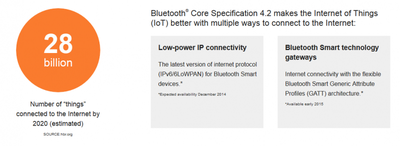
“Bluetooth 4.2 is all about continuing to make Bluetooth Smart the best solution to connect all the technology in your life – from personal sensors to your connected home. In addition to the improvements to the specification itself, a new profile known as IPSP enables IPv6 for Bluetooth, opening entirely new doors for device connectivity,” said Mark Powell, executive director of the Bluetooth SIG. “Bluetooth Smart is the only technology that can scale with the market, provide developers the flexibility to innovate, and be the foundation for the IoT.”
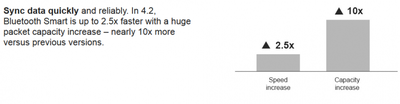
The new 4.2 spec also promises speedier data transfers between devices, up to 2.5 times faster than previous versions. Bluetooth SIG promises that "increased data transfer speeds and packet capacity reduces the opportunity for transmission errors to occur and reduces battery consumption, resulting in a more efficient connection."
The new privacy features also take aim at lowering power consumption, while protecting consumers from being tracked through their Bluetooth devices. As more retail stores and public places accept Bluetooth beacons and similar applications, Bluetooth SIG hopes to be at the forefront for protecting every user's personal and private information.
The new privacy features put control back into the hands of the consumer by making it difficult for eavesdroppers to track a device through its Bluetooth connection without permission. For example, when shopping in a retail store with beacons, unless you’ve enabled permission for the beacon to engage with your device, you can’t be tracked.
The standard Bluetooth 4.2 specification is available now, with the new direct Internet access feature due within a month.
While the iPhone 18 Pro and iPhone 18 Pro Max are not expected to launch for more than five more months, there are already plenty of rumors about the devices.

It was initially reported that the iPhone 18 Pro models would have fully under-screen Face ID, with only a front camera visible in the top-left corner of the screen. However, the latest rumors indicate that only one Face ID component...
Apple's CarPlay system for accessing iPhone apps on a vehicle's dashboard screen received three popular apps this week: ChatGPT, Google Meet, and Audiomack.
CarPlay Ultra in an Aston Martin
In addition, WhatsApp is beta testing a revamped CarPlay app that will improve upon the basic Siri-based functionality that was previously available.
Make sure you have the latest version of each app...
Apple is looking for a "breakthrough" with its push into wearable AI devices, including an "AirTag-sized pendant," according to Bloomberg's Mark Gurman.
In a report, he said the pendant is reminiscent of the failed Humane AI Pin, but it would be an iPhone accessory rather than a standalone product.
The pendant would feature an "always-on" camera and a microphone for Siri voice commands,...
While the iPhone 18 Pro and iPhone 18 Pro Max are not expected to launch for more than five more months, there are already plenty of rumors about the devices.
It was initially reported that the iPhone 18 Pro models would have fully under-screen Face ID, with only a front camera visible in the top-left corner of the screen. However, the latest rumors indicate that only one Face ID component...
Apple's CarPlay system for accessing iPhone apps on a vehicle's dashboard screen received three popular apps this week: ChatGPT, Google Meet, and Audiomack.
CarPlay Ultra in an Aston Martin
In addition, WhatsApp is beta testing a revamped CarPlay app that will improve upon the basic Siri-based functionality that was previously available.
Make sure you have the latest version of each app...
Apple is looking for a "breakthrough" with its push into wearable AI devices, including an "AirTag-sized pendant," according to Bloomberg's Mark Gurman.
In a report, he said the pendant is reminiscent of the failed Humane AI Pin, but it would be an iPhone accessory rather than a standalone product.
The pendant would feature an "always-on" camera and a microphone for Siri voice commands,...
Too bad iOS users won't ever get a full Bluetooth implementation, unlike those of competing mobile operating systems.
Hilarious, iOS users had Bluetooth 4.0 LONG before the competing mobile OS's and it went completely unnoticed. Yet a profile or two not being supported because the OS offers other methods to do such things is just completely horrible, right?
Have you ever tried exchanging files (photos etc.), contacts etc. with non-Apple devices wirelessly? Obviously not.
Who uses bluetooth anymore?... oh, wait, never mind.
Uh... Everyone?
It's been getting better and better and more and more common each day for years, now.
This new 4.2 spec being IPv6-only is also a great thing. It will hopefully get a lot of lazy network people off their asses and get IPv6 working in more places. So many places (especially in the US) have been putting it off and putting it off for years.
Do you understand that one of the goals (of iOS from 2007 was to NOT have a general use file system that a user has to maintain? Obviously not. :rolleyes:
Do you understand that iOS also has
- Camera Roll to store incoming photos in / serve as a source for outgoing photos
- a Contacts database acting both as an input / output
- etc?
So much for "there's no point in having OBEX" on an OS not supporting direct access to the file system... importing to / exporting from the above system databases would certainly be feasible without a visible filesystem. Too bad iOS doesn't support even this.