Skip to Content

Apple to Pay $450 Million to Settle E-Book Price Fixing Case

ibooks-iconAccording to court records filed on Wednesday, July 16, Apple will pay $450 million as part of an out-of-court settlement with class action lawyers and state district attorneys over e-book price fixing, reports Reuters.

Apple first reached a settlement agreement with the 33 U.S. states and territories involved in the lawsuit in June, successfully avoiding a lengthy and expensive damages trial. Settlement details were sealed at that time, however, pending court approval. $400 million of the $450 million is earmarked for consumers.

The settlement is contingent on a pending appeals case Apple filed in February with the U.S. Circuit Court of Appeals in New York. In the filing, Apple asked the court to overturn the original ruling that found the company guilty of conspiring to fix e-book prices.

"We have obviously studied Judge Cote's July 2013 ruling in detail, and believe that the 2nd Circuit will agree with her conclusion that Apple did violate federal antitrust laws," said Steve W. Berman, managing partner of Hagens Berman and lead attorney representing the consumer class. "In any case of this magnitude, there are high degrees of uncertainty, and Apple's appeal of Judge Cote's well-reasoned ruling is an example of that uncertainty."

Though found guilty, Apple has maintained its innocence throughout the dispute, claiming that it "kick-started competition in a highly concentrated market, delivering higher output, lower price levels, and accelerated innovation." Should Apple's appeal be successful, sending the claim back to District Court, the company will pay out $50 million to settle consumer damages claims. If the appeals court reverses the initial decision entirely, Apple will pay no damages.

Along with $450 million in damages, Apple has also been subjected to several penalties levied by the U.S. Department of Justice, including an order to hire an external antitrust monitor. Publishers involved in the case, including Hachette, HarperCollins, Simon & Schuster, Macmillan, and Penguin also settled for a total of $166 million, which has already been making its way to customers in the form of refunds.


Popular Stories

Multicolored Low Cost A18 Pro MacBook Feature

Apple Accidentally Leaks 'MacBook Neo'

Tuesday March 3, 2026 7:00 am PST by
Apple appears to have prematurely revealed the name of its rumored lower-cost MacBook model, which is expected to be announced this Wednesday. A regulatory document for a "MacBook Neo" (Model A3404) has appeared on Apple's website. Unfortunately, there are no further details or images available yet. While the PDF file does not contain the "MacBook Neo" name, it briefly appeared in a link...
MacBook Neo Feature Pastel 1

Apple Announces $599 'MacBook Neo' With A18 Pro Chip

Wednesday March 4, 2026 6:15 am PST by
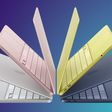
Apple today announced the "MacBook Neo," an all-new kind of low-cost Mac featuring the A18 Pro chip for $599. The MacBook Neo is the first Mac to be powered by an iPhone chip; the A18 Pro debuted in 2024's iPhone 16 Pro models. Apple says it is up to 50% faster for everyday tasks than the bestselling PC with the latest shipping Intel Core Ultra 5, up to 3x faster for on-device AI workloads,...
imac video apple feature

Apple Unveils Two New Products

Monday March 2, 2026 7:49 am PST by
Apple today introduced two new devices, including the iPhone 17e and an updated iPad Air. iPhone 17e features the same overall design as the iPhone 16e, but it gains Apple's A19 chip, MagSafe for magnetic wireless charging and magnetic accessories, Apple's second-generation C1X modem for faster 5G, and a doubled 256GB of base storage. In the U.S., the iPhone 17e starts at $599, just like the ...

Top Rated Comments

152 months ago
What a joke.

Apple tries to save the e-book industry from an abusive monopolist (Amazon) and instead of being thanked for improving the state of competition, the government slaps it down to protect the monopolist.
Score: 29 Votes (Like | Disagree)
152 months ago
What a shame ...

Yes, I agree with you 100%.

it's too bad that Apple has to resort to these measures when they've got billions in the bank.
Score: 21 Votes (Like | Disagree)
ouimetnick Avatar
152 months ago
What a joke.

Apple tries to save the e-book industry from an abusive monopolist (Amazon) and instead of being thanked for improving the state of competition, the government slaps it down to protect the monopolist.
Hi Tim! :cool: didn't know you have a MacRumors account.
Score: 14 Votes (Like | Disagree)
johnnnw Avatar
152 months ago
What a joke.

Apple tries to save the e-book industry from an abusive monopolist (Amazon) and instead of being thanked for improving the state of competition, the government slaps it down to protect the monopolist.
Hahahahahahahahaha you are so brainwashed it's unbelievable

Hope you don't get an email signed "Tim Cook" telling you to jump off a bridge or something, you'd believe it was him.

Tip: it's fake

Apple can do no wrong in your eyes
Score: 12 Votes (Like | Disagree)
152 months ago
Though found guilty, Apple has maintained its innocence throughout the dispute
Yes, paying $450m as an out of court settlement screams "we are innocent" to me.
Score: 12 Votes (Like | Disagree)
jclo Avatar
152 months ago
I never understood that judgement. What exactly was the damage?

Legit question here, what is the difference between what Apple did and what Amazon does? Because I hear people say that Amazon gets away with worse than what Apple did.

is this the things about Apple and Publishers making prices "set" for ebooks?


This is an odd thing. it sounds like stopping the "price fix" means a company can sell books for a really low price (even at a loss) which is GOOD for the consumer.
BUT, that means smaller companies that cannot afford to sell that low or at a loss will LOOSE OUT. Which means less competition overall which isn't good for the consumer.

Like a double-edged (or triple-edged) sword.

Under the original wholesale model, companies like Amazon would pay a set amount for books from publishers and were then free to price ebooks however they wanted. Amazon often sold books at a loss or at very small profit margins to edge other sellers out of the market (and to encourage customer loyalty), which in turn forced publishers to continually cut the price on books. Publishers dislike the wholesale model because it encourages consumers to expect lower priced books, a burden that ultimately falls on them.

Under the agency model, set up by Apple, publishers set the price for books and retailers like Amazon were paid a set amount for every book sold (a 30/70 split, more or less). Because Amazon wasn't buying outright and setting its own prices, this ultimately led to higher e-book prices and more profit for publishers. Apple and six major publishers forced Amazon into an agency model over a wholesale model.

Another issue surrounding Apple's agreement with the major publishers included a "most favored nation" clause that prevented publishers from selling books at other retailers at a price lower than what was available in the iBookstore. Basically, publishers set book prices higher and no one could sell them lower than what was available in the iBookstore, and according to the DOJ, this resulted in artificially higher prices across the board for consumers. Definitely somewhat of a lose/lose situation -- either customers get higher prices or Amazon kills competition by taking a loss.
Score: 10 Votes (Like | Disagree)