Future Mac Notebooks Could Feature 'Buttonless' Trackpad Design - MacRumors
Skip to Content

Future Mac Notebooks Could Feature 'Buttonless' Trackpad Design

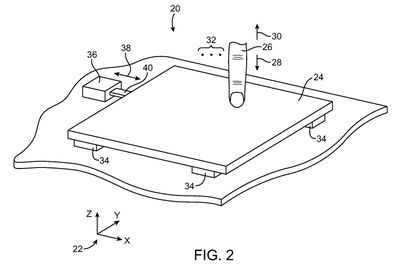
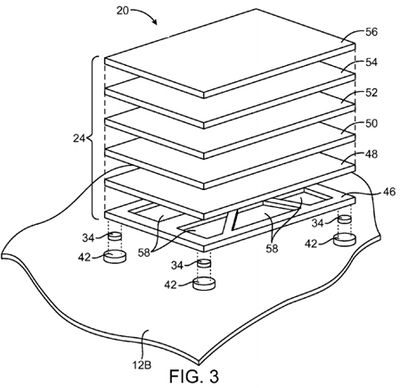
Apple today was awarded U.S. Patent No. 8,633,916 (via AppleInsider), which describes a touchpad that utilizes force sensors and acuator feedback. The buttonless design uses an array of sensors and an actuator to mimic the function and tactile feedback of the current trackpad found in the company's MacBook product lines.
trackpad-patent
Currently, Apple's trackpad technology is based on an integrated button design. Surface touch sensors track the movement of fingers and a hinged button allows the trackpad to click when a user presses down on it. A switch located under the trackpad is actuated when a click pivots the trackpad downward on its rear hinge. The pivoting motion of this button makes it difficult to click near the rear edge of the trackpad and requires extra space within the chassis of the notebook.

In the newly awarded patent, which was filed in December 2009, Apple builds upon its current design by using a surface touch sensor and four corner force sensors to track finger movement and clicking input from the user. An actuator would be used to provide tactile feedback. Also similar to the current trackpad, a buttonless trackpad may have user-customizable settings that adjust the sensitivity levels for the click pressure or the tactile feedback.
apple_trackpad14_3

In addition to processing touch sensor signals to determine the location of touch events, signals from the force sensors may be processed. A rectangular touch pad may have four corners. Force sensors may be mounted under each of the four corners. When a user presses on the surface of the touch pad, the force sensors may pick up four corresponding independent force signals.

Tactile feedback may be provided using an actuator. The actuator may be controlled by actuator drive signals. As a user of an electronic device interacts with the touch pad, the user may make gestures and perform other touch-related tasks. When the user desires to select an on-screen object or perform other tasks of the type traditionally associated with button actuation events, the user may press downwards against the surface of the track pad. When sufficient force is detected, appropriate action may be taken and drive signals may be applied to the actuator. The actuator may impart movement to the touch pad.

Whether Apple chooses to incorporate this new trackpad technology or not is unknown, but a move to do so would make sense considering that Apple's multi-touch trackpad debuted with the MacBook Air in 2008, and has made its way to every MacBook since then. But given the fact that it has been over four years since the patent's filing, Apple may simply have abandoned the proposed design for unknown reasons.
Related Roundups: MacBook Pro, MacBook Air
Tag: Patent
Related Forums: MacBook Pro, MacBook Air

Popular Stories

iPhone 18 Pro Deep Red Feature

iPhone 18 Pro Launching Later This Year With These 12 New Features

Wednesday March 18, 2026 7:39 am PDT by
While the iPhone 18 Pro and iPhone 18 Pro Max are not expected to launch for another six months or so, there are already plenty of rumors about the devices. It was initially reported that the iPhone 18 Pro models would have fully under-screen Face ID, with only a front camera visible in the top-left corner of the screen. However, the latest rumors indicate that only one Face ID component...
Apple Logo Sketch Feature

Apple Has Now Unveiled Eight New Products This Month

Tuesday March 17, 2026 9:25 am PDT by
Apple has unveiled a whopping eight new products so far this March, including an iPhone 17e, iPad Air models with the M4 chip, MacBook Air models with the M5 chip, MacBook Pro models with M5 Pro and M5 Max chips, an updated Studio Display, a higher-end Studio Display XDR, and now the AirPods Max 2 this week. iPhone 17e features the same overall design as the iPhone 16e, but it gains Apple's...
ios 26 4 yellow

Here Are Apple's Release Notes for iOS 26.4

Wednesday March 18, 2026 11:56 am PDT by
Apple provided developers and public beta testers with the release candidate versions of iOS 26.4 and iPadOS 26.4, which means we're going to see a public launch as soon as next week. The RC versions of the software include Apple's official release notes, giving us final details on what's included in the update. Apple Music - Playlist Playground (beta) generates a playlist from your...

Top Rated Comments

dannys1 Avatar
159 months ago
Is anyone on this forum capable of reading, or just moaning?

It explains quite clearly that when you press down it would still function and feel a button now you miserable sods.

The benefit is that they can remove the dated hinge mechanism which makes more power for good things and you'll be able to click at both the bottom AND the top of the trackpad...basically its like now, but better.

Its not rocket science to read and understand.
Score: 17 Votes (Like | Disagree)
159 months ago
But I like buttons...
Score: 11 Votes (Like | Disagree)
roadbloc Avatar
159 months ago
No thanks. I like my buttons. Never been a huge fan of touch. Trackpads are fine, but without two buttons for clicking, I'm out. And no doubt living in the past. :(
Score: 10 Votes (Like | Disagree)
159 months ago
I don't know if I would like this. I almost always use the click as opposed to the tap
Score: 8 Votes (Like | Disagree)
159 months ago
A TrackPad without a button definitely seems like a good idea. I changed my settings to 'tap to click' practically on day 1 because it's much easier and quicker

Same here, it works perfectly fine for me. IMO Trackpads don't need a button anymore - a one- or two-finger tap is enough.

But i also think that we don't need force sensors and acuator feedback in the trackpad - but Apple will prove me wrong :p
Score: 4 Votes (Like | Disagree)
159 months ago
I can't remember a single instance of a patent filing revealing an upcoming Apple product's feature. Could you guys point me to some recent one that turned out to be true?
Score: 4 Votes (Like | Disagree)