After being found guilty in federal court of conspiring to artificially inflate e-book prices, legal experts are estimating that Apple could owe as much as $500 million in damages.
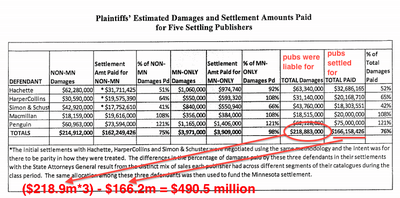
GigaOm has shared a chart provided to the federal judge in the case by the Texas attorney general. It shows how much in damages the five publishers have been found liable and how much they have paid in settlements. The remainder -- after damages have been trebled for willful violations -- works out to roughly $500 million.
The chart shows that the publishers have paid out over $166 million so far. Earlier this month, a lawyer from Hagens Berman — the class action firm in the case — told my colleague Jeff Roberts that Apple would likely face a liability payment of harm to consumers times three, minus the $166 million already paid out by publishers. On Wednesday, Law360 reported (paywall) the same thing, calculating that if Apple loses its appeal it would face about $490 million in damages. I annotated the chart above with those figures.
Apple has indicated that it will appeal the guilty ruling and it's likely that it will be many months or even years before the case is resolved.
Bloomberg's Mark Gurman has high expectations for Apple's first foldable iPhone.
In his Power On newsletter today, he said the foldable iPhone will be "the most significant overhaul in the iPhone's history."
"iPhone 4, iPhone 6 and iPhone X were clearly a big deal, but this is a whole new design," he said.
Like Samsung's Galaxy Z Fold 7, the foldable iPhone will reportedly open up like ...
March has been an incredibly busy month for Apple, with the company unveiling more than 10 new products and accessories. We said hello to the MacBook Neo at the start of the month, and we bid farewell to the Mac Pro at the end of it.
Nevertheless, there is still a lot more to come this year.
Beyond the usual annual updates to iPhones and Apple Watches, Apple's all-new smart home hub is...
Saturday March 28, 2026 8:00 am PDT by Joe Rossignol
Apple is expected to release two new iPhone apps this year, including an Apple Business app and a Siri app with chatbot-like functionality.
With the Apple Business app, employees at businesses using the new Apple Business platform will be able to install apps for work, view contact information for colleagues, and request support. Apple Business is launching on April 14, and it replaces Apple ...
This sounds like 'rob the rich' since they have the money...
Nah. Apple was really trying to scam us all into paying higher prices. It wasn't an accident that ebook prices went from a generally standard $10 to whatever the hell the publishers wanted when the iPad came around.
What I don't get is why in the original case part of their defense didn't include pointing out the Amazon was illegally selling ebooks below cost as an anti-competitive move, and that their model put a stop to that, which is why prices went up.
Actually, it is not illegal to sell books below cost. It may or may not be a smart business move, but it's not illegal.
What is illegal however is selling something (in this case books) at a set price and telling the manufacturer (in this case the publishers) that they can't let anyone else sell it for a lower price. This is what Apple was doing and why they should definitely be considered guilty.
Many gas stations tried something similar about 10 years ago and were fined for it. Retailers have tried this before and didn't get away with it. Why should Apple be let off the hook?
What I don't get is why in the original case part of their defense didn't include pointing out the Amazon was illegally selling ebooks below cost as an anti-competitive move, and that their model put a stop to that, which is why prices went up.


 After being found guilty in federal court of conspiring to artificially inflate e-book prices, legal experts are estimating that Apple could owe as much as $500 million in damages.