Apple's Reorganization Goes Deeper Than Just Who's In Charge

Former Apple employee Matt Drance has an interesting take on yesterday's executive shakeup at Apple. He notes that the new division of responsibilities across three top executives is a sea change from how Apple has traditionally operated.
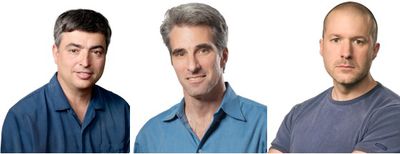
Not only is this a profound increase in responsibility for all three of these top executives, it’s a profound change in Apple’s organization going as far back as I can remember. There’s a long-standing pattern of separating watershed products important to the company’s future. The Mac and Apple teams. Mac OS X and Classic. The iPod division. iOS and Mac OS X. Suddenly, Tim Cook has pulled the reins in. Federighi owns software. Ive owns design. Cue owns services. Period.
Instead of separating products into different teams, Tim Cook has now divided responsibility for completing products across three separate divisions, each headed by a long-time Apple executive. All three divisions will be required to work together in order to finish and ship anything, necessitating increased collaboration and perhaps consistency across the company.
Om Malik has another take on why Apple's products -- in particular those in Scott Forstall's charge -- have faltered a bit in the past few years: releasing a product based on a schedule, rather than releasing it when it's finished.
The time-based schedule is one of the reasons why Siri and Maps arrived as half-baked products and were met with derision. Many engineers inside Apple could foresee problems with Maps. Why? Because Maps were driven by a time schedule.
Maps and Siri are complex products whose dependencies (for the lack of a better word) go deep into different parts of the phone and even the network. The schedule-driven release culture makes folks less daring — why take arrows in your back for failing to deliver a radical new feature on a pre-dictated time? If this cultural warp continues, Apple might have a bigger headache on its hands. Ive’s appointment as the Human Interface honcho means that more risk-taking needs to come into the products.

Popular Stories
Apple is about to release iOS 26.2, the second major point update for iPhones since iOS 26 was rolled out in September, and there are at least 15 notable changes and improvements worth checking out. We've rounded them up below.
Apple is expected to roll out iOS 26.2 to compatible devices sometime between December 8 and December 16. When the update drops, you can check Apple's servers for the ...
Intel is expected to begin supplying some Mac and iPad chips in a few years, and the latest rumor claims the partnership might extend to the iPhone.
In a research note with investment firm GF Securities this week, obtained by MacRumors, analyst Jeff Pu said he and his colleagues "now expect" Intel to reach a supply deal with Apple for at least some non-pro iPhone chips starting in 2028....
A U.S. appeals court has upheld a temporary restraining order that prevents OpenAI and Jony Ive's new hardware venture from using the name "io" for products similar to those planned by AI audio startup iyO, Bloomberg Law reports.
iyO sued OpenAI earlier this year after the latter announced its partnership with Ive's new firm, arguing that OpenAI's planned "io" branding was too close to its...
Apple's iPhone development roadmap runs several years into the future and the company is continually working with suppliers on several successive iPhone models at the same time, which is why we often get rumored features months ahead of launch. The iPhone 18 series is no different, and we already have a good idea of what to expect for the iPhone 18 Pro and iPhone 18 Pro Max.
One thing worth...
In a statement shared with Bloomberg on Wednesday, Apple confirmed that its software design chief Alan Dye will be leaving. Apple said Dye will be succeeded by Stephen Lemay, who has been a software designer at the company since 1999.
Meta CEO Mark Zuckerberg announced that Dye will lead a new creative studio within the company's AR/VR division Reality Labs.
On his blog Daring Fireball,...
There is uncertainty about Apple's head of hardware engineering John Ternus succeeding Tim Cook as CEO, The Information reports. Some former Apple executives apparently hope that a new "dark-horse" candidate will emerge.
Ternus is considered to be the most likely candidate to succeed Cook as CEO. The report notes that he is more likely to become CEO than software head chief Craig Federighi, ...
Apple is expected to launch a new foldable iPhone next year, based on multiple rumors and credible sources. The long-awaited device has been rumored for years now, but signs increasingly suggest that 2026 could indeed be the year that Apple releases its first foldable device.
Subscribe to the MacRumors YouTube channel for more videos.
Below, we've collated an updated set of key details that ...
Apple is encouraging iPhone users who are still running iOS 18 to upgrade to iOS 26 by making the iOS 26 software upgrade option more prominent.
Since iOS 26 launched in September, it has been displayed as an optional upgrade at the bottom of the Software Update interface in the Settings app. iOS 18 has been the default operating system option, and users running iOS 18 have seen iOS 18...
Apple today seeded the release candidate versions of upcoming iOS 26.2 and iPadOS 26.2 updates to developers and public beta testers, with the software coming two weeks after Apple seeded the third betas. The release candidates represent the final versions of iOS 26.2 and iPadOS 26.2 that will be provided to the public if no further bugs are found during this final week of testing....
2026 could be a bumper year for Apple's Mac lineup, with the company expected to announce as many as four separate MacBook launches. Rumors suggest Apple will court both ends of the consumer spectrum, with more affordable options for students and feature-rich premium lines for users that seek the highest specifications from a laptop.
Below is a breakdown of what we're expecting over the next ...