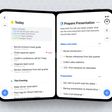
Demonstration of iPad User Guide utilizing 'AdLib' framework
Done21 reports on the curious discovery of a new Web-based framework used in the iPad that allows web pages to behave in ways much more akin to native applications than previously observed. The framework, dubbed 'AdLib' by the report's author after the name of the file containing the code, was first noticed in action when navigating to Apple's iPad User Guide using the iPad's mobile version of Safari. It allows the user guide, which is simply a web page, to be offered in a split-pane view with scrollbars and with a native app-like feel.
What's particularly interesting is that it does something that shouldn't really be possible in Mobile Webkit: It includes scrolling panes that can be manipulated with a single finger, complete with the signature iPhone OS "scroll bars" and elastic transitions. If you have ever worked with Safari on the iPhone, you know that having scrolling boxes of content is sort of possible, but requires a special two-finger gesture to scroll.
Curiosity got the best of me, so I loaded the page in Safari on my laptop (and changed Safari's user agent to mimic the iPad) and got to work with the developer tools. After extracting the JavaScript and de-minifying it, my suspicions were confirmed. Apple was manually reading the touch events, calculating the inertia of the scrolling, and manually drawing the scroll bars. It was incredible that it worked so smoothly in the browser.
The framework, which weighs in at about 4,300 lines of code, permits Mobile Safari to display the native-like user guide simply using HTML, CSS, JavaScript, the basic web technologies supported by the iPhone and iPad. It appears similar in some respects to the PastryKit framework described by John Gruber last December, although AdLib appears to be a more advanced version that incorporates iPad-specific references.
It remains to be seen whether Apple will release the custom API for use by third-developers, but despite an absence of documentation, the report notes that the framework is "extremely well thought out and complete" and could be of significant utility to developers.
Update: For those interested in the actual code, a commented version has been discovered on Apple's developer site.