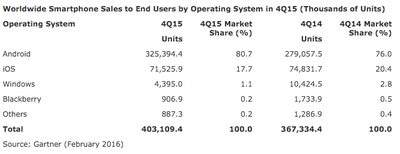
The latest numbers from research firm Gartner reveal that the smartphone industry continues to be largely a two-horse race between iOS and Android. The two mobile operating systems combined for 98.4 percent worldwide market share in the fourth calendar quarter of 2015, compared to 96.4 percent in the year-ago quarter.
Android remained the world's most widely used smartphone operating system with 80.7 percent market share, while iOS recorded 17.7 percent market share. The fourth quarter has historically been the most successful for iPhone and Android-based smartphone sales due to the holiday shopping season.
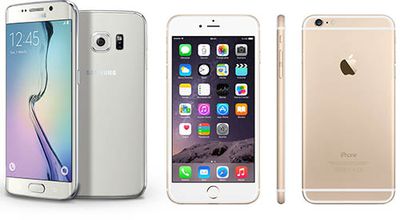
Apple and Samsung shipped a collective 551.2 million smartphones in 2015, trailed by Huawei, Lenovo-Motorola, and Xiaomi with 107.1 million, 73.9 million, and 72 million shipments respectively, according to recent Strategy Analytics data. Global smartphone shipments totaled a record 1.44 billion in 2015.
Windows Phone was perhaps the closest platform to being a true third place competitor, but its market share has dwindled as iOS and Android continue to grow. Samsung and Mozilla also have Linux-based mobile operating systems in Tizen and Firefox OS respectively, but adoption of each platform is comparatively slim.

Saturday February 7, 2026 9:26 am PST by Joe Rossignol
Apple today shared an ad that shows how the upgraded Center Stage front camera on the latest iPhones improves the process of taking a group selfie.
"Watch how the new front facing camera on iPhone 17 Pro takes group selfies that automatically expand and rotate as more people come into frame," says Apple. While the ad is focused on the iPhone 17 Pro and iPhone 17 Pro Max, the regular iPhone...
Monday February 9, 2026 6:24 am PST by Joe Rossignol
In select U.S. states, residents can add their driver's license or state ID to the Apple Wallet app on the iPhone and Apple Watch, and then use it to display proof of identity or age at select airports and businesses, and in select apps.
The feature is currently available in 13 U.S. states and Puerto Rico, and it is expected to launch in at least seven more in the future.
To set up the...
Tuesday February 10, 2026 4:27 pm PST by Juli Clover
Apple is planning to launch new MacBook Pro models as soon as early March, but if you can, this is one generation you should skip because there's something much better in the works.
We're waiting on 14-inch and 16-inch MacBook Pro models with M5 Pro and M5 Max chips, with few changes other than the processor upgrade. There won't be any tweaks to the design or the display, but later this...
Wednesday February 11, 2026 10:07 am PST by Juli Clover
Apple today released iOS 26.3 and iPadOS 26.3, the latest updates to the iOS 26 and iPadOS 26 operating systems that came out in September. The new software comes almost two months after Apple released iOS 26.2 and iPadOS 26.2.
The new software can be downloaded on eligible iPhones and iPads over-the-air by going to Settings > General > Software Update.
According to Apple's release notes, ...
Tuesday February 10, 2026 6:33 am PST by Joe Rossignol
It has been a slow start to 2026 for Apple product launches, with only a new AirTag and a special Apple Watch band released so far. We are still waiting for MacBook Pro models with M5 Pro and M5 Max chips, the iPhone 17e, a lower-cost MacBook with an iPhone chip, long-rumored updates to the Apple TV and HomePod mini, and much more.
Apple is expected to release/update the following products...
Not sure what those entities have to do with this thread.
You said consumers should care about profits, and I'm guessing when your electric bill, gas bill, cell bill, interest rate etc goes up, you aren't cheering the companies on because they are making a good profit.
iOS and Android Capture Combined 98.4% Share of Smartphone Market
Interesting language in the title.
Really, it should read something like "Apple secures just 17.7% of market, down from 20.4%" or "Apple's smartphone market share declines to 17.7%". But by lumping Apple in with Android, MacRumors are trying to make it all sound positive for Apple.
Microsoft could use the same logic by saying "iOS, Android and Windows Phone capture combined 99.5% share of smartphone market"
No mention of the fact that Windows is at 87%. No mention of the fact that various Linuxes and Unixes make up another 2% or so.
But when we talk about iOS, it's important to talk about the market share that everyone else has, and the fact that iOS + Android make up 98% of the market, even though nearly identical statements could be said about OS X and Windows. [doublepost=1455811689][/doublepost] That's because Microsoft has thrown in the towel. They're now putting their services on Android and iOS devices.
Although I feel that the move was premature. I feel like they could really use laptops running Windows 10 to sell Surface products, which could then be used to sell Windows 10 Phones.
My view is that Microsoft really screwed up and had a great chance to come up with a third alternative system that would have had great leverage in taking advantage of Windows 10. Instead, they are short sighted and only playing with others.