Apple Releases iTunes 10.4 As 64-Bit Cocoa App For Lion
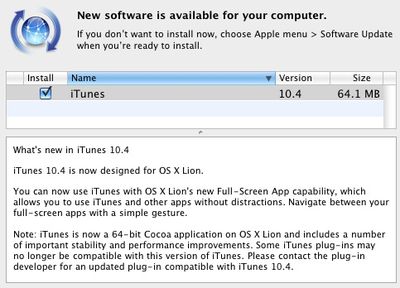
Apple this morning released iTunes 10.4 with support for Lion's Full-Screen Apps feature and, more importantly, iTunes is now a 64-bit Cocoa application under Lion.
You can now use iTunes with OS X Lion's new Full-Screen App capability, which allows you to use iTunes and other apps without distractions. Navigate between your full-screen apps with a simple gesture.
Note: iTunes is now a 64-bit Cocoa application on OS X Lion and includes a number of important stability and performance improvements. Some iTunes plug-ins may no longer be compatible with this version of iTunes. Please contact the plug-in developer for an updated plug-in compatible with iTunes 10.4.
After WWDC last month, Apple released a beta of iTunes 10.5 that was 64-bit, but it seems we don't have to wait for 10.5 to take advantage of the feature:
The primary advantage afforded 64-bit applications is the ability to address more than 4GB of memory which can be a distinct advantage for applications which use large data sets. Adobe, for example, received some criticism in 2008 that their Photoshop products were slow to adopt 64-bit mode on the Mac. 64-bit Photoshop for Mac ultimately arrived with CS5.
The reason for the long delay was the fact that Apple dropped support for 64-bit mode in Carbon back in 2007, requiring developers to port their existing Carbon applications to Cocoa in order to take advantage of 64-bit mode. This primarily affected older applications such as Photoshop and iTunes which had existed prior to Mac OS X and were still using Carbon, Apple's legacy API. Meanwhile, Cocoa was Apple's native API for Mac OS X and offered some additional user interface advantages. For better or worse, many users saw Cocoa applications as superior to their Carbon counterparts due to historic baggage of many of the Carbon applications.
64-bit support only exists in Lion; iTunes remains a 32-bit application under Snow Leopard.
Popular Stories
Apple is planning to launch new MacBook Pro models as soon as early March, but if you can, this is one generation you should skip because there's something much better in the works.
We're waiting on 14-inch and 16-inch MacBook Pro models with M5 Pro and M5 Max chips, with few changes other than the processor upgrade. There won't be any tweaks to the design or the display, but later this...
Wednesday February 11, 2026 10:07 am PST by
Juli CloverApple today released iOS 26.3 and iPadOS 26.3, the latest updates to the iOS 26 and iPadOS 26 operating systems that came out in September. The new software comes almost two months after Apple released iOS 26.2 and iPadOS 26.2.
The new software can be downloaded on eligible iPhones and iPads over-the-air by going to Settings > General > Software Update.
According to Apple's release notes, ...
It has been a slow start to 2026 for Apple product launches, with only a new AirTag and a special Apple Watch band released so far. We are still waiting for MacBook Pro models with M5 Pro and M5 Max chips, the iPhone 17e, a lower-cost MacBook with an iPhone chip, long-rumored updates to the Apple TV and HomePod mini, and much more.
Apple is expected to release/update the following products...
Apple plans to announce the iPhone 17e on Thursday, February 19, according to Macwelt, the German equivalent of Macworld.
The report said the iPhone 17e will be announced in a press release on the Apple Newsroom website, so do not expect an event for this device specifically.
The iPhone 17e will be a spec-bumped successor to the iPhone 16e. Rumors claim the device will have four key...
Apple acquired Canadian graph database company Kuzu last year, it has emerged.
The acquisition, spotted by AppleInsider, was completed in October 2025 for an undisclosed sum. The company's website was subsequently taken down and its Github repository was archived, as is commonplace for Apple acquisitions.
Kuzu was "an embedded graph database built for query speed, scalability, and easy of ...