MacRumors

Microsoft yesterday launched a Windows 7 campaign website announcing a discount program aimed at college and university students, bringing the cost of Windows 7 Home Premium or Professional for eligible customers down to $29.99 to effectively match Apple's Mac OS X Snow Leopard pricing. The offer, which expires January 3rd, 2010 is valid for the download version of Windows 7, and users wishing to purchase a physical disk will be required to pay an additional $13.00.

- You qualify if you have a valid .EDU e-mail OR an e-mail address through one of the educational institutions listed here.
- You are enrolled in coursework, current proof or enrollment may be required in the United States.
- Your PC is able to run Windows 7 - use this tool to check. THIS IS VERY IMPORTANT!

Microsoft's full terms and conditions note that students must be actively enrolled in at least 0.5 course credits at the time of purchase and may be required to provide proof of enrollment. As noted on the Windows 7 Team Blog, pre-orders are available in the US immediately, with the UK to follow on September 30th. Students in Australia, Canada, France, Germany, Korea and Mexico will be able to take advantage of the program once Windows 7 launches on October 22nd.

At its October 22nd launch, Windows 7 will carry much higher non-promotional prices of $119.99 (upgrade) and $199.99 (full) for the Home Premium edition, $199.99 (upgrade) and $299.99 (full) for the Professional edition, and $219.99 (upgrade) and $319.99 (full) for the Ultimate edition. A comparison of the various versions is available to assist customers in deciding which version is right for them.

The Register reports that some high-profile iPhone app developers can simply call a dedicated contact at Apple to get assistance with App Store issues.

Mike Simon, CEO of LogMeIn, describes that a representative at Apple had recently called the company and offered to be a single point of contact for any App Store-related issues. Simon stated, "We now have a number we can call to ask questions."

LogMeIn is the developer of an app that offers one-click remote control of a Mac or PC from an iPhone. Available in the App Store for $29.99 [App Store], it has been featured in Apple's print and television ads promoting the App Store.

Simon also mentioned that he is aware of one other developer with similar access to App Store support, but declined to name this developer.

This type of direct and personalized access to App Store developer support is a distinct departure from the experiences of other developers who have made public their trials and tribulations in getting information from Apple on the app approval process. Tapbots is one developer who recently encountered problems with their Convertbot app [App Store], experiencing a rejected update over an icon that was too similar to one used by Apple in its own apps. Blunder Move is another developer who experienced similar issues over "shiny chat bubbles" within their Chess Wars app, and the large amount of press coverage the developer's blog post about this problem received may have been a factor in Apple's move to make direct contact with the developer to resolve the issue.

Apple's response to the FCC after its inquiry into the purported rejection of the Google Voice app specified that there are "40 full-time trained reviewers" and that "at least two different reviewers study each application so that the review process is applied uniformly." It is not known if the dedicated contact reportedly available to LogMeIn is part of this staff.

Related Forum: iPhone

The Wall Street Journal today announced that it will begin charging for mobile access to its news content as of October 24th. While mobile applications such as the WSJ's iPhone application [App Store] will remain free of charge and will offer free access to selected content, full access will require a weekly subscription fee.

Beginning Oct. 24, the WSJ Mobile Reader application, currently available on BlackBerry smartphones and Apple iPhone and iPod touch devices, will require a separate mobile subscription for full access to Journal subscription content. The application itself will remain free to download and contain both free and subscription content, emulating the experience found on WSJ.com.

Users who currently subscribe to both the print and online versions of The Wall Street Journal will continue to have free access to mobile content, but other users will be required to pay fees in order to access the majority of content. Users with either an existing online or print subscription to The Wall Street Journal will be required to pay $1.00 per week for mobile access, while those with no other subscriptions will be charged $2.00 per week. Users who register prior to the October 24th launch will receive a 90-day extension of no-fee access.

In addition to the new subscription offering, several new features will be added to the WSJ Mobile Reader, including advanced save and share functions, enhanced market data, stock tracking and personalization capabilities.

"Our new mobile subscription model will enable us to continue to invest in the world's most essential news content and deliver it to our subscribers wherever and whenever they want it," said Gordon McLeod, president of The Wall Street Journal Digital Network. "This transition also reinforces the value of our content on mobile, just as we've done online for more than a decade."

Related Forum: iPhone

CNET reports that a coalition of music groups including publishers, songwriters, and composers is looking to increase the compensation they receive from digital distribution of their work. Having been unsuccessful at negotiating increased fees with distributors such as Apple, the groups, which include the American Society of Composers, Authors and Publishers (ASCAP) and Broadcast Music Inc. (BMI) among others, have begun lobbying the U.S. Congress for to pass legislation to address their claims.

At a time when many iTunes shoppers are still fuming over Apple's first-ever increase in song prices, the demands by the American Society of Composers, Authors and Publishers (ASCAP), Broadcast Music Inc. (BMI), and other performing-rights groups, would likely lead to more price hikes at iTunes. This would also undoubtedly confirm the perception held by many that those overseeing the music industry are greedy.

At the heart of the issue is the "performance fee", a type of licensing fee used to compensate composers and publishers when their work is performed in public. The music groups argue that digital distribution of their work, including 30-second song samples and in TV and movie downloads such as those found on iTunes, constitutes public performance and thus requires performance fees to be paid by the distributors.

Apparently, the music industry can't obtain the fees through negotiations. They have begun lobbying Congress to pass legislation that require anyone selling a download to pay a performance fee, according to David Israelite, president and CEO of the National Music Publishers Association.

"If you watch a TV show on broadcast, cable or satellite TV there is a performance fee collected," Israelite said. "But if that same TV show is downloaded over iTunes, there's not. We're arguing that the law needs to be clarified that regardless of the method by which a consumer watches the show there is a performance right."

The issue is complicated by the existence of other fees such as upfront "synchronization fees" that cover inclusion of songs in film or TV shows. Those fees are typically supplemented by performance fees when the film or TV shows are aired, although many composers have given away their synchronization fee rights in hopes of obtaining performance fees further down the road, but as the landscape has begun shifting to digital distribution, those composers are finding themselves with shrinking performance fee income.

"This is really a fight about the future," Israelite said. "As more and more people watch TV or movies over an Internet line as opposed to cable or broadcast signal, then we're going to lose the income of the performance. For people who do production and background music, that's how they make their living."

On the topic of 30-second music samples, Jonathan Potter, executive director of the Digital Media Association that represents distributors such as Apple, argues that copyright law protects distributors from being charged performance fees for such offerings.

"They are picking on Apple because they say Apple is making a bundle of money," Potter said. "But these companies should be thrilled that Apple and the other services are selling music and generating millions, maybe tens of millions, in royalties."

The music groups have so far had little success in their lobbying efforts with Congress, and courts have consistently sided with digital distributors in their claims that downloaded songs are not considered public performances. Composers and publishers have not, however, given up the fight.


Related Forum: Mac Apps

According to market research firm NPD, Apple's Mac OS X Snow Leopard has seen very strong sales thus far, having sold more than twice as many copies during its first two weeks on the market as Mac OS X Leopard did in late 2007. Early sales of Snow Leopard also exceed those of 2005's Mac OS X Tiger by nearly four times.

"Even though some considered Snow Leopard to be less feature-focused than the releases of Leopard or Tiger, the ease of upgrading to Snow Leopard and the affordable pricing made it a win-win for Apple computer owners - thus helping to push sales to record numbers" said Stephen Baker, vice president of industry analysis at NPD.

The report notes that Snow Leopard generated significant sales momentum, with sales dropping only 25% from week 1 to week 2. Leopard and Tiger reportedly experienced approximately 60% drops in sales numbers in their second weeks on the market.

Research analyst Gene Munster had previously estimated that Apple would sell approximately five million copies of Snow Leopard during its launch quarter, which ends later this month. Given that Apple sold over two million copies of Leopard in just its first weekend, NPD's data suggests that Apple should easily reach Munster's target.

CNET reports that GPS firm Navigon will be releasing a new feature for its MobileNavigator North America [App Store, $89.99] iPhone application that will add live traffic data to assist users in plotting routes. The add-on will be available beginning next month as a one-time $24.99 in-app purchase, although it will be discounted to $19.99 for the first four weeks of availability.

According to Navigon, the new Traffic Live feature will provide precise traffic information by using real-time speed data from over 1 million drivers across North America, including commercial fleets such as trucks and taxis, as well as regular drivers with GPS systems. The feature also uses information from traffic cameras, speed sensors, and conventional traffic messages coming through a radio network.

Navigon, which launched its North American iPhone application in late July, and has offered several updates since that time. The most recent update to MobileNavigator North America, released just last week, adds support for full text-to-speech and integrated iPod controls, as well as several other features.

Related Forum: iPhone

Hardmac reports on a performance comparison between Mac OS X Leopard and Mac OS X Snow Leopard from Christophe Ducommun, developer of MovieGate, a video encoding and DVD creation software package. Ducommun, who is optimizing his application to take advantage of the Grand Central Dispatch and Open CL features of Snow Leopard, has found remarkable performance improvements for his software on the operating system when running on a Mac Pro.

Christophe Ducommun who keeps optimizing Snow Leopard for his application MovieGate just sent us results to illustrate how Snow Leopard can improve performance when one can make use of Grand Central and Open CL. Tests below have been performed with a Mac Pro 2007 (Quad Core 2.66 GHz with a GeForce 8800 GT).

The results include an approximately 50% increase in video encoding speed when compared to Leopard, while also reducing the CPU load during video decoding by passing some of the work to the graphics processing unit.

Snow Leopard
150 frame/s for encoding in MPEG-2
70% CPU load for decoding
130% CPU load for MPEG-2 encoding (ffmpeg)

Leopard
104 frame/s for encoding in MPEG-2
165% CPU load for decoding
100% CPU load for MPEG-2 encoding (ffmpeg)

While Ducommun's experience is relatively rare at this point due to the inability for the vast majority of applications to make such comprehensive use of Grand Central Dispatch and Open CL at this time, it highlights the potential performance gains these core technologies can bring to Mac OS X as developers begin to take advantage of them.

Chip design firm ARM today announced the development of two dual-core chip designs based on the company's Cortex-A9 platform. Implementations of the new chip designs, which will deliver performance in excess of 2 GHz while drawing less than 0.25 W of power per CPU, will be available in the fourth quarter of this year.

The Cortex-A9 speed-optimized hard macro implementation will provide system designers with an industry standard ARM processor incorporating aggressive low-power techniques to further extend ARM's performance leadership into high-margin consumer and enterprise devices within the power envelope necessary for compact, high-density and thermally constrained environments. This hard macro implementation operates in excess of 2GHz when selected from typical silicon and represents an ideal solution for high-margin performance-oriented applications.

ARM is positioning the chip design for use in such consumer electronics devices as set-top boxes, digital TVs, and printers, although it has been claimed in the past that the chips would be appropriate for mobile platforms and would appear in those devices in 2010.

The iPhone 3GS utilizes a Cortex-A8-based processor from Samsung, suggesting that the Cortex-A9 could be a natural fit for the next-generation iPhone, although the thermally-constrained environment and energy requirements of the iPhone would likely dictate that the chip be underclocked as has been done for several iPhone and iPod touch models.

Apple, which acquired ARM chip design firm P.A. Semi in April 2008, has been rumored to be working on its own ARM-based chip designs for both the iPhone and the much-anticipated Apple tablet, and the introduction of dual-core Cortex-A9 processors would offer the company additional computing power and energy-saving options upon which to base its device designs.

Related Forum: iPhone

Tech Trader Daily reports on a note to clients from research firm Wedge Partners predicting the release of updated iMac and MacBook models within the next several weeks. The refresh is expected to bring a significant redesign to the iMac, while the MacBook is likely to see only limited enhancements on the design front.

Wedge sees a redesigned iMac witjh a "thinner, organic design, likely with smoothed or rounded edges. The MacBook redesign "is likely to be limited," Wedge asserts.

The note also suggests that the updates will bring lower price tags in order to aggressively compete against Windows 7-based PCs and the low-cost netbook segment.

Wedge Partners' report echoes previous claims suggesting that Apple is working on refreshed iMac and MacBook designs to be accompanied by lower price points later this year, but is the first to point to a release window for the new models in the very near future.

Related Roundup: iMac
Buyer's Guide: iMac (Don't Buy)
Related Forums: iMac, MacBook

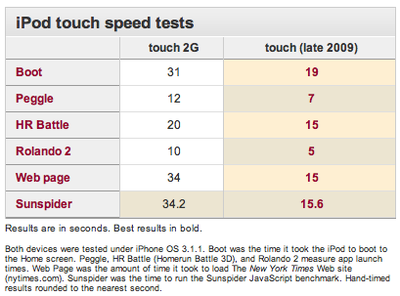
At Apple's "It's Only Rock and Roll" media event last week, the company introduced new iPod touch models with 32 GB and 64 GB capacities, advertising the devices as offering "up to 50 percent faster performance". Macworld has performed speed tests comparing the new iPod touch to the previous-generation model, and found that on a number of tasks the new model does meet or exceed Apple's performance claims.

160605 ipod touch speed tests

The speed tests conducted were similar to ones run in June on the iPhone 3GS, and while the new iPhone running Apple's just-released iPhone OS 3.1 was not included in the latest comparison, the new iPod touch appears to even be slightly faster at some tasks than the iPhone 3GS.

But it's not just in benchmarks such as these where the new iPod wins out. Just as the iPhone 3GS was faster than the iPhone 3G at everything, the new iPod touch feels much faster at any task you throw at it: applications launch (and quit) faster, Web pages load more quickly, processor-intensive games and programs perform better -- you name it.

We'll be testing the latest iPod touch's performance -- compared to both the previous touch and the iPhone 3GS -- for our official review, but it's clear that Apple has beefed up its newest touchscreen device.

Related Forum: iPod touch and iPod

HP today introduced the MediaSmart EX490 and EX495 home servers, offering upgraded features and greater Mac compatibility for the company's line of cross-platform home servers that received significant praise at Macworld Expo earlier this year.

HP today launched the HP MediaSmart EX490 and EX495 Home Servers, new models offering increased capacity, high-performance processors, more control, new user interface and additional Mac support - all at a lower price.

Based on the Microsoft Windows Home Server platform, the updated HP MediaSmart Servers have a refined user interface and a web-based home page that makes accessing and using the server easier than ever. Additionally, the new models offer a new video converter with custom settings and profiles that will automatically convert video libraries, including unprotected DVDs.

HP has addressed several shortcomings of the previous versions of the server line, adding server administration, media collection, and "bare metal" Time Machine data recovery for Macs. MediaSmart Home offers an overview of the new Mac-related features alongside a thorough overall review of the new servers, finding them a significant update to HP's already-solid MediaSmart home server line.

The new EX490 and EX495 also support the free HP MediaSmart Server iStream iPhone application introduced in April to allow iPhone and iPod touch users to stream media to their handheld devices.

Pre-orders for the new HP MediaSmart Server models are available beginning today with suggested retail pricing beginning at $549 for the EX490 with a Celeron processor and a single 1 TB hard drive and $699 for the EX495 with an upgraded dual-core 2.5 GHz Pentium processor and a single 1.5 TB hard drive. Additional hard drive capacity up to 7 TB (internal) or 17 TB (internal plus external) is supported.

Microsoft today announced that it has begun shipping Office 2008 for Mac Business Edition, replacing the previous Standard Edition and Special Media Edition with a single package offering the complete Office suite with support for Microsoft Exchange included.

The new Office 2008 for Mac Business Edition is a lot like it sounds... a suite that's packed with tools and features needed to grow and manage a business. It has all the familiar Office applications (Word, Excel, PowerPoint, Entourage, all updated with Service Pack 2) while including new tools to provide a more complete productivity package for the enterprise:

- Entourage 2008, Web Services Edition - Provides faster data synchronization so Entourage users on Exchange 2007 will experience improved email and calendaring support. Additionally, we've added the ability to sync Tasks, Notes and Categories - one of the top customer requests - making Entourage 2008, Web Services Edition the best client for Exchange on the Mac.

- Document Connection for Mac - Improves access and browsing to documents on SharePoint Products and Technologies and Microsoft Office Live Workspace for streamlined collaboration

- Extras - More than 200 business-related templates and clip art, along with lynda.com training

Office 2008 for Mac Business Edition carries a recommended retail price of $399.95 for the full version and $239.95 for an upgrade version. The existing Microsoft Office 2008 for Mac Home and Student Edition, which offers the basic Office components but lacks a number of advanced features, continues to be offered at a suggested retail price of $149.95.

Microsoft announced the introduction of Office 2008 for Mac Business Edition last month alongside details of Outlook for Mac's inclusion in the next major version of Office scheduled for launch in late 2010.

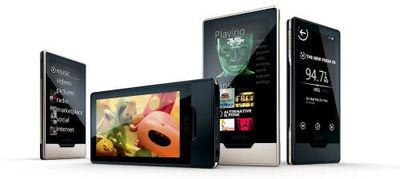
111635 zune family 500

Microsoft today officially launched the Zune HD, the company's next-generation touchscreen media player designed to compete directly against Apple's iPod touch. Originally announced in May, the Zune HD is available in 16 GB ($219.99 in black) and 32 GB ($289.99 in platinum) capacities.

Zune HD marks a significant step forward for portable media players, combining powerful hardware components such as an organic light-emitting diode (OLED) multitouch screen, an NVIDIA Tegra HD processor and HD Radio capabilities with software advancements such as the new Quickplay menu, a well-featured Web browser, and engaging music and video playback features to deliver a new portable listening and viewing experience. Quickplay is a new signature menu for Zune, putting customers one touch away from the content they love, such as favorites, last played items and media most recently added, eliminating the need to dig through menus to find the music, videos, pictures or podcasts they want.

Microsoft has also confirmed that the company will be adding games and other applications to the Zune Marketplace for use on the Zune HD.

Later this year, Zune plans to release free applications such as Twitter for Zune and Facebook for Zune, in addition to fun 3-D games such as "Project Gotham Racing: Ferrari Edition," "Vans Sk8: Pool Service" and "Audiosurf Tilt." Games can be added to Zune HD via Zune Marketplace over the Wi-Fi connection or when connected to the Zune PC software.

Wired offers a first-look review of the new device, finding it a worthy competitor to the iPod touch with solid potential, but in need of additional features such as Mac support, greater video offerings, and of course a robust application store.

Apple today announced that Bruce Sewell, former general counsel and senior vice president at Intel, will join Apple in a similar role, holding titles of General Counsel and Senior Vice President, Legal and Government Affairs. Sewell, who takes the position of the retiring Daniel Cooperman, will report directly to Apple CEO Steve Jobs.

"We are thrilled to have Bruce join our executive team, and wish Dan a very happy retirement," said Steve Jobs, Apple's CEO. "With Bruce's extensive experience in litigation, securities and intellectual property, we expect this to be a seamless transition."

Intel announced Sewell's departure yesterday alongside several other organizational changes, but provided no information on his future plans. Sewell's apparently-sudden departure raised some eyebrows given current antitrust investigations focused on Intel, but today's announcement by Apple provides reassurance regarding the circumstances of his departure.

After several quiet weeks on the tablet rumor front as it became clear that no such device would be introduced at Apple's "It's Only Rock and Roll" media event, a new report from Taiwan Economic News revives rumor discussions by claiming that Apple's tablet computer will launch in February 2010 at a price point between $799 and $999. The report also claims that the tablet will utilize a P.A. Semi-engineered processor and will contain built-in 3G wireless connectivity. A 9.6-inch touch screen and an extended-life battery round out the claimed details.

As Apple Inc. will launch its newest tablet PCs next February, a couple of Taiwanese suppliers of PC parts and components have managed to join the supply chain and will start delivery to Apple in December, according to industry sources.

The tablet PC features a 9.6-inch screen, finger-touch function and built-in HSPDA (high speed download packet access) module, and adopts a P.A. SEMI processor chip and long lasting battery pack, selling for between US$799 and US$999.

The report claims that Dynapack has won a contract to supply up to 300,000 batteries per month for the new unit and notes that Wintek, Apple's current iPhone screen supplier, will supply touchscreens for the new device.

The claims echo a previous report by Taiwanese media several months ago, although that report had pointed to an October 2009 launch for the tablet. Other reports have also pointed to an early 2010 launch, as well as the inclusion of a chip platform from P.A. Semi. The chipmaker, which was acquired by Apple in April 2008, has been rumored to have been divided into two teams: one focused on iPhone and iPod touch projects and the other working on tablet computers.

A recent report has suggested that Apple CEO Steve Jobs has been almost singularly focused on the much-rumored tablet since his return from a medical leave of absence in late June, suggesting the product may be in the final design stages after several years of fits and starts.

Silicon Alley Insider reports on data from research firm NPD showing that U.S. Mac sales were up 7% year-over-year during the months of July and August, ahead of most analysts' projections. The data, reported by Piper Jaffray analyst Gene Munster, also shows a 16% decline in year-over-year iPod sales, a performance slightly below analysts' expectations.

Munster says NPD data from July and August show Mac sales up 7% year-over-year through August, while the Street is expecting 5% year-over-year growth for the quarter.

Back-to-school sales in the first few months of the quarter probably helped, but at least Apple could handle some deceleration this month and still meet expectations. (And Apple's international growth, not represented in NPD's figures, should help, too.)

Apple noted during its most recent earning conference call that it expects the market for Apple's traditional MP3 players to decline as users increasingly opt for the company's iPod touch or iPhone models. The introduction of new video camera-equipped iPod nano models at last week's "It's Only Rock and Roll" media event, however, may provide a boost to Apple's "traditional MP3 player" segment over the last few weeks of the quarter.

Apple today released a number of updates for Xsan, the company's enterprise-class storage area network (SAN) solution. Xsan 2.2 brings support for Mac OS X Snow Leopard, as well as a number of other changes.

- Xsan 2.2 Admin Update for 10.6 (35 MB)

The 2.2 update is recommended for all systems running Xsan 2. This update includes general administration fixes for remotely administering, configuring and maintaining Xsan deployments, and includes specific fixes for:

- using SAN Setup Assistant to configure volumes, LUNs and affinities
- changing a computer between client and metadata controller roles
- listing computers connected to the SAN
- visually displaying when LUNs have been truncated

For detailed information on this update, please visit this website: http://support.apple.com/kb/HT3172

- Xsan 2.2 FileSystem Update for 10.6 (39 MB)

The Xsan 2.2 FileSystem update is recommended for all systems running Xsan 2. This update includes general file system fixes, as well as specific fixes for:

- 64-bit support on Snow Leopard versions of Mac OS X and Mac OS X Server
- using native extended attributes
- file system performance and reliability
- volume reliability during metadata controller failover scenarios

For detailed information on this update, please visit this website: http://support.apple.com/kb/HT3172

- Xsan 2.2 Admin Update for 10.5 (34 MB)
- Xsan 2.2 FileSystem Update for 10.5 (35 MB)
- Xsan 2.2 Install Disc (246 MB)
- Xsan Uninstaller (544 KB)

MacRumors has heard from multiple sources that Apple is planning to enhance the in-store iPhone purchasing and activation process at its retail stores. The changes, due to be rolled out as soon as tomorrow, will involve layout changes to current stores to create "iPhone Activation Zones" where customers can pick up and activate iPhones after having gone through the pre-authorization process online.

The activation zones will reportedly be staffed by a new category of retail store employee called "iPhone Experts", who will be denoted by unique name badges and t-shirts. With the move, Apple is clearly looking to streamline the iPhone purchasing experience for customers and provide a dedicated iPhone point of contact within the crowded retail store setting, particularly for new customers whose first experience with Apple products may be the iPhone.

Related Forum: iPhone