iPad Pro's Tandem OLED Display Tech Could Extend to Future Vision Pro
LG and Samsung have prototyped micro-OLED displays with tandem OLED technology, according to Korean publication Sisa Journal, paving the way for a future model of Apple's Vision Pro mixed-reality headset to potentially adopt the technology.
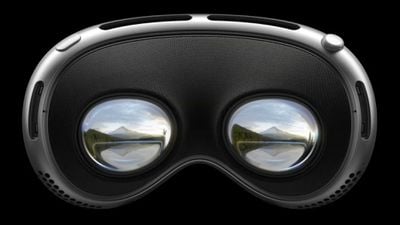
The report said it is unclear if or when LG and Samsung will begin mass production of tandem micro-OLED displays, but with a second-generation Vision Pro not expected to be released until late 2026 at the earliest, there is still time for the two companies to commercialize the technology for potential inclusion in the next model.
Earlier this year, Apple released new iPad Pro models with tandem OLED displays, which have two organic light-emitting layers stacked together for increased brightness, improved power efficiency, and longer longevity compared to single-layer OLED displays. These same benefits would extend to a future Vision Pro that adopts the technology.
Here is how Apple described the iPad Pro's tandem OLED technology:
The Ultra Retina XDR display features state-of-the-art tandem OLED technology that uses two OLED panels and combines the light from both to provide phenomenal full-screen brightness. The new iPad Pro supports an incredible 1000 nits of full-screen brightness for SDR and HDR content, and 1600 nits peak for HDR. No other device of its kind delivers this level of extreme dynamic range. Tandem OLED technology enables sub-millisecond control over the colour and luminance of each pixel, taking XDR precision further than ever. Specular highlights in photos and video appear even brighter, and there's more detail in shadows and low light than ever before on iPad — all while delivering even more responsiveness to content in motion.
The current Vision Pro is equipped with two 4K micro-OLED displays supplied by Sony.
All in all, the technology now exists for the next-generation Vision Pro to feature even brighter and more power efficient displays in a few years from now.
Popular Stories
Bloomberg's Mark Gurman has high expectations for Apple's first foldable iPhone.
In his Power On newsletter today, he said the foldable iPhone will be "the most significant overhaul in the iPhone's history."
"iPhone 4, iPhone 6 and iPhone X were clearly a big deal, but this is a whole new design," he said.
Like Samsung's Galaxy Z Fold 7, the foldable iPhone will reportedly open up like ...
March has been an incredibly busy month for Apple, with the company unveiling more than 10 new products and accessories. We said hello to the MacBook Neo at the start of the month, and we bid farewell to the Mac Pro at the end of it.
Nevertheless, there is still a lot more to come this year.
Beyond the usual annual updates to iPhones and Apple Watches, Apple's all-new smart home hub is...
Apple is expected to release two new iPhone apps this year, including an Apple Business app and a Siri app with chatbot-like functionality.
With the Apple Business app, employees at businesses using the new Apple Business platform will be able to install apps for work, view contact information for colleagues, and request support. Apple Business is launching on April 14, and it replaces Apple ...
Popular Stories
Apple today provided developers with the fourth betas of upcoming watchOS 26.4 and visionOS 26.4 betas for testing purposes. The software comes a week after Apple released the third betas.
The software updates are available through the Settings app on each device, and because these are developer betas, a free developer account is required.
watchOS 26.4 adds a new Average Bedtime metric to ...
Apple today seeded the release candidate versions of upcoming watchOS 26.4, tvOS 26.4 and visionOS 26.4 updates for testing purposes. The software comes a week after Apple released the fourth betas. Release candidates are the final updates that will be provided to the public in the near future if no final bugs are discovered.
The software updates are available through the Settings app on...
X-Plane, which is advertised as being the "world's most advanced flight simulator," is coming to Apple's Vision Pro in the next month or so.
The upcoming visionOS 26.4 update adds support for NVIDIA's CloudXR 6.0 platform, and this will enable Vision Pro users to wirelessly stream immersive PC games from NVIDIA RTX-powered servers via Wi-Fi, including the flight simulator X-Plane 12. Accordin...