Skip to Content

macOS Sequoia: How Window Tiling and Snapping Currently Works

With macOS Sequoia, Apple has introduced a new window tiling management feature that aims to make it easy to arrange open windows into a layout that works best for you.
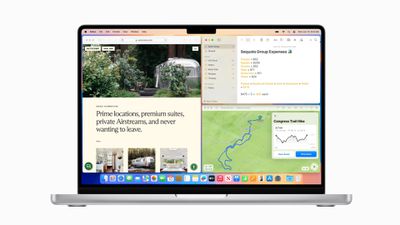
macos 15 tiling
PC users have had tiling since at least Windows 7 and Aero Snap, and if you've ever used those, the new window tiling feature in macOS Sequoia will be familiar. In the absence of the feature, Mac users have relied on several third-party tools like Magnet, Moom, and Rectangle to achieve similar results, but as things stand, in beta 1, window management in macOS still needs some work before it can approach the utility of those apps.
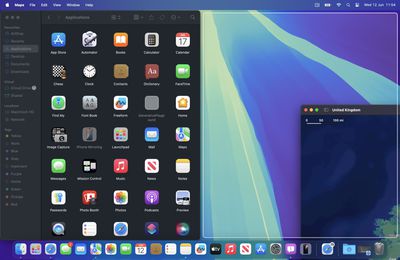
tiling macos two apps
When you drag a window to the edge of the screen, macOS Sequoia suggests a tiled position by displaying a frame, and you release the window to drop it right into place. This way, you can quickly arrange two app windows side by side, or place four windows in corners to keep several apps in view at once. When a window has been dragged to tile on one side or the other, dragging it back immediately resizes it to its original width and height, which is a nice touch.
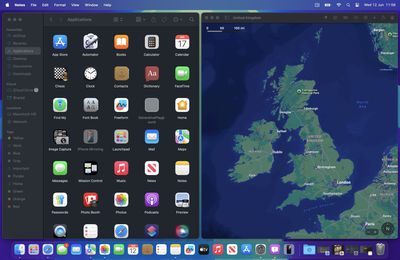
macos tiled two apps
The dragging system is far from infallible though. If you drag a window to the side of the screen and hold it for more than a couple of seconds, you can sometimes unintentionally switch to an adjacent desktop space if one is active. It can also be quite tricky to place certain app windows so that they snap to corners.
macos tiling overlapping
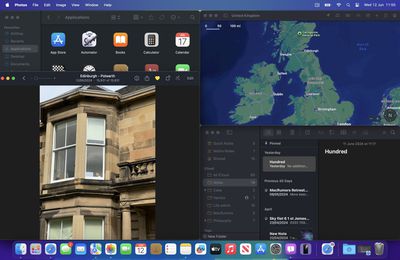
Also, some apps by design will not reduce down beyond a certain size, so you can end up with tiled windows overlapping each other or falling off the screen. If you have a group of apps that play nice together when tiled, the tiling system can leave unsightly gaps between the windows where the desktop wallpaper is exposed, but there's a setting that can rectify this.
system settings tiling
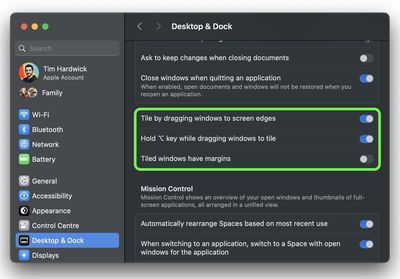
In System Settings, you'll find tiling options in a new section in the Desktop & Dock menu. For example, tiling can be activated by holding the Option key while dragging windows. You can also toggle off "Tiled windows have margins," which reduces gaps between windows.
tiling options green traffic light

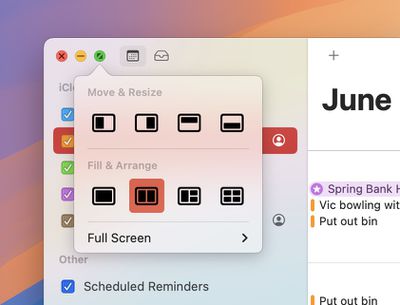
Image credit: MacRumors forum member Danbalsh

macOS 15 also adds new tiling options to the green traffic light in the top corner of windows. Hover your pointer over the green button, and a menu appears with options to move and resize or fill and arrange all open windows. These options generally seem to work better than the drag-to-snap tiling system in its current state.

Overall, tiling windows in macOS Sequoia does not feel properly implemented yet, but this is developer beta 1, and Apple will surely refine its functionality before we get to the public release of macOS 15 in September.


Related Forum: macOS Sequoia

Popular Stories

Multicolored Low Cost A18 Pro MacBook Feature

Apple Accidentally Leaks 'MacBook Neo'

Tuesday March 3, 2026 7:00 am PST by
Apple appears to have prematurely revealed the name of its rumored lower-cost MacBook model, which is expected to be announced this Wednesday. A regulatory document for a "MacBook Neo" (Model A3404) has appeared on Apple's website. Unfortunately, there are no further details or images available yet. While the PDF file does not contain the "MacBook Neo" name, it briefly appeared in a link...
imac video apple feature

Apple Unveils Two New Products

Monday March 2, 2026 7:49 am PST by
Apple today introduced two new devices, including the iPhone 17e and an updated iPad Air. iPhone 17e features the same overall design as the iPhone 16e, but it gains Apple's A19 chip, MagSafe for magnetic wireless charging and magnetic accessories, Apple's second-generation C1X modem for faster 5G, and a doubled 256GB of base storage. In the U.S., the iPhone 17e starts at $599, just like the ...
Apple iPhone 17e feature

Apple Announces iPhone 17e With A19 Chip, MagSafe, and More

Monday March 2, 2026 6:07 am PST by
Apple today announced the iPhone 17e, featuring the A19 chip, MagSafe connectivity, faster charging, and more. The iPhone 17e contains the A19 chip introduced in iPhone 17. It features a 6-core GPU and a 4-core GPU. Apple pointed out that this makes it up to 2x faster than the iPhone 11. The new 16-core Neural Engine is optimized for large generative models. The iPhone 17e also contains...

Top Rated Comments

PsykX Avatar
23 months ago
Finally we can have this feature built-in.

Perhaps the only major thing where I have always preferred Windows over macOS is that in macOS I often find myself having a mess of windows all over the place. Windows Aero has been really useful for the last like 15 years...
Score: 23 Votes (Like | Disagree)
23 months ago
This type of windows management should have been built in 15 plus years ago. It’s so fundamental to the OS to be able to manage windows without resorting to third party apps.

As a user of windows and Mac I was just shocked year after year Mac OS not having a decent windows management built in. It’s a no brainer.
Score: 18 Votes (Like | Disagree)
Cookie285 Avatar
23 months ago
For those wondering, fn + control + arrow keys seem to work as global shortcuts to move windows. fn + control + R returns to the previous state. Oddly enough it doesn't seem to work in every app yet?
Score: 16 Votes (Like | Disagree)
B4U Avatar
23 months ago
Would be real nice to have a bigger screen than 24" on the current iMac to make great use of this.
Score: 11 Votes (Like | Disagree)
jonnysods Avatar
23 months ago
This is a huge step in the right direction. I tell you what would be nice as well - when in Finder using the columns view that column width is the same width as the file name. The amount of fiddling around so I can navigate every single time is a pain!
Score: 11 Votes (Like | Disagree)
23 months ago

Meh. I’ve lived without it and I have zero interest in my Mac looking anything like Windows which I cannot stand. At least it can be turned off.
Being able to position windows on your screen isn't making your Mac look like Windows...it's functionality, sort of like a mouse cursor, dragging windows, menus, etc., don't make your Mac look like Windows despite they both have the same functions.
Score: 10 Votes (Like | Disagree)