CES 2024: This 'MagicMirror' Analyzes Facial Blood Flow to Monitor Vital Signs - MacRumors
Skip to Content

CES 2024: This 'MagicMirror' Analyzes Facial Blood Flow to Monitor Vital Signs

NuraLogix this week unveiled the Anura MagicMirror, a new health product that is designed to use a combination of sensors and artificial intelligence to check vital signs and provide disease risk assessments.


The 21.5-inch tabletop smart mirror takes a 30 second scan when a person sits in front of it, analyzing facial blood flow to provide a wealth of information. It uses a patented Transdermal Optical Imaging technology to detect a person's face and monitor blood flow. Machine learning algorithms use the data to provide information on more than 100 health parameters.

NuraLogix says that the MagicMirror can provide health information that includes blood pressure, BMI, heart rate variability, pulse rate, breathing rate, and facial skin age. It can provide risk assessments for diabetes, cardiovascular disease, stroke, hypertension, fatty liver disease, and more, plus it offers assessments of mental stress and depression risk.
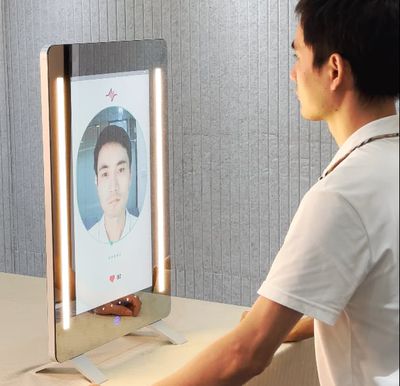
anura magic mirror
More information on the MagicMirror can be found on the NuraLogix website. The company has not provided a launch date or a price, but the device appears to be aimed at clinic waiting rooms, retirement homes, and other health-related facilities.

Popular Stories

iPhone 18 Pro Rumored Colors

What's Coming in September: New iPhones, Apple Watches and More

Thursday August 13, 2026 4:20 pm PDT by
Apple will introduce at least five new devices at its iPhone-centric event next month, and it's also possible we'll get devices waiting on Siri AI like the Apple TV. iPhone 18 Pro The iPhone 18 Pro is going to look like the iPhone 17 Pro, but with a smaller Dynamic Island. It's getting some internal updates, including a new Wide camera with a variable aperture for more control over lighting ...

iPhone 17 One Year Later Thumb 1

Should You Buy an iPhone 17 Now or Wait for iPhone 18?

Friday August 14, 2026 12:15 pm PDT by
For the first time since Apple started selling standard and "Pro" iPhones, we're not going to get an entry-level iPhone model this fall. Apple doesn't plan to release an iPhone 18 in September, and will only launch the iPhone 18 Pro, iPhone 18 Pro Max, and foldable iPhone Ultra. The lower-cost iPhone 18 won't come out until spring 2027. Subscribe to the MacRumors YouTube channel for more ...

Everything New Your iPhone Can Do on iOS 27 Feature 1

30 New Things Your iPhone Can Do in iOS 27

Friday August 14, 2026 6:24 am PDT by
Apple will release iOS 27 in September, and despite the company's focus this year on refining its flagship operating system and nixing bugs, there are still many additional features on the way, not least of which is Apple's new context-aware Siri, re-tooled for the generative AI era. This year's major iPhone software update isn't all about AI, though, as the following feature list...

Top Rated Comments

34 months ago
You: "Mirror, Mirror on the wall, who's the healthiest of them all?"

Mirror: "Not you, sorry."
Score: 10 Votes (Like | Disagree)
34 months ago
There are a lot of CES announcements that, even if the thing shipped on time and did exactly what the company claims it will, are still useless garbage. This one at least would in fact do something valuable, if it actually delivered on its promises and did so with reasonable accuracy--it would probably be too expensive for regular consumer use, but this sort of "easy monitoring" is the kind of technology that can potentially do more for general health maintenance than a lot of the much fancier stuff.

The Apple Watch resting heartrate monitoring is a simple example of one such thing that does work, and is valuable--in my case, after starting a medication, I could see my resting rate go up by 15 BPM over a period of time, which in turn explained some annoying things I'd been experiencing. Stopped the drug, and could see a clear graph of my heart rate going down to a healthy level over a period of a few weeks, all without doing anything but wearing a watch regularly that I would have done anyway.


I predict that in three years every one of these will be eWaste in a landfill.
I predict that none of them will end up as ewaste, because none of them will actually ship.
Score: 6 Votes (Like | Disagree)
34 months ago
That amount of information ostensibly out of a grainy 30-second video of your face is unhinged. Even if there are other sensors contributing.
Score: 5 Votes (Like | Disagree)
Rafagon Avatar
34 months ago

Agreed. The growing non-medical “health sensor” devices are concerning. A careful balance of innovation and snake oil is one that needs to be maintained.
On their website, the would-be customer is warned, "In the United States, this product is for Investigational Use Only. The performance characteristics of this product have not been established."

This is enough for me not to be interested in this contraption.
Score: 4 Votes (Like | Disagree)
Celtic-moniker Avatar
34 months ago

There are a lot of CES announcements that, even if the thing shipped on time and did exactly what the company claims it will, are still useless garbage. This one at least would in fact do something valuable, if it actually delivered on its promises and did so with reasonable accuracy--it would probably be too expensive for regular consumer use, but this sort of "easy monitoring" is the kind of technology that can potentially do more for general health maintenance than a lot of the much fancier stuff.

The Apple Watch resting heartrate monitoring is a simple example of one such thing that does work, and is valuable--in my case, after starting a medication, I could see my resting rate go up by 15 BPM over a period of time, which in turn explained some annoying things I'd been experiencing. Stopped the drug, and could see a clear graph of my heart rate going down to a healthy level over a period of a few weeks, all without doing anything but wearing a watch regularly that I would have done anyway.


I predict that none of them will end up as ewaste, because none of them will actually ship.
I disagree and I am saying this as a healthcare professional. This device at best produces data from non clinically tested sources, which will provide little to no reliability. But this sits up there with full-body MRIs, something which is advertised as providing early intervention on catching problems - theoretically, before real symptoms come on - only for it to provide merely a steady income for MRI manufacturers and operators and nothing to patients bar potential misdiagnosis and anxiety.
It is a tool for those that are anxious about their health to throw more money at.
Diagnostic tools are best used when looking for a targeted outcome. The development of diagnostic technology follows the pattern of needing an outcome, and developing a tool for it.
Here, we have a technology being developed for the sake of diagnosing... well, nothing. The technology has no baseline outcome to work towards and no requirement to provide the user with strictly usable information. Worse, while it ostensibly provides possibly a prompt for a patient to see a doctor, it in fact potentially could cause someone not to, and in turn miss both valuable advice and proper diagnosis. The's nothing in this that a correct set of measurements and a blood test taken by your GP (MD or whatever you have in your country) can offer - and with more privacy to boot.
Score: 3 Votes (Like | Disagree)
japanime Avatar
34 months ago

NuraLogix says that the MagicMirror can provide health information that includes blood pressure, BMI, heart rate variability, pulse rate, breathing rate, and facial skin age. It can provide risk assessments for diabetes, cardiovascular disease, stroke, hypertension, fatty liver disease, and more, plus it offers assessments of mental stress and depression risk.
Does it also serve you a daily dose of snake oil? 🤣
Score: 3 Votes (Like | Disagree)