Apple Bans Employees From Using ChatGPT Amid Its Own AI Efforts
Apple has restricted employee use of ChatGPT and other external artificial intelligence utilities amid the development of its own similar technology, The Wall Street Journal reports.
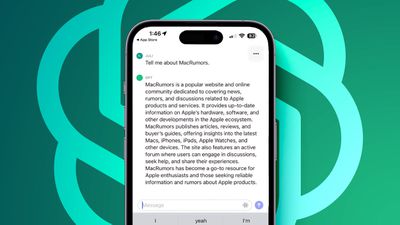
According to a document seen by The Wall Street Journal and individuals who claim to be familiar with the matter, Apple is concerned that AI tools could leak the company's confidential data. In addition to ChatGPT, Apple has barred staff from using GitHub's Copilot, a tool that helps write code with autocompletion.
Many businesses, such as banks, financial services, and healthcare institutions, have avoided adopting ChatGPT out of fear that their employees could inadvertently give the chatbot sensitive proprietary information. Samsung banned employee use of generative AI utilities like ChatGPT after discovering that staff had uploaded sensitive source code to the platform. The company was said to be concerned that data transmitted to artificial intelligence platforms including Bing and Google Bard could end up being disclosed to other users. JPMorgan Chase and Verizon have similarly banned use of these AI tools.
OpenAI has already sold Morgan Stanley a private ChatGPT service that allows employees to ask questions and analyze content in thousands of the bank's market research documents. Microsoft is working on a version of ChatGPT targeted at business customers to address privacy concerns.
The move comes in the context of Apple apparently working on its own large language models and AI technologies, led by senior vice president of Machine Learning and AI Strategy John Giannandrea. Giannandrea previously worked for Google and now reports directly to Apple CEO Tim Cook. The Wall Street Journal did not provide more information about what Apple's AI efforts encompass at this time.
OpenAI's ChatGPT has been accessible on the web and via several third-party iOS apps for some time, but yesterday the company released the first official ChatGPT app for the iPhone and iPad.
Popular Stories
Apple today confirmed to Reuters that it has acquired Q.ai, an Israeli startup that is working on artificial intelligence technology for audio.
Apple paid close to $2 billion for Q.ai, according to sources cited by the Financial Times. That would make this Apple's second-biggest acquisition ever, after it paid $3 billion for the popular headphone and audio brand Beats in 2014.
Q.ai has...
Apple today introduced its first two physical products of 2026: a second-generation AirTag and the Black Unity Connection Braided Solo Loop for the Apple Watch.
Read our coverage of each announcement to learn more:Apple Unveils New AirTag With Longer Range, Louder Speaker, and More
Apple Introduces New Black Unity Apple Watch BandBoth the new AirTag and the Black Unity Connection Braided...
Alongside iOS 26.2.1, Apple today released an updated version of iOS 12 for devices that are still running that operating system update, eight years after the software was first released.
iOS 12.5.8 is available for the iPhone 5s and the iPhone 6, meaning Apple is continuing to support these devices for 13 and 12 years after launch, respectively. The iPhone 5s came out in September 2013,...
Update: Apple Creator Studio is now available.
Apple Creator Studio launches this Wednesday, January 28. The all-in-one subscription provides access to the Final Cut Pro, Logic Pro, Pixelmator Pro, Motion, Compressor, and MainStage apps, with U.S. pricing set at $12.99 per month or $129 per year.
A subscription to Apple Creator Studio also unlocks "intelligent features" and "premium...
On an earnings call with equity analysts today, Apple CEO Tim Cook responded to fast-rising RAM and SSD storage chip prices in the supply chain.
Prices for RAM and NAND storage chips are surging lately due to high demand from companies building out AI servers, resulting in supply constraints.
Cook said that rising memory chip prices had a "minimal impact" on Apple's gross margin in the...