Apple to Make Custom Displays In-House, Starting With MicroLED for Apple Watch Ultra in 2024
Starting in 2024, Apple plans to use custom displays that it designs in-house for mobile devices like the iPhone and Apple Watch, reports Bloomberg. The shift to its own displays will allow Apple to rely less on display partners that include Samsung and LG.
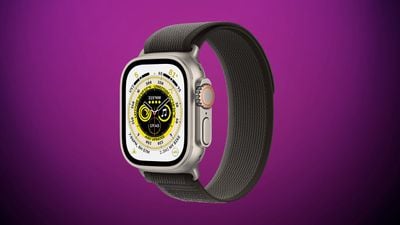
Apple's transition will begin with the high-end Apple Watch Ultra at the end of 2024, with the device set to adopt microLED display technology. After introducing microLED displays in the Apple Watch, Apple will expand them to the iPhone and other devices. The displays will likely be manufactured by an outside supplier, but designed by Apple.
According to Bloomberg, Apple is making a "sweeping effort" to make more of its own components for iPhones, iPads, and Macs, so that it does not need to work with as many third-party component suppliers. Apple is now creating its own A-series and M-series chips for iPhones, iPads, and Macs, and it is also working on modem chips and other wireless chips that will let it end its relationships with suppliers like Qualcomm and Broadcom.
Apple is already testing microLED displays for the Apple Watch, and the technology will bring brighter and more vibrant colors, along with improved viewing angles. Bloomberg says that the displays "make content appear like it's painted on top of the glass."
The company initially planned to swap to microLED displays as early as 2020, but there were technical challenges to overcome. Apple also planned to use microLED for larger displays, but for cost reasons, decided to focus first on the Apple Watch. Apple has spent several billion dollars developing display technology, and the transition is said to be one of Apple's most "critical projects."
Bloomberg warns that the 2024 target date could potentially slip to 2025, or if there continue to be production difficulties, a limited supply of the new devices could be offered to begin with. There will be an Apple Watch refresh in 2023, but with few new features.
Popular Stories
Apple today confirmed to Reuters that it has acquired Q.ai, an Israeli startup that is working on artificial intelligence technology for audio.
Apple paid close to $2 billion for Q.ai, according to sources cited by the Financial Times. That would make this Apple's second-biggest acquisition ever, after it paid $3 billion for the popular headphone and audio brand Beats in 2014.
Q.ai has...
Apple recently updated its online store with a new ordering process for Macs, including the MacBook Air, MacBook Pro, iMac, Mac mini, Mac Studio, and Mac Pro.
There used to be a handful of standard configurations available for each Mac, but now you must configure a Mac entirely from scratch on a feature-by-feature basis. In other words, ordering a new Mac now works much like ordering an...
A newly surfaced resale operation is seemingly offering Apple Store–exclusive display accessories to the public for the first time, potentially giving consumers access to Apple-designed hardware that the company has historically kept confined to its retail environments.
Apple designs a range of premium MagSafe charging stands, display trays, and hardware systems exclusively for displays in ...
Update: Apple Creator Studio is now available.
Apple Creator Studio launches this Wednesday, January 28. The all-in-one subscription provides access to the Final Cut Pro, Logic Pro, Pixelmator Pro, Motion, Compressor, and MainStage apps, with U.S. pricing set at $12.99 per month or $129 per year.
A subscription to Apple Creator Studio also unlocks "intelligent features" and "premium...
Apple today introduced its first two physical products of 2026: a second-generation AirTag and the Black Unity Connection Braided Solo Loop for the Apple Watch.
Read our coverage of each announcement to learn more:Apple Unveils New AirTag With Longer Range, Louder Speaker, and More
Apple Introduces New Black Unity Apple Watch BandBoth the new AirTag and the Black Unity Connection Braided...