Apple is working on a new "Custom Accessibility Mode" for iPhone and iPad, according to evidence uncovered by 9to5Mac in the second iOS 16.2 developer beta.
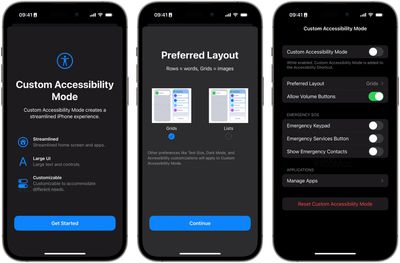
Image credit: 9to5Mac
Apple released the second betas of iOS 16.2 and iPadOS 16.2 to developers on Tuesday, including camera bug fixes, support for 5G in India, a Medication widget, and references to the new Custom Accessibility Mode, which 9to5Mac found "under the hood."
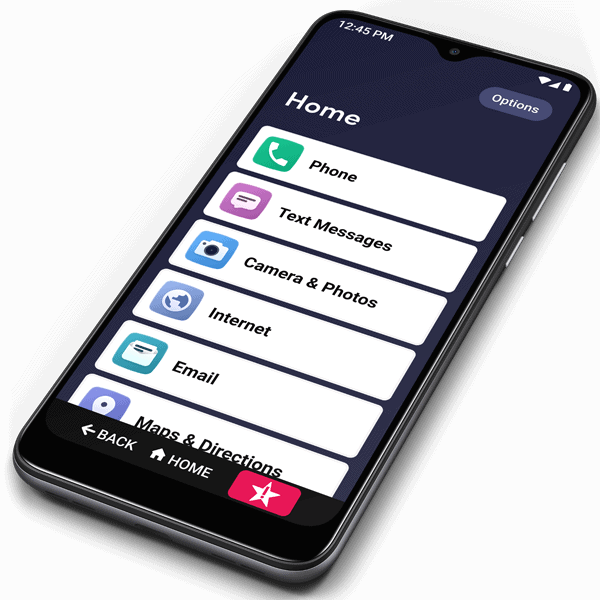
Within those references, Apple describes the new mode as offering "a customizable, streamlined way to use your iPhone and iPad," although how the feature works isn't completely clear, as it is not yet enabled for developers to test.
That said, screenshots suggest the new mode will allow users to replace the typical Lock Screen and "Springboard" Home Screen with more accessible UI elements, as well as remove the Dock, set much larger app icons, larger hardware interface elements, allowed contacts, and a simpler interface for Messages.
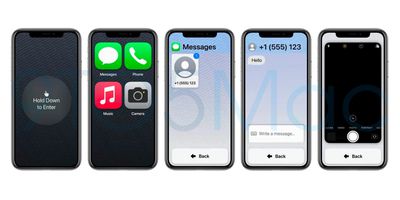
Image credit: 9to5Mac
Given the dearth of references, it's not certain that the Custom Accessibility Mode will go live with the release of iOS 16.2. Apple could be just laying the groundwork, with the feature still in the early stages of development. For everything else in the second beta of iOS 16.2, be sure to check out our roundup of changes.
Tuesday February 3, 2026 7:47 am PST by Joe Rossignol
While the iOS 26.3 Release Candidate is now available ahead of a public release, the first iOS 26.4 beta is likely still at least a week away. Following beta testing, iOS 26.4 will likely be released to the general public in March or April.
Below, we have recapped known or rumored iOS 26.3 and iOS 26.4 features so far.
iOS 26.3
iPhone to Android Transfer Tool
iOS 26.3 makes it easier...
Tuesday February 3, 2026 12:45 pm PST by Joe Rossignol
Apple recently acquired Israeli startup Q.ai for close to $2 billion, according to Financial Times sources. That would make this Apple's second-biggest acquisition ever, after it paid $3 billion for the popular headphone maker Beats in 2014.
This is also the largest known Apple acquisition since the company purchased Intel's smartphone modem business and patents for $1 billion in 2019....
Tuesday February 3, 2026 8:55 am PST by Joe Rossignol
In 2022, Apple introduced a new Apple Home architecture that is "more reliable and efficient," and the deadline to upgrade and avoid issues is fast approaching.
In an email this week, Apple gave customers a final reminder to upgrade their Home app by February 10, 2026. Apple says users who do not upgrade may experience issues with accessories and automations, or lose access to their smart...
Tuesday February 3, 2026 12:12 pm PST by Juli Clover
New M5 Pro and M5 Max MacBook Pro models are slated to launch in the near future, according to information shared with MacRumors by an Apple Premium Reseller.
Subscribe to the MacRumors YouTube channel for more videos.
The third-party Apple retailer said that MacBook Pro stock is very low currently because there is an imminent new product introduction. Apple typically coordinates supply with...
Sunday February 1, 2026 12:31 pm PST by Joe Rossignol
The calendar has turned to February, and a new report indicates that Apple's next product launch is "imminent," in the form of new MacBook Pro models.
"All signs point to an imminent launch of next-generation MacBook Pros that retain the current form factor but deliver faster chips," Bloomberg's Mark Gurman said on Sunday. "I'm told the new models — code-named J714 and J716 — are slated...
Apple doesn’t get the credit it clearly deserves for its accessibility efforts. My father had a terrible tremor, so gestures were difficult for him. Thank God Apple made an assistive touch function, or else he wouldn’t have been able to use a phone.
This is amazing - it looks exactly like what I was mocking up in my head all weekend for my father, and feeling frustrated that it’s something I didn’t think Apple would ever build. iPhones have gotten much harder to use for older people over the last few years. Neither of my parents ever fully adapted after iOS 7 made UI controls much less obvious and clear. And as my Dad’s tremors have gotten worse, the gestures, edge swipes, and long presses essentially make his phone a minefield. Existing accessibility options help a bit, but don’t do enough to fundamentally fix the big-picture UI paradigms that are an issue for older users.
We need options for huge home screen icons and/or a list view with large labels for the homescreen, a way to prevent accidental rearranging, a way to disable control center and the other edge swipe gestures, and a much simpler way for a family member to control your screen from FaceTime (he doesn’t under stand how to share screen from FaceTime, and the button icons are absolutely inscrutable). And frankly, this mode should offer dramatically fewer features. For Photos.app, just let it be a big picture frame with a way to scroll backwards in time through the grid view; hide all the UI about albums, organization, and editing. It’s so overwhelming to people who don’t or can’t keep up with so many new changes every year.
I tried to talk to him about a Jitterbug Smart, which I think is solving a lot of these issues, but we’ve been an Apple family since 1984, and he doesn’t want to give it up (and when I showed it to him he said “but those are for old people”…he’s 82). And I have a sneaking suspicion that once you’re past the Jitterbug’s launcher, the apps themselves will be the typical Android hard-to-use UI, so it’s not complete win.
Apple built its reputation on ease of use, and people used to marvel at how babies could pick up and use an iPad. You don’t hear that anymore. For myself, I want all the gestures, shortcuts, automations, and power user tweaks I can get my hands on. But I don’t want that to come at the expense of a worse experience for others. iPhone needs a way to accommodate our parents. Really hope this pans out.