Next-Generation MacBook Pros Rumored to Feature 'Very High-Bandwidth' RAM

Apple's next-generation 14-inch and 16-inch MacBook Pro models with M2 Pro and M2 Max chips will be equipped with "very high-bandwidth, high-speed RAM," according to information shared by MacRumors Forums member Amethyst, who accurately revealed details about the Mac Studio and Studio Display before those products were announced.
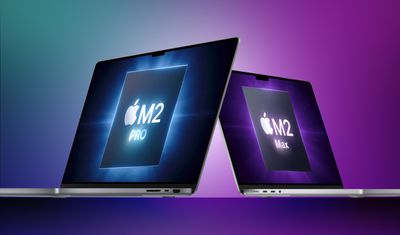
14 vs 16 inch mbp m2 pro and max feature 1
The current 14-inch and 16-inch MacBook Pro models are equipped with LPDDR5 RAM from Samsung, with the M1 Pro chip providing up to 200 GB/s of memory bandwidth and the M1 Max chip topping out at 400 GB/s. On a speculative basis, it is possible that the next MacBook Pro models could be equipped with Samsung's latest LPDDR5X RAM for up to 33% increased memory bandwidth with up to 20% less power consumption. This would result in up to 300 GB/s memory bandwidth for the M2 Pro and up to 600 GB/s for the M2 Max.

Bloomberg's Mark Gurman expects the next MacBook Pros to have few other changes beyond the M2 Pro and M2 Max chips. At this point, it seems likely that the laptops will be announced in November at the earliest with press releases on the Apple Newsroom site. Apple has launched new Macs in November multiple times in recent years, including the original 16-inch MacBook Pro in 2019 and the first three Macs with the M1 chip in 2020.

The current 14-inch and 16-inch MacBook Pro models with the M1 Pro and M1 Max chips were released in October 2021 and featured a complete redesign with a notch in the display and additional ports like HDMI, MagSafe, and an SD card reader.


Related Roundup: MacBook Pro
Buyer's Guide: MacBook Pro (Caution)

Related Forum: MacBook Pro

Popular Stories

iPhone Top Left Hole Punch Face ID Feature Purple

iPhone 18 Pro Launching Later This Year With These 12 New Features

Thursday January 15, 2026 10:56 am PST by
While the iPhone 18 Pro and iPhone 18 Pro Max are not expected to launch for another eight months, there are already plenty of rumors about the devices. Below, we have recapped 12 features rumored for the iPhone 18 Pro models, as of January 2026: The same overall design is expected, with 6.3-inch and 6.9-inch display sizes, and a "plateau" housing three rear cameras Under-screen Face ID...
Apple MacBook Pro M4 hero

These 5 Apple Products Will Reportedly Be Upgraded With OLED Displays

Friday January 16, 2026 7:07 pm PST by
Apple plans to upgrade the iPad mini, MacBook Pro, iPad Air, iMac, and MacBook Air with OLED displays between 2026 and 2028, according to DigiTimes. Bloomberg's Mark Gurman previously reported that the iPad mini and MacBook Pro will receive an OLED display as early as this year, but he does not expect the MacBook Air to adopt the technology until 2028 at the earliest. A new iPad Air is...
Apple Wallet ID Illinois

Apple Plans to Expand iPhone Driver's Licenses to These 7 U.S. States

Friday January 16, 2026 12:12 pm PST by
In select U.S. states, residents can add their driver's license or state ID to the Apple Wallet app on the iPhone and Apple Watch, and then use it to display proof of identity or age at select airports and businesses, and in select apps. The feature is currently available in 13 U.S. states and Puerto Rico, and it is expected to launch in at least seven more in the future. To set up the...
iOS 27 Mock Quick

iOS 27 Will Add These 8 New Features to Your iPhone

Sunday January 18, 2026 3:51 pm PST by
iOS 27 is still many months away, but there are already plenty of rumors about new features that will be included in the software update. The first beta of iOS 27 will be released during WWDC 2026 in June, and the update should be released to all users with a compatible iPhone in September. Bloomberg's Mark Gurman said that iOS 27 will be similar to Mac OS X Snow Leopard, in the sense...
14 inch MacBook Pro Keyboard

MacBook Pro Buyers Now Facing Up to a Two-Month Wait Ahead of New Models

Sunday January 18, 2026 6:50 pm PST by
MacBook Pro availability is tightening on Apple's online store, with select configurations facing up to a two-month delivery timeframe in the United States. A few 14-inch and 16-inch MacBook Pro configurations with an M4 Pro chip are not facing any shipping delay, but estimated delivery dates for many configurations with an M4 Max chip range from February 6 to February 24 or even later. At...

Top Rated Comments

roach1245 Avatar
42 months ago
Some notes on memory bandwidth of the Apple Silicon machines (which is already extremely high) vs the new Ryzen / Intel CPUs that were released a few days / weeks ago:

Ran a simple benchmark on a new Ryzen 7950x desktop build (64GB RAM) here in the lab (the build will be returned to the supplier) vs my M1 Max laptop (64GB RAM).

Task: Take about 10000 parquet files (10.6GB total) and append them into 1 dataframe (> 400 million observations) in memory.

Hypothesis: The Ryzen 7950x should be way faster - at first thought - because it has 16 cores (versus 8 M1 Max performance cores) that are also clocked way higher.

Result: They are equally as fast because the Ryzen CPU is bottlenecked by memory bandwidth (very fast cores but just 2 memory channels on the CPU).

The files:


The task is most efficiently done in parallel using all cores available, used both polars (Rust ) and pandas-modin (C++) to do this as fast as possible.

When using all 8 performance cores on my M1 Max, memory bandwidth to CPU is at about 120 GB/s (theoretical max is 200Gb/s).


Yet the Ryzen 7950x can do 81 GB/s memory bandwidth at most as the memory runs at 5200MT/s (* 8 bytes * 2 memory channels)/1024 = 81.25 GB/s (you can stretch this to about 100 GB/s if you heavily overclock). Thus despite the 7950x's 16 faster cores it's as fast as my M1 Max with 10 cores in this task because about 6 Ryzen cores are enough to reach that 81GB/s of bandwidth. The other 10 cores are starved from input and just idling.

This is not new; others have ran similar tasks with similar results. E.g. https://tlkh.dev/benchmarking-the-apple-m1-max who finds that

"... adding more cores on the 5600X does not help (2 cores are enough to maximize memory bandwidth), while 10 cores on the M1 Max is the optimal configuration".

The M1 Ultra has 20 cores and 400GB/s of memory bandwidth and thus runs way faster than the Ryzen 7950X as none of its 20 cores are starved. This is even more so when the Ryzen 7950X is decked out with 128GB of DDR5 RAM instead (4 DIMM slots) and therefore runs at a slower 3600 MT/s instead which is a meager 56.25 GB/s memory bandwidth. 5 Ryzen cores can fully consume that; the other 11 cores will just idle.

This is also iterated at http://hrtapps.com/blogs/20220427/ which similarly highlights the importance of memory bandwidth (in computational fluid dynamics in this case) and finds that:

"M1 Ultra has an extremely high 800 GB/sec memory bandwidth.... which leads to a level of CPU performance scaling that I don’t even see on supercomputers, and is the result of a SoC (system on a chip) design"

The new Intel Raptor Lake CPUs also only have 2 memory channels and top out at about 120GB/s max memory bandwidth (heavily overclockded) as well so there won't be a difference here.

So just a heads up: the new Ryzen/Intel CPUs are good for gaming and workflows which are not so much memory dependent, but if you're doing data analysis or other scientific HPC work of some sort that is CPU-and-memory bound (thus not GPU machine learning) you'll very quickly run into memory bandwidth limits. Then you better stick to Apple's M1 / M2 chips or the AMD / Intel CPUs with more than 2 memory channels and thus more memory bandwidth (which are also way more expensive, e.g. the AMD ThreadRipper Pro 5965WX with 26 cores and 8 memory channels at 200GB/s memory bandwidth max for which you have to pay $2400 just for the chip itself and $1000 for a compatible motherboard).
Score: 73 Votes (Like | Disagree)
TheYayAreaLiving ?️ Avatar
42 months ago

Also 'very high prices'
Prices not so high. Remembering the golden era. Apple Online Store, 2002.

Attachment Image
Score: 30 Votes (Like | Disagree)
applicious84 Avatar
42 months ago

Some notes on memory bandwidth of the Apple Silicon machines (which is already extremely high) vs the new Ryzen / Intel CPUs that were released a few days / weeks ago:

Ran a simple benchmark on a new Ryzen 7950x desktop build (64GB RAM) here in the lab (the build will be returned to the supplier) vs my M1 Max laptop (64GB RAM).

Task: Take about 1000 parquet files (10.6GB total) and append them into 1 file (> 400 million observations).

Hypothesis: The Ryzen 7950x should be way faster - at first thought - because it has 16 cores (versus 8 M1 Max performance cores) that are also clocked way higher.

Result: They are equally as fast because the Ryzen CPU is bottlenecked by memory bandwidth (very fast cores but just 2 memory channels on the CPU).

The files:


The task is most efficiently done in parallel using all cores available, used both polars (Rust ) and pandas-modin (C++) to do this as fast as possible.

When using all 8 performance cores on my M1 Max, memory bandwidth to CPU is at about 120 GB/s (theoretical max is 200Gb/s).


Yet the Ryzen 7950x can do 81 GB/s memory bandwidth at most as the memory runs at 5200MT/s (* 8 bytes * 2 memory channels)/1024 = 81.25 GB/s (you can stretch this to about 100 GB/s if you heavily overclock). Thus despite the 7950x's 16 faster cores it's as fast as my M1 Max with 10 cores in this task because about 6 Ryzen cores are enough to reach that 81GB/s of bandwidth. The other 10 cores are starved from input and just idling.

This is not new; others have ran similar tasks with similar results. E.g. https://tlkh.dev/benchmarking-the-apple-m1-max who finds that

"... adding more cores on the 5600X does not help (2 cores are enough to maximize memory bandwidth), while 10 cores on the M1 Max is the optimal configuration".

Or what was referred to earlier: http://hrtapps.com/blogs/20220427/ ('http://hrtapps.com/blogs/20220427/').

The M1 Ultra has 20 cores and 400GB/s of memory bandwidth and thus runs way faster than the Ryzen 7950X as none of its 20 cores are starved. This is even more so when the Ryzen 7950X is decked out with 128GB of DDR5 RAM instead (4 DIMM slots) and therefore runs at a slower 3600 MT/s instead which is a meager 56.25 GB/s memory bandwidth. 5 Ryzen cores can fully consume that; the other 11 cores will just idle.

The new Intel Raptor Lake CPUs also only have 2 memory channels and top out at about 100GB/s max memory bandwidth as well so there won't be a difference here.

So just a heads up: the new Ryzen/Intel CPUs are good for gaming and workflows which are not so much memory dependent, but if you're doing data analysis or other scientific HPC work of some sort that is CPU-and-memory bound (thus not GPU machine learning) you'll very quickly run into memory bandwidth limits. Then you better stick to Apple's M1 / M2 chips or the AMD / Intel CPUs with more than 2 memory channels and thus more memory bandwidth (which are also way more expensive, e.g. the AMD ThreadRipper Pro 5965WX with 26 cores and 8 memory channels at 200GB/s memory bandwidth max for which you have to pay $2400 just for the chip itself and $1000 for a compatible motherboard).
You do realize this forum is for fanboys and not tech nerds, right? I'll read this on Anand Tech and Tom's Hardware, my friend ;)

Oh, and much appreciated. Nice post :)
Score: 17 Votes (Like | Disagree)
Lakersfan74 Avatar
42 months ago
Waiting for no need to upgrade from M1 posts.
Score: 16 Votes (Like | Disagree)
Mrkevinfinnerty Avatar
42 months ago
Also 'very high prices'
Score: 13 Votes (Like | Disagree)
temende Avatar
42 months ago
Nice improvement, but what matters more is memory latency, not bandwidth.
Score: 11 Votes (Like | Disagree)