Skip to Content

Newer Macs Can Use Another Mac as an External Display on macOS Monterey

One of the key new features of macOS Monterey is the ability to AirPlay content to a Mac from other Apple devices, such as an iPhone, iPad, or another Mac. According to the macOS Monterey features page, AirPlay to Mac works works both wirelessly or wired using a USB cable, with Apple noting that a wired connection is useful when you want to ensure that there's no latency or don't have access to a Wi-Fi connection.
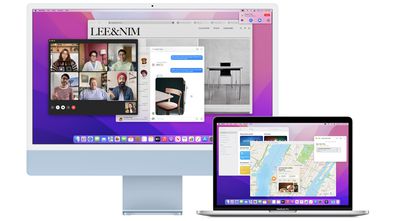
imac macbook pro macos monterey
AirPlay to Mac also allows users to extend or mirror an Apple device's display to a Mac, and we've confirmed this works on a Mac-to-Mac basis. This makes it possible for supported Macs to use another Mac as an external display, and with AirPlay to Mac working both wirelessly or with a wired connection, Apple has come close to reviving Target Display Mode, which allowed 2009 to 2014 iMac models to serve as another Mac's external display.

It's worth noting that these new AirPlay features do not serve as a complete Target Display Mode replacement, as we've been told that AirPlay compresses video sent from one Mac to another, and at least some latency might still be possible.

Starting with macOS Monterey, a supported Mac can also function as an AirPlay 2 speaker source, allowing users to wirelessly stream music or podcasts from an Apple device to a Mac or use the computer as a secondary speaker for multi-room audio.

AirPlay to Mac works with a 2018 or later MacBook Pro or MacBook Air, a 2019 or later iMac or Mac Pro, an iMac Pro, and the 2020 Mac mini.

macOS Monterey is available now in beta for developers, with a public beta to follow in July. The software update will likely be publicly released for all compatible Macs at some point between late September and early November.

Related Forum: macOS Monterey

Popular Stories

imac video apple feature

Apple Unveils Seven New Products

Friday March 6, 2026 11:48 am PST by
Apple this week unveiled seven products, including an iPhone 17e, an iPad Air with the M4 chip, updated MacBook Air and MacBook Pro models, a new Studio Display, a higher-end Studio Display XDR, and an all-new MacBook Neo that starts at just $599. iPhone 17e features the same overall design as the iPhone 16e, but it gains Apple's A19 chip, MagSafe for magnetic wireless charging and magnetic...
Apple MacBook Pro M4 hero

Apple Planning 'MacBook Ultra' With Touchscreen and Higher Price

Sunday March 8, 2026 8:05 am PDT by
Apple is planning to launch an all-new "MacBook Ultra" model this year, featuring an OLED display, touchscreen, and a higher price point, Bloomberg's Mark Gurman reports. Gurman revealed the information in his latest "Power On" newsletter. While Apple has been widely expected to launch new M6-series MacBook Pro models with OLED displays, touchscreen functionality, and a new, thinner design...


MacBook Neo Feature Pastel 1

First MacBook Neo Benchmarks Are In: Here's How It Compares to the M1 MacBook Air

Thursday March 5, 2026 4:07 pm PST by
Benchmarks for the new MacBook Neo surfaced today, and unsurprisingly, CPU performance is almost identical to the iPhone 16 Pro. The MacBook Neo uses the same 6-core A18 Pro chip that was first introduced in the iPhone 16 Pro, but it has one fewer GPU core. The MacBook Neo earned a single-core score of 3461 and a multi-core score of 8668, along with a Metal score of 31286. Here's how the...

Top Rated Comments

iObama Avatar
62 months ago
Ugh. Wish I could use my 2017 4K iMac as an external display for my M1 Pro. It’s a beautiful monitor that now just sits on my desk, while I use a 24” 1080p monitor with my M1. Boo.
Score: 32 Votes (Like | Disagree)
62 months ago
Here are the supported devices since it didn't seem to be included in the article:


"Available on MacBook Pro (2018 and later), MacBook Air (2018 and later), iMac (2019 and later), iMac Pro (2017), Mac mini (2020 and later), Mac Pro (2019), iPhone 7 and later, iPad Pro (2nd generation and later), iPad Air (3rd generation and later), iPad (6th generation and later), and iPad mini (5th generation and later). Older iPhone, iPad, and Mac models may share content at a lower resolution to supported Mac models when “Allow AirPlay for” is set to “Everyone” or “Anyone on the same network” in Sharing preferences." (https://www.apple.com/macos/monterey-preview/features/#footnote-6)
This is great for my use, as I have wanted to use my 2020 iMac as a display for my work MacBook Pro when I'm at home (which is most of the time now). I tried out Luna Display, but it has some issues that don't work for me. My hope this works well, and with a hardwired connection the latency is not too bad.

Formatting the list better:

* MacBook Pro (2018 and later)
* MacBook Air (2018 and later)
* iMac (2019 and later)
* iMac Pro (2017)
* Mac mini (2020 and later)
* Mac Pro (2019)
* iPhone 7 and later
* iPad Pro (2nd generation and later)
* iPad Air (3rd generation and later)
* iPad (6th generation and later)
* iPad mini (5th generation and later)
Score: 13 Votes (Like | Disagree)
casperes1996 Avatar
62 months ago
Yeah, no I would've loved Target Display mode for my 2020 iMac to connect a PlayStation or something to it. This is alright for some things, but frankly I don't see myself using it
Score: 12 Votes (Like | Disagree)
JippaLippa Avatar
62 months ago
That's a very cool feature for people with desktop and a macbook on the side, for portable use.
Score: 9 Votes (Like | Disagree)
62 months ago
For those getting a little too enthusiastic after reading the headline:

It's worth noting that these new AirPlay features do not serve as a complete Target Display Mode replacement, as we've been told that AirPlay compresses video sent from one Mac to another, and at least some latency might still be possible.
Plus, forget about connecting a PC, which you could do with non-Retina iMacs.
Score: 9 Votes (Like | Disagree)
EugW Avatar
62 months ago
I can still use my Target Display Mode 2010 iMac as a second display with any Mac, or even a Windows PC.

The main problem is that Apple has killed subpixel anti-aliasing, which makes any recent version of macOS look bad on non-Retina screens.
Score: 9 Votes (Like | Disagree)