Apple Launches All-in-One Web Page With Privacy Labels for Its Own Apps
Apple today updated its privacy website with a new "Labels" section that brings privacy labels for all of Apple's apps together in one place, making it easier for users to learn about how Apple apps handle their personal data.
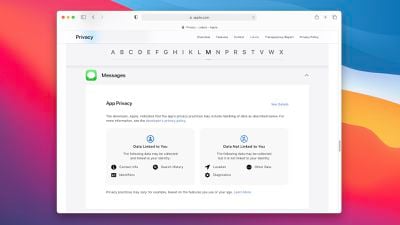
Apple already provided privacy labels for its apps since the feature launched last year, but on individual support pages, so this new "Labels" section makes it easier to view the labels all in one place, and in alphabetical order. Privacy labels are available for Apple's apps across iOS, iPadOS, macOS, watchOS, and tvOS, so some apps like GarageBand appear more than once. Apple has also included labels for developer tools like Xcode and even the App Store itself, providing a very comprehensive level of privacy information.
Apple emphasizes that users will not find any data under "Data Used to Track You" for its apps, as Apple does not track users. Apple says it holds itself to a higher standard than it does for all other developers, who will be permitted to track users if they obtain their permission via the App Tracking Transparency framework that will be enforced as of iOS 14.5.
Apple introduced privacy labels on the App Store in December, providing users with a broad overview of the data types an app may collect, and whether the information is used to track them or is linked to their identity or device. These labels appear in App Store listings for third-party apps and downloadable Apple apps like Apple Podcasts, while built-in apps that cannot be removed like Messages have labels on Apple's website.
Apple has required developers to fill out the privacy labels when submitting new apps and app updates to the App Store since early December, but the labels function on an honor system. Apple previously said it "conducts routine and ongoing audits of the information provided" and works with developers to correct any inaccuracies, adding that apps that fail to come into compliance may ultimately face removal from the App Store.
Popular Stories
Apple today confirmed to Reuters that it has acquired Q.ai, an Israeli startup that is working on artificial intelligence technology for audio.
Apple paid close to $2 billion for Q.ai, according to sources cited by the Financial Times. That would make this Apple's second-biggest acquisition ever, after it paid $3 billion for the popular headphone and audio brand Beats in 2014.
Q.ai has...
Apple recently updated its online store with a new ordering process for Macs, including the MacBook Air, MacBook Pro, iMac, Mac mini, Mac Studio, and Mac Pro.
There used to be a handful of standard configurations available for each Mac, but now you must configure a Mac entirely from scratch on a feature-by-feature basis. In other words, ordering a new Mac now works much like ordering an...
Last year, Apple launched CarPlay Ultra, the long-awaited next-generation version of its CarPlay software system for vehicles. Nearly nine months later, CarPlay Ultra is still limited to Aston Martin's latest luxury vehicles, but that should change fairly soon.
In May 2025, Apple said many other vehicle brands planned to offer CarPlay Ultra, including Hyundai, Kia, and Genesis. At the time,...
A newly surfaced resale operation is seemingly offering Apple Store–exclusive display accessories to the public for the first time, potentially giving consumers access to Apple-designed hardware that the company has historically kept confined to its retail environments.
Apple designs a range of premium MagSafe charging stands, display trays, and hardware systems exclusively for displays in ...
Apple today introduced its first two physical products of 2026: a second-generation AirTag and the Black Unity Connection Braided Solo Loop for the Apple Watch.
Read our coverage of each announcement to learn more:Apple Unveils New AirTag With Longer Range, Louder Speaker, and More
Apple Introduces New Black Unity Apple Watch BandBoth the new AirTag and the Black Unity Connection Braided...