Apple University Dean Shares Deep Dive Into Apple's Organizational Structure

Apple University dean and vice president Joel Podolny today wrote an in-depth article on Apple's organizational structure for Harvard Business Review.
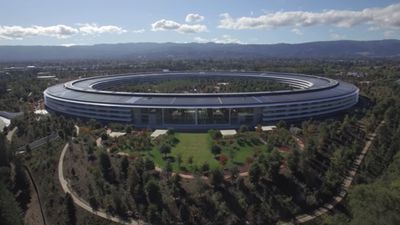
appleparknovember
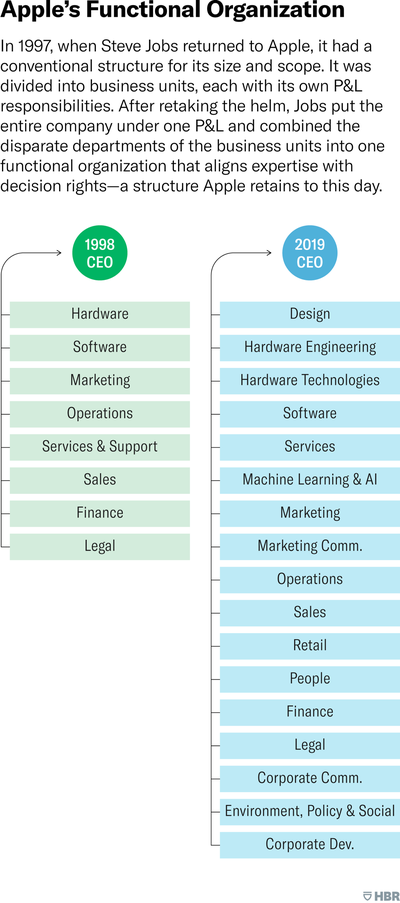
Titled "How Apple is Organized for Innovation," Podolny's piece delves deep into Apple's structure and how that has helped it grow over the years. Starting back when Jobs took over the company when he returned to Apple 1997, Podolny explains how Jobs fired the managers of each individual business unit and converted Apple into "one functional organization," a setup that Apple continues to have to this day.

As was the case with Jobs before him, CEO Tim Cook occupies the only position on the organizational chart where the design, engineering, operations, marketing, and retail of any of Apple's main products meet. In effect, besides the CEO, the company operates with no conventional general managers: people who control an entire process from product development through sales and are judged according to a P&L statement.

Apple's structure dictates that the people who have the most expertise and experience in a given domain should have the decision rights for that domain, with the company relying on technical experts rather than managers to make key decisions.
applefunctionalorganization
Apple's financial structure, where executive bonuses are based on companywide financial success rather than departmental success, also allows for more freedom when it comes to product decisions because there's not specific financial pressure on a single release. "The finance team is not involved in the product road map meetings of engineering teams, and engineering teams are not involved in pricing decisions," writes Podolny.

All of Apple's managers, from senior vice president and down, are expected to have deep expertise in their area, immersion in detail of the work being done under their leadership, and willingness to collaborate and make collective decisions. "Leaders should know the details of their organization three levels down," is one of Apple's principles.

As Apple has grown, Apple CEO Tim Cook has needed to make adjustments to the structure as Apple enters into new markets and technologies.

The adjustments Tim Cook has implemented in recent years include dividing the hardware function into hardware engineering and hardware technologies; adding artificial intelligence and machine learning as a functional area; and moving human interface out of software to merge it with industrial design, creating an integrated design function.

Podolny's full piece goes into much more detail on how Apple's internal structure works, complete with many examples of Apple's successes. It can be read in full at Harvard Business Review.
Popular Stories

airpods pro 3 purple

New, Higher End AirPods Pro Coming This Year

Tuesday January 20, 2026 9:05 am PST by
Apple is planning to debut a high-end secondary version of AirPods Pro 3 this year, sitting in the lineup alongside the current model, reports suggest. Back in September 2025, supply chain analyst Ming-Chi Kuo reported that Apple is planning to introduce a successor to the AirPods Pro 3 in 2026. This would be somewhat unusual since Apple normally waits around three years to make major...
smaller dynamic island iphone 18 pro Filip Vabrous%CC%8Cek

iPhone 18 Pro Leak: Smaller Dynamic Island, No Top-Left Camera Cutout

Tuesday January 20, 2026 2:34 am PST by
Over the last few months, rumors around the iPhone 18 Pro's front-panel design have been conflicted, with some supply-chain leaks pointing to under-display Face ID, reports suggesting a top-left hole-punch camera, and debate over whether the familiar Dynamic Island will shrink, shift, or disappear entirely. Today, Weibo-based leaker Instant Digital shared new details that appear to clarify the ...
Apple Logo Spotlight

Apple Expected to Unveil Five All-New Products This Year

Wednesday January 21, 2026 10:54 am PST by
In addition to updating many of its existing products, Apple is expected to unveil five all-new products this year, including a smart home hub, a Face ID doorbell, a MacBook with an A18 Pro chip, a foldable iPhone, and augmented reality glasses. Below, we have recapped rumored features for each product. Smart Home Hub Apple home hub (concept) Apple's long-rumored smart home hub should...
Liquid Glass App Store Feature

App Store and Apple TV Experiencing Outage

Tuesday January 20, 2026 4:36 pm PST by
Apple's App Store, iTunes Store, and Apple TV service are experiencing an outage at the current time, according to Apple's System Status page. Apple says that some users may be experiencing issues with the App Store and iTunes Store. Apple also says some users may be seeing intermittent issues with Apple TV. The Apple TV Channels feature is down too, and users may be unable to access some...
airtag prime day 2

Apple Developing AirTag-Sized AI Pin With Dual Cameras

Wednesday January 21, 2026 12:31 pm PST by
Apple is working on a small, wearable AI pin equipped with multiple cameras, a speaker, and microphones, reports The Information. If it actually launches, the AI pin will likely run the new Siri chatbot that Apple plans to unveil in iOS 27. The pin is said to be similar in size to an AirTag, with a thin, flat, circular disc shape. It has an aluminum and glass shell, and two cameras at the...

Top Rated Comments

az431 Avatar
69 months ago

Them writing an HBR article about innovation is the best indicator they stopped innovating.
Yeah that makes zero sense.
Score: 13 Votes (Like | Disagree)
eastwoodandy Avatar
69 months ago

Sounds great in theory, but in reality, do people really think executives aren't going to direct their attention to financially under-performing units?

If one unit is under-performing, another has to make up for the deficiency in order to maintain company-wide financial targets. Everyone ends up looking at the bottom line.

HomePod not selling well? Let's increase the mark up of iPhone accessories in response.
But there isn’t a HomePod division, that’s the point. The success of the HomePod is spread over most of those divisions, Sales, Marketing, Design, Software, Hardware Engineering etc
Score: 8 Votes (Like | Disagree)
Apple Freak Avatar
69 months ago

Never heard of Apple University
I'd love to attend but you have to be an employee first.


What's baffling is that some people want to work for that company
I'd DIE to work for Apple someday!
Score: 7 Votes (Like | Disagree)
TheYayAreaLiving ?️ Avatar
69 months ago
This will be taught in Grad College in the Business World. Case study time.
Score: 6 Votes (Like | Disagree)
Dekema2 Avatar
69 months ago
Never heard of Apple University
Score: 6 Votes (Like | Disagree)
JPack Avatar
69 months ago

Apple's financial structure, where executive bonuses are based on companywide financial success rather than departmental success, also allows for more freedom when it comes to product decisions because there's not specific financial pressure on a single release. "The finance team is not involved in the product road map meetings of engineering teams, and engineering teams are not involved in pricing decisions," writes Podolny.
Sounds great in theory, but in reality, do people really think executives aren't going to direct their attention to financially under-performing units?

If one unit is under-performing, another has to make up for the deficiency in order to maintain company-wide financial targets. Everyone ends up looking at the bottom line.

HomePod not selling well? Let's increase the mark up of iPhone accessories in response.
Score: 5 Votes (Like | Disagree)