T-Mobile Won't Make Serious Push Into 5G Until Second Half of 2019

T-Mobile won't be making a serious push into launching and promoting its 5G network until the second half of 2019, T-Mobile CTO Neville Ray said in an interview shared by CNET today.

The carrier had initially planned to promote 5G in the first half of 2019, but it is delaying that rollout because smartphones able to take advantage of its 5G network won't be available until later.
tmobile600mhz5g

Image via CNET

According to Ray, T-Mobile had hoped that smartphone makers and chip manufacturers would have 5G devices ready to use the lower-band 600 megahertz spectrum that will power much of its 5G network, but that hasn't quite happened. The company instead plans to "go big" with 5G later in 2019.

The 5G version of the Galaxy S10 from Samsung, which will come in April, offers millimeter wave support compatible with Verizon, AT&T, and Sprint, but not T-Mobile. T-Mobile is deploying millimeter wave, but coverage at the moment is "too minimal for the company to promote."

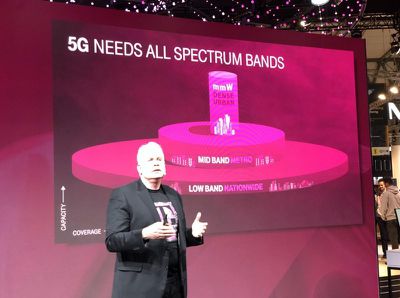
T-Mobile is planning to use the 600MHz spectrum to power most of its 5G network because while it offers slower peak speeds, it provides better coverage than the millimeter wave spectrum that Verizon and AT&T are currently focusing on more heavily.

Early 5G devices like the Galaxy S10 5G will use millimeter wave spectrum. T-Mobile plans to sell the Galaxy S10 5G, but given that its millimeter wave deployment is so limited at this time, Ray is not sure the company will promote Samsung's newest smartphone.

CNET's original story suggested T-Mobile was delaying its 5G launch entirely, but Ray says that is not true. On Twitter, Ray clarified that 5G will still start rolling out in the first half of 2019, but that it will get "more meaningful" in the second half of the year when there are actual devices that can take advantage of the 600MHz 5G spectrum.


The network differences put T-Mobile a bit behind other cellular companies. AT&T has rolled out 5G in 12 cities, Verizon has a 5G home broadband service in a limited number of cities, and Sprint is planning to launch its 5G network in May.

T-Mobile isn't worried about AT&T and Verizon having an edge in the race to deploy 5G just because millimeter wave spectrum has such a limited range. "You can't go to a US consumer and charge them a big premium and it works on three street corners," Ray told CNET.

Full 5G rollout with faster overall speeds will require carriers to offer 5G connectivity across multiple spectrums, with the fastest, millimeter wave, limited to dense urban areas. AT&T is also planning to offer 5G on low-band spectrum starting in 2019, with nationwide coverage planned for 2020.

For Apple users, the 2019 rollout of 5G means little because there won't be iPhones able to use 5G networks until at least 2020. Rumors have suggested Apple won't introduce a 5G-capable iPhone in 2019, and Intel recently confirmed that its 5G hardware won't be in consumer products until 2020. Apple is currently using Intel's modem chips in its ‌iPhone‌ lineup due to an ongoing legal spat with Qualcomm.

Tags: 5G, T-Mobile

Popular Stories

imac video apple feature

Apple Unveils First New Products of 2026

Monday January 26, 2026 1:55 pm PST by
Apple today introduced its first two physical products of 2026: a second-generation AirTag and the Black Unity Connection Braided Solo Loop for the Apple Watch. Read our coverage of each announcement to learn more:Apple Unveils New AirTag With Longer Range, Louder Speaker, and More Apple Introduces New Black Unity Apple Watch BandBoth the new AirTag and the Black Unity Connection Braided...
iPhone 5s

iPhone 5s Gets New Software Update 13 Years After Launch

Monday January 26, 2026 3:56 pm PST by
Alongside iOS 26.2.1, Apple today released an updated version of iOS 12 for devices that are still running that operating system update, eight years after the software was first released. iOS 12.5.8 is available for the iPhone 5s and the iPhone 6, meaning Apple is continuing to support these devices for 13 and 12 years after launch, respectively. The iPhone 5s came out in September 2013,...
Second Generation AirTag Feature

Apple Unveils New AirTag With Longer Range, Louder Speaker, and More

Monday January 26, 2026 6:07 am PST by
Apple today introduced the second-generation AirTag, with key features including longer range for tracking items and a louder speaker. For those who are not familiar, the AirTag is a small accessory that you can attach to your backpack, keys, or other items. Then, you can track the location of those items in the Find My app on the iPhone, iPad, Mac, Apple Watch, and iCloud.com. The new...
Apple Logo Spotlight

Apple to Launch These 20+ Products This Year

Sunday January 25, 2026 6:02 pm PST by
2026 promises to be yet another busy year for Apple, with the company rumored to be planning more than 20 product announcements over the coming months. Beyond the usual updates to iPhones, iPads, Macs, and Apple Watches, Apple is expected to release its all-new smart home hub, which was reportedly delayed until the more personalized version of Siri is ready. Other unique products rumored for ...
M5 MacBook Pro

Apple Reportedly Aiming to Upgrade the MacBook Pro Twice This Year

Sunday January 25, 2026 11:46 am PST by
Apple plans to release new MacBook Pro, MacBook Air, Mac Studio, and Studio Display models in the first half of this year, according to Bloomberg's Mark Gurman. In his Power On newsletter today, Gurman added that redesigned MacBook Pro models with an OLED touch screen "should be hitting toward the end of 2026," meaning that the MacBook Pro line would be upgraded twice this year. First up...

Top Rated Comments

Lenora Lynn Avatar
90 months ago
Translation: We will wait for ATT and Verizon to pay all the up front costs and swoop in once the tech is mature and commoditized.
Not really, since pretty much no company is doing much rollout in any of 2019.
Score: 11 Votes (Like | Disagree)
Sedulous Avatar
90 months ago
Who really cares? 5G will not be beneficial for the vast majority of users. If anything, I think T-mobile has the better plan. 600 MHz spectrum may be slower but at least it can pass through a wall. So unlike the Verizon and AT&T, T-mobile might actually have a more reliably decent signal. Gigabit speeds on mobile is useless if it cannot be received.
Score: 11 Votes (Like | Disagree)
jlocker Avatar
90 months ago
The real reason is T-Mobile and Sprint are about to merge and you don't want to spend a lot of money on 5G hardware when you are going to be using sprint towers as the infrastructure and spend a bunch of money on hardware all over again.
Score: 5 Votes (Like | Disagree)
nutmac Avatar
90 months ago
At 28-39 GHz in the US, which translates to only few hundred feet of usable range, mmWave is meaningful only in very densely populated metro cities, or top 50 markets (if at that).

mmWave spectrum holdings by top US carriers:

* AT&T: 39 GHz (30% of top 50 markets)
* Sprint: None
* T-Mobile: 28 GHz (12% of top 50 markets)
* Verizon: 28 GHz (76% of top 50 markets) and 39 GHz (46% of top 50 markets)

Sprint is betting on 2.5 GHz and T-Mobile is betting on 600 MHz. Neither will offer as much bandwidth as mmWave, which is why they want to merge so that they can leverage Carrier Aggregation (combining multiple frequencies). If Sprint and T-Mobiles does merge, the combined 5G spectrum can be very effective and superior to AT&T and Verizon's 5G offering.
Score: 5 Votes (Like | Disagree)
btrach144 Avatar
90 months ago
I’d prefer richer LTE rather than spotty 5G.
Score: 5 Votes (Like | Disagree)
archer75 Avatar
90 months ago
Do you currently have 5G at home?

I think 5G fixed wireless access will have a much greater impact for the average user than 5G mobile.
absolutely agree. 5g for mobile is severely overrated. But it will change the home internet landscape.
Score: 4 Votes (Like | Disagree)