The number one top-selling paid Utilities app on the Mac App Store in the United States has been found to steal the browser history of anyone who downloads it, and is still on the App Store as of this article. A video posted in August gave a proof of concept to how the app "Adware Doctor" steals user data, and security researcher Patrick Wardle has now looked into the app and shared his findings with TechCrunch.
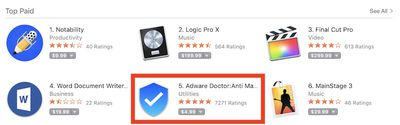
Adware Doctor's Mac App Store page says it will "keep your Mac safe" and "get rid of annoying pop-up ads." Besides being at the top of the Utilities chart on the Mac App Store, Adware Doctor is also currently the number five top paid app on the entire store in the U.S., behind apps like Notability and Apple's own Final Cut Pro.
In his blog post, Wardle explains that Adware Doctor withdraws sensitive user data -- predominantly any website you've searched for and browsed on -- and sends it to servers in China run by the app's makers. Apple was contacted a month ago -- around the time the original proof of concept video was shared online -- and promised it would investigate, but the $4.99 app remains on the Mac App Store.
TechCrunch gave an overview of Wardle's findings:
Wardle found that the downloaded app jumped through hoops to bypass Apple’s Mac sandboxing features, which prevents apps from grabbing data on the hard drive, and upload a user’s browser history on Chrome, Firefox, and Safari browsers.
Wardle found that the app, thanks to Apple’s own flawed vetting, could request access to the user’s home directory and its files. That isn’t out of the ordinary, Wardle says, because tools that market themselves as anti-malware or anti-adware expect access to the user’s files to scan for problems. When a user allows that access, the app can detect and clean adware — but if found to be malicious, it can “collect and exfiltrate any user file,” said Wardle.
Once the data is collected, it’s zipped into an archive file and sent to a domain based in China.
Towards the end of his post, Wardle discussed the ramifications of Adware Doctor and the privacy issue it presents, stating, "The fact that application has been surreptitiously exfiltrating users' browsing history, possibly for years, is, to put it mildly, rather f----- up!" The researcher also points out that Apple itself touts the Mac App Store as "the safest place to download apps for your Mac," which is often true.
Given the app violates numerous App Store Rules and Guidelines, namely including user consent on data collection, Wardle hopes that the increased spotlight on Adware Doctor's nefarious data collecting will make Apple take action. Even though Mac App Store customers who used the app would never be able to get their private browsing history back, the researcher says that Apple could begin to address the situation "by pulling the app and refunding all affected users."
Update 8:52 a.m. PT: Apple confirmed that Adware Doctor has been removed from the Mac App Store, along with the developer's other app "AdBlock Master."