Doctors Reveal Seizure Insights Gained From ResearchKit App - MacRumors
Skip to Content

Doctors Reveal Seizure Insights Gained From ResearchKit App

Medical doctors who used an Apple Watch app to discover the most common triggers of epileptic seizures will present their findings at the American Academy of Neurology's 69th Annual Meeting today in Boston, Massachusetts.

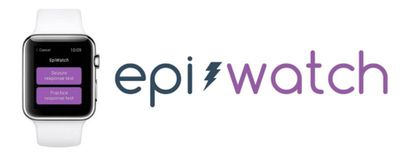
The 10-month study involved 598 people who tracked their seizures with an iPhone app called EpiWatch, which was built by Johns Hopkins using Apple's ResearchKit software framework. The app features a custom Apple Watch complication that provides patients with one-touch access to record accelerometer and heart rate sensor data. When participants felt a seizure aura coming on, they were asked to launch the app to let it record their heart rate and movements for 10 minutes.
Screen Shot 2 2
After the seizure had come to an end, participants filled out a brief survey about seizure type, aura, loss of awareness, and possible trigger that led to the seizure.

"The data collected will help researchers better understand epilepsy, while helping people with epilepsy keep a more complete history of their seizures," said study author Gregory Krauss, MD, in a press release. "The app also provides helpful tracking of seizures, prescription medication use and drug side effects -- activities that are important in helping people manage their condition."

Overall, 40 percent of the group tracked a total of 1,485 seizures, with 177 people reporting what triggered their seizures. Stress was revealed to be the most common trigger, and was linked to 37 percent of the seizures, while 18 percent of sufferers identified lack of sleep as another contributing factor. Meanwhile, menstruation was found to be a cause in 12 percent of recorded seizures, and overexertion accounted for 11 percent.

Stress was more commonly reported as a trigger for participants who worked full-time (35 percent), compared to those who worked part-time (21 percent), were unemployed (27 percent), or were disabled, (29 percent).

"Seizures are very unpredictable," said Krauss. "Our eventual goal is to be able to use wearable technology to predict an oncoming seizure. This could potentially save lives as well as give people with epilepsy more freedom. The data collected in this study helps us take a step in that direction."

The insights result from one of three ResearchKit studies launched by Johns Hopkins and Oregon Health & Science University in October 2015, which sought to learn more about autism, epilepsy and melanoma.

(Thanks, Fred!)
Related Roundup: Apple Watch 11

Popular Stories

airpods pro 3 pink

EU Drops Battery Removal Requirement for Apple Watch and AirPods

Wednesday July 15, 2026 7:02 am PDT by
The European Commission yesterday adopted new exemptions to its Batteries Regulation that free the Apple Watch and AirPods from having to offer user-removable and replaceable batteries. The EU's Batteries Regulation generally requires consumer products sold in the region to let users swap out their own batteries, a push meant to keep devices in use longer and make it easier to recover...
Apple Watch Series 10 Jet Black Touch ID

Apple Watch Series 12 Launching in September With These New Features

Monday July 20, 2026 1:00 pm PDT by
With the Apple Watch Series 12 now just two months away, we have created a recap of rumored new features, with some more likely than others. Below, we have outlined everything rumored so far for the Apple Watch Series 12. More Likely New Chip After One-Year Hiatus While the Apple Watch Series 11, Apple Watch Ultra 3, and Apple Watch SE 3 all contain the same S10 chip as the previous...
apple watch rescue

Apple Shares Apple Watch SOS Success Story

Tuesday July 21, 2026 9:26 am PDT by
Apple today highlighted the SOS feature in the Apple Watch, publishing a short video featuring a man named Phil, who crashed while mountain biking. Phil was biking with his two young children when he had an accident and was knocked unconscious. His Apple Watch detected the fall, calling emergency services and alerting his wife. He ended up breaking his collarbone and seven ribs, but was...

Top Rated Comments

StevenPG Avatar
124 months ago
This is great news for Apple research kit. I hope to see more news like this. And maybe one day lead to some cures.
Score: 4 Votes (Like | Disagree)
shpankey Avatar
124 months ago
As a father with a child that has seizures... this makes my heart so happy. What a wonderful thing!
Score: 3 Votes (Like | Disagree)
sblemmy Avatar
124 months ago
Ultimately, I think this is what Tim Cook's legacy will be for Apple. The US spends over $3 trillion a year on healthcare, yet we lag behind our European counterparts on key health indicators such as infant mortality and life expectancy.

You'd be hard pressed to find someone who didn't agree that the US health care market is fundamentally flawed, particularly when it comes to patient care management and communication. In most ways, the health care industry is ripe for technological disruption.

I recall when Steve Jobs introduced the iPhone, he talked bout how profitable capturing just a small segment of the cell phone market would be for Apple. If Apple revolutionized and monetized just 1/2% of the healthcare market, they'd easily rake in $15 billion a year.
Score: 2 Votes (Like | Disagree)
prasand Avatar
124 months ago
good sh-t. great even. Glad to see the advances in understanding that Apple Watch and / or HealthKit data provides.
Score: 2 Votes (Like | Disagree)
Sweetfeld28 Avatar
124 months ago
I'm thankful that Apple is helping further research for these medical issues. I had Epilepsy as a child, I'll never forget the stress and panic that each episode caused.
Score: 1 Votes (Like | Disagree)