Latest iOS 9.3 Beta Unbricks iPhones Affected by 'January 1, 1970' Date Bug
The most recent beta of iOS 9.3, provided to developers and public beta testers earlier this week, fixes a bug that caused 64-bit iPhones and iPads to be disabled or "bricked" when the date was set to January 1, 1970.
Discovered in mid-February, the "1970" bug occurs whenever an iOS device's date is manually set to 1970, resulting in a continuous reboot cycle. Speculation has suggested the reboot loop is the result of an integer underflow that causes the iPhone to reset the date to the maximum value, a huge number that iOS devices may be unable to process.
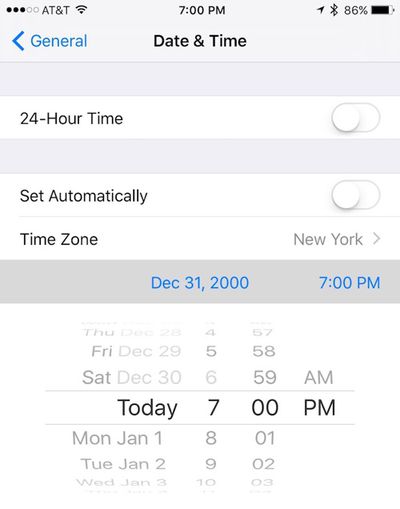
With iOS 9.3 beta 4, the date on the iPhone or iPad can't be set beyond December 31, 2000 at 7:00 p.m. ET, which equates to 1/1/01 at 12:00 a.m. GMT. That effectively puts an end to the 1970 bug, which was used to trick some people into bricking their devices.
The beta also introduces a fix for devices that had been disabled by the bug. As explained on the MacRumors forums, devices stuck in boot loops were able to be restored to working order through a restore using iOS 9.3 beta 4.
This update fixed the 1970 date bug. Had two retail units stuck in boot loops do to some pricks setting the date to 1970 and restoring in DFU mode did not help. But restorting to this BETA update made both devices go back to normal.
Previously, there was no clear fix for devices that had been affected by the bug aside from disconnecting the battery, requiring users to go to the Genius Bar at an Apple retail store or attempt risky self-repairs. Apple promised a fix in an "upcoming software update," which appears to be iOS 9.3.
iOS 9.3 is currently only available to developers and public beta testers, but we may be nearing the end of the beta testing period. Apple has said the software will debut in the spring, and it's likely we will see it launch to the public following the company's rumored March 15 event where it is expected to introduce the iPhone 5se, the iPad Air 3, and new Apple Watch bands.
Popular Stories
In addition to updating many of its existing products, Apple is expected to unveil five all-new products this year, including a smart home hub, a Face ID doorbell, a MacBook with an A18 Pro chip, a foldable iPhone, and augmented reality glasses.
Below, we have recapped rumored features for each product.
Smart Home Hub
Apple home hub (concept)
Apple's long-rumored smart home hub should...
Apple is planning to debut a high-end secondary version of AirPods Pro 3 this year, sitting in the lineup alongside the current model, reports suggest.
Back in September 2025, supply chain analyst Ming-Chi Kuo reported that Apple is planning to introduce a successor to the AirPods Pro 3 in 2026. This would be somewhat unusual since Apple normally waits around three years to make major...
Apple is working on a small, wearable AI pin equipped with multiple cameras, a speaker, and microphones, reports The Information. If it actually launches, the AI pin will likely run the new Siri chatbot that Apple plans to unveil in iOS 27.
The pin is said to be similar in size to an AirTag, with a thin, flat, circular disc shape. It has an aluminum and glass shell, and two cameras at the...
Over the last few months, rumors around the iPhone 18 Pro's front-panel design have been conflicted, with some supply-chain leaks pointing to under-display Face ID, reports suggesting a top-left hole-punch camera, and debate over whether the familiar Dynamic Island will shrink, shift, or disappear entirely.
Today, Weibo-based leaker Instant Digital shared new details that appear to clarify the ...
Apple is expected to release MacBook Pro models with M5 Pro and M5 Max chips soon, but you might want to pass on them, as bigger changes are around the corner.
It has been reported that the MacBook Pro will be receiving a major redesign in late 2026 or in 2027. Six new features have been rumored so far, including an OLED display, touch capabilities, a Dynamic Island, M6 Pro and M6 Max chips...