New Research Claims iMessage Accounts for 30% of Mobile Spam Messages
iMessage is responsible for more than 30% of all spam messages on mobile devices, according to research done by security expert Tom Landesman and anti-spam company Cloudmark (via Wired). The researcher notes that there are multiple reasons as to why the platform has become a prime choice for spammers, stating that iMessage's reach across the iPhone, iPad, and Mac along with its accessibility have made it easy to target users:
That fusion of the desktop and mobile world makes it particularly easy for scammers to write a Mac OS script that can send messages to all types of devices just as fast as Apple will allow. “It’s almost like a spammer’s dream,” says Landesman. “With four lines of code, using Apple scripts, you can tell your Mac machine to send message to whoever they want.”
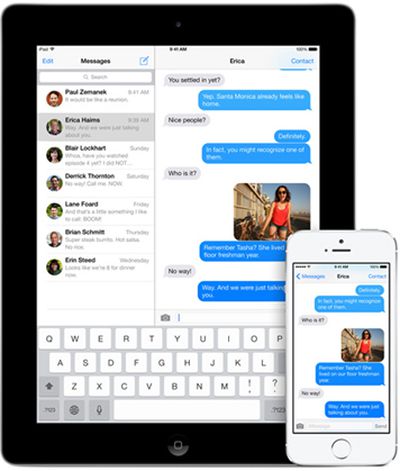
With iMessage, spammers can send unwanted messages to a user's associated emails and phone numbers if enabled. The ability for the desktop Messages client to verify numbers with the iMessage network has also made sending spam to confirmed users easier, along with the fact that signing up for the service can be done with just an email. The researcher further notes that iMessage's read receipts feature (which can be turned off) allows spammers to better generate a list of verified users to spam based on activity.
Apple has made a few moves to combat spam in iMessage over the past year, adding a rate-limit for sent messages after some iOS developers experienced a denial-of-service prank, and adding a spam reporting tool. However, that tool remains a bit complicated to use, as it requires users to send Apple an email containing the screenshot of the spam message, the email or phone number it was received from, and the date and time.
Popular Stories
In addition to updating many of its existing products, Apple is expected to unveil five all-new products this year, including a smart home hub, a Face ID doorbell, a MacBook with an A18 Pro chip, a foldable iPhone, and augmented reality glasses.
Below, we have recapped rumored features for each product.
Smart Home Hub
Apple home hub (concept)
Apple's long-rumored smart home hub should...
Apple is planning to debut a high-end secondary version of AirPods Pro 3 this year, sitting in the lineup alongside the current model, reports suggest.
Back in September 2025, supply chain analyst Ming-Chi Kuo reported that Apple is planning to introduce a successor to the AirPods Pro 3 in 2026. This would be somewhat unusual since Apple normally waits around three years to make major...
Apple is working on a small, wearable AI pin equipped with multiple cameras, a speaker, and microphones, reports The Information. If it actually launches, the AI pin will likely run the new Siri chatbot that Apple plans to unveil in iOS 27.
The pin is said to be similar in size to an AirTag, with a thin, flat, circular disc shape. It has an aluminum and glass shell, and two cameras at the...
Over the last few months, rumors around the iPhone 18 Pro's front-panel design have been conflicted, with some supply-chain leaks pointing to under-display Face ID, reports suggesting a top-left hole-punch camera, and debate over whether the familiar Dynamic Island will shrink, shift, or disappear entirely.
Today, Weibo-based leaker Instant Digital shared new details that appear to clarify the ...
Apple is expected to release MacBook Pro models with M5 Pro and M5 Max chips soon, but you might want to pass on them, as bigger changes are around the corner.
It has been reported that the MacBook Pro will be receiving a major redesign in late 2026 or in 2027. Six new features have been rumored so far, including an OLED display, touch capabilities, a Dynamic Island, M6 Pro and M6 Max chips...