Skip to Content

Testing Finds Inaccurate Touch Sensing on iPhone 5s/5c, But Neglects Perspective Compensation

New touch screen testing conducted by Finnish technology company OptoFidelity has suggested [PDF] the touch displays of Apple's iPhone 5s and iPhone 5c are less accurate than the display of the Samsung Galaxy S3, but the testing has failed to take into account that Apple has designed its iPhones to compensate for different usage angles.

Using its proprietary OptoFidelity Touch Panel Performance Tester, which compares the coordinates of touches by a robot with an artificial finger to coordinates from a touch device, the company measured the accuracy of both the iPhone 5s, the iPhone 5c, and the Galaxy S3. The video below demonstrates how the testing was carried out.


The test assigned a PASS/FAIL score when the actual touch position registered greater than ±1 mm off from the reported coordinates from the artificial finger, marking passes with green dots and fails with red dots. According to the test, both of Apple's iPhones demonstrated "extremely bad" performance near the edges and the top of the screen.
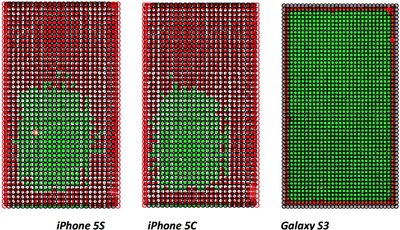
touchscreenaccuracy
OptoFidelity suggests that this impacts both top and edge screen functionality, making it more difficult to perform tasks like accessing the Q and P keys on the virtual keyboard as they are located towards the edges of the display, but machine testing does not replicate real world usage, where the phone is held at and viewed from various angles.

iOS is designed to compensate for the angle that it expects a phone to be held at, which suggests that some of the discrepancies between screen accuracy between the iPhone 5s/5c and the Galaxy S3 may be intentional on Apple's part, in order to provide a better experience for users that are not holding their phones in static positions.

In addition to testing touch screen accuracy, OptoFidelity also took a look at touch screen latency, which was previously examined by Agawi. As with those initial tests that showed the iPhone 5 to be far more accurate than its Android counterparts, OptoFidelity had similar results with the iPhone 5s and the iPhone 5c.

Testing functionality such as web browsing opening time and camera application opening time revealed that the iPhones were more responsive than the Galaxy S3, with the iPhone 5s registering slightly faster response times.
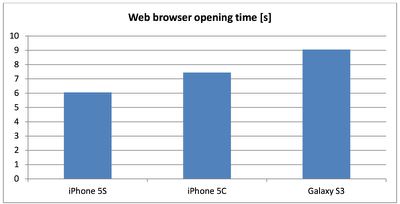
optolatency

Popular Stories

Multicolored Low Cost A18 Pro MacBook Feature

Apple Accidentally Leaks 'MacBook Neo'

Tuesday March 3, 2026 7:00 am PST by
Apple appears to have prematurely revealed the name of its rumored lower-cost MacBook model, which is expected to be announced this Wednesday. A regulatory document for a "MacBook Neo" (Model A3404) has appeared on Apple's website. Unfortunately, there are no further details or images available yet. While the PDF file does not contain the "MacBook Neo" name, it briefly appeared in a link...
imac video apple feature

Apple Unveils Two New Products

Monday March 2, 2026 7:49 am PST by
Apple today introduced two new devices, including the iPhone 17e and an updated iPad Air. iPhone 17e features the same overall design as the iPhone 16e, but it gains Apple's A19 chip, MagSafe for magnetic wireless charging and magnetic accessories, Apple's second-generation C1X modem for faster 5G, and a doubled 256GB of base storage. In the U.S., the iPhone 17e starts at $599, just like the ...
MacBook Neo Feature Pastel 1

Apple Announces $599 'MacBook Neo' With A18 Pro Chip

Wednesday March 4, 2026 6:15 am PST by
Apple today announced the "MacBook Neo," an all-new kind of low-cost Mac featuring the A18 Pro chip for $599. The MacBook Neo is the first Mac to be powered by an iPhone chip; the A18 Pro debuted in 2024's iPhone 16 Pro models. Apple says it is up to 50% faster for everyday tasks than the bestselling PC with the latest shipping Intel Core Ultra 5, up to 3x faster for on-device AI workloads,...

Top Rated Comments

iSee Avatar
161 months ago
Once again Apple thumbs its nose at the robot market :mad: ;)
Score: 20 Votes (Like | Disagree)
161 months ago
Shouldn't they be testing against a GS4?
Score: 20 Votes (Like | Disagree)
atzeX Avatar
161 months ago
It is intentional by Apple.

Try to touch some buttons if the UI is upside down... difficult, isn’t it?

Guess why ;)

(Apple offsets the touch so that your eye-finger-button line is straight on the target)
Score: 16 Votes (Like | Disagree)
204353 Avatar
161 months ago
These tests mean nothing because the iPhone actually registers touches slightly above the centre of where you put your fingertip, an intentional compensation to make it prefer the 'tip' of your finger, rather than the middle of the contact area.

Try tapping buttons with your iOS upside-down (with orientation lock on) and you'll see how different it is. I know the article kinda mentions this feature, but I thought I'd make it clear how it actually works.
Score: 15 Votes (Like | Disagree)
polterbyte Avatar
161 months ago
Yes, because that's EXACTLY how everybody uses their phones: with an artificial finger dangling from a robot arm. /s

Prepare for touchscreenprecisiongate, about which absolutely nobody is complaining.

Obligatory endnote: Apple is doomed. DOOMED!
Score: 13 Votes (Like | Disagree)
Carlanga Avatar
161 months ago
Just an observation: There is a thread here in the forum since A.M. about it (not mine), maybe ~4 hours before this front page post. Lately MR keeps taking thread subjects from the sub forums and then making it a new rumor w/out mentions.

Either way, the test is interesting.
Score: 12 Votes (Like | Disagree)