Inside Apple's A7 Chip, M7 Motion Coprocessor, and More from the iPhone 5s

At its media event introducing the new iPhones earlier this month, Apple highlighted several chip innovations included on the iPhone 5s including a new A7 main chip with one billion transistors and a smaller M7 "motion coprocessor" designed to efficiently measure accelerometer, gyroscope, and compass data and thus allow for enhanced fitness tracking, navigation, and more.

Chipworks and iFixit have now posted a teardown revealing what's inside these chips, as well as several other components of the iPhone 5s, offering an interesting first glimpse at these components at the heart of the device.

In looking at the A7, Chipworks noted that it is indeed manufactured by Samsung using its 28-nm process node. Apple has been seeking to shift its A-series chip production from Samsung to TSMC, but TSMC's chip production will reportedly not start until early 2014.
a7_a6_gate_pitch

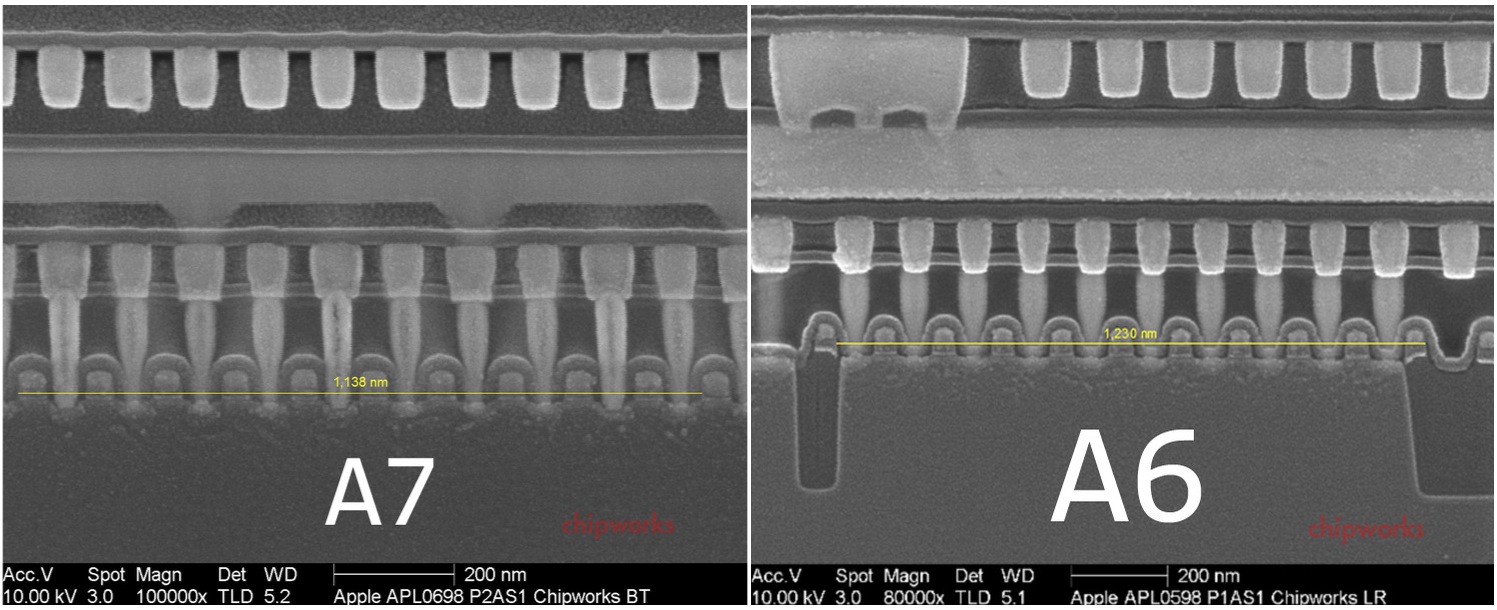
Gate pitch comparison of A7 and A6 (click for larger)

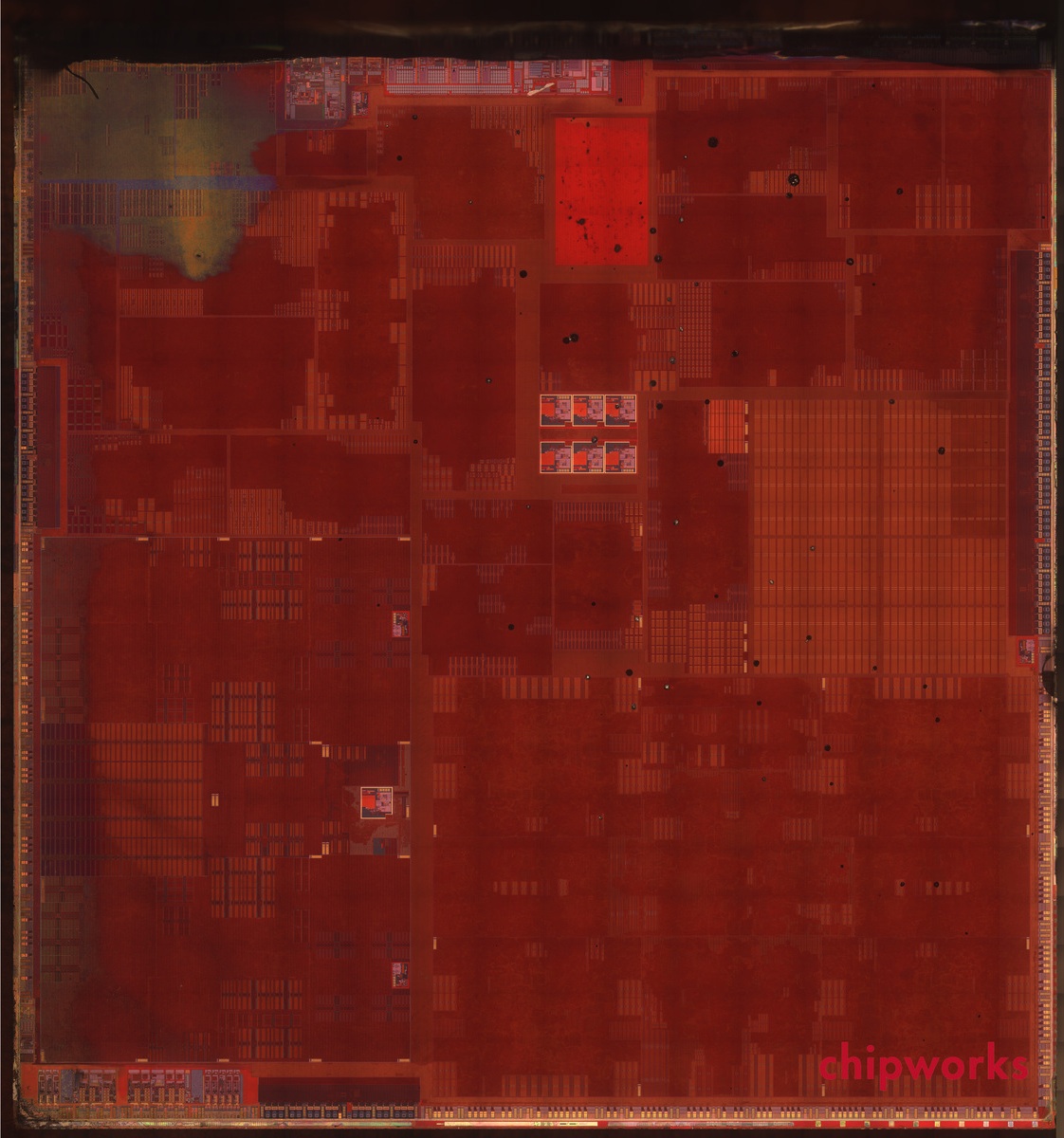
For the A7, Apple and Samsung have reduced spacing between transistors to 114 nanometers, a 7.3% decrease compared to the A6 chip. That denser transistor packing plus a slightly increased die size has helped Apple to fit approximately one billion transistors on the chip.

It turns out that the A7′s “gate pitch” — the distance between each transistor — is 114 nm, compared to the A6′s 123 nm.

Those 9 nm are a big deal. Looking to improve on their current 32 nm process, Apple decided to make the A7 with the same 28 nm process as the eight-core Samsung Exynos 5410, the current flagship CPU for Samsung’s own Galaxy line.
a7_transistor_die

A7 transistor die photo (click for larger)

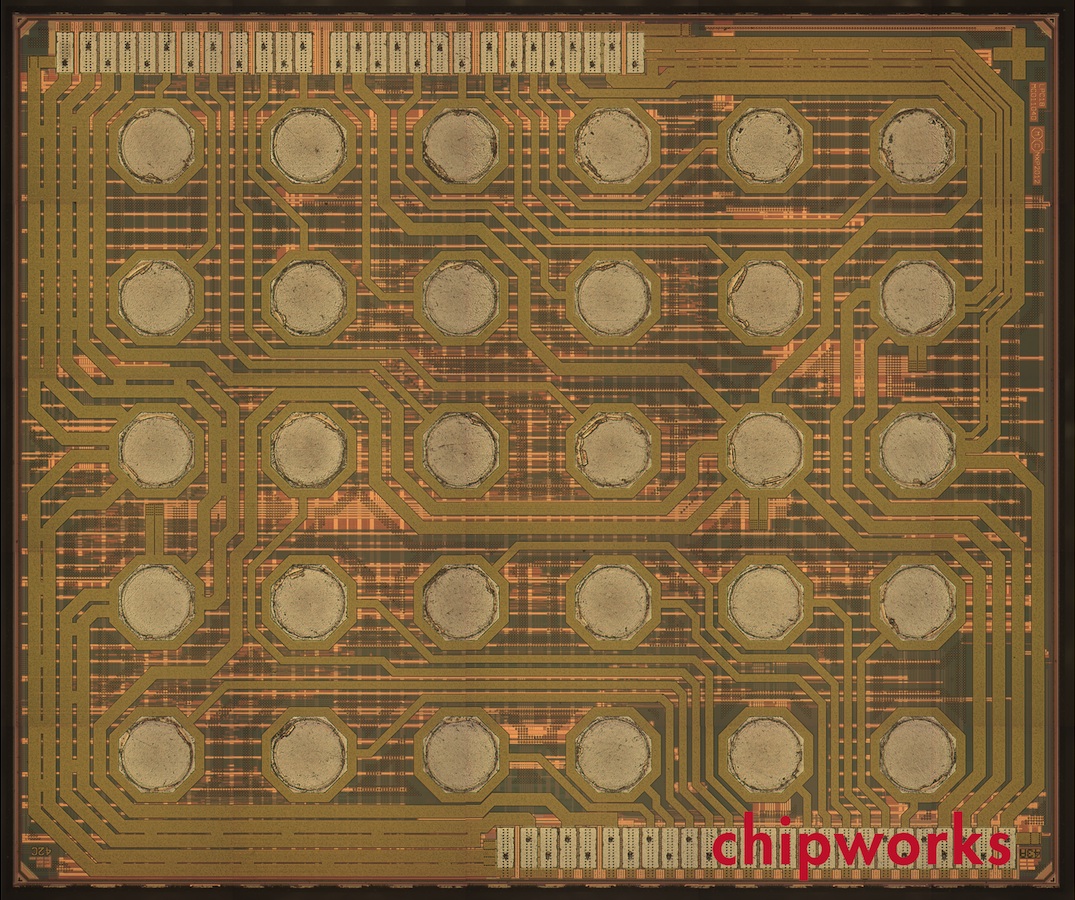
Chipworks also took a look at the M7, which is actually an ARM Cortex-M3 part from NXP running at 180 MHz. The chip allows for low-power collection of motion data drawn from a Bosch Sensortec accelerometer, an STMicroelectronics gyroscope, and an AKM magnetometer.

After collecting information from the accelerometer, gyroscope, and magnetometer, the M7 performs some matrix math processing magic to produce an absolute orientation of the phone relative to the world. This data is then passed to the A7 in a neat package, probably in the form of three headings (roll, pitch, and yaw).

Using the A7 to monitor this sort of data would be mega-overkill, so the M7 was introduced to maintain a constant, low-power watch over these sensors.
m7_die_photo

M7 die photo (click for larger)

Finally, Chipworks performed some analysis on several other components from the iPhone 5S, including the rear camera sensor and LTE modem, while iFixit pointed to the Wi-Fi module and various radio and power amplifier components that all work together to provide connectivity for the new iPhone.
Related Forum: iPhone

Popular Stories

maxresdefault

Apple Shows Off a Key Reason to Upgrade to the iPhone 17

Saturday February 7, 2026 9:26 am PST by
Apple today shared an ad that shows how the upgraded Center Stage front camera on the latest iPhones improves the process of taking a group selfie. "Watch how the new front facing camera on iPhone 17 Pro takes group selfies that automatically expand and rotate as more people come into frame," says Apple. While the ad is focused on the iPhone 17 Pro and iPhone 17 Pro Max, the regular iPhone...
Finder Siri Feature

Why Apple's iOS 26.4 Siri Upgrade Will Be Bigger Than Originally Promised

Friday February 6, 2026 3:06 pm PST by
In the iOS 26.4 update that's coming this spring, Apple will introduce a new version of Siri that's going to overhaul how we interact with the personal assistant and what it's able to do. The iOS 26.4 version of Siri won't work like ChatGPT or Claude, but it will rely on large language models (LLMs) and has been updated from the ground up. Upgraded Architecture The next-generation...
wwdc sans text feature

Apple Rumored to Announce New Product on February 19

Thursday February 5, 2026 12:22 pm PST by
Apple plans to announce the iPhone 17e on Thursday, February 19, according to Macwelt, the German equivalent of Macworld. The report, citing industry sources, is available in English on Macworld. Apple announced the iPhone 16e on Wednesday, February 19 last year, so the iPhone 17e would be unveiled exactly one year later if this rumor is accurate. It is quite uncommon for Apple to unveil...
apple wallet drivers license feature iPhone 15 pro

Apple Says These 7 U.S. States Plan to Offer iPhone Driver's Licenses

Monday February 9, 2026 6:24 am PST by
In select U.S. states, residents can add their driver's license or state ID to the Apple Wallet app on the iPhone and Apple Watch, and then use it to display proof of identity or age at select airports and businesses, and in select apps. The feature is currently available in 13 U.S. states and Puerto Rico, and it is expected to launch in at least seven more in the future. To set up the...
14 inch MacBook Pro Keyboard

New MacBook Pros Could Now Arrive in March

Sunday February 8, 2026 6:02 am PST by
New MacBook Pro models with the M5 Pro and M5 Max chips could arrive as soon as Monday, March 2, according to Bloomberg's Mark Gurman. In today's "Power On" newsletter, Gurman said that the release of new MacBook Pro models is tied to the release of macOS Tahoe 26.3. The launch is said to be slated for as early as the week of March 2. He added that the M4 Pro and M4 Max models on sale today...

Top Rated Comments

sransari Avatar
162 months ago
such gr8 advancements in dental x-ray technology
Score: 11 Votes (Like | Disagree)
JHankwitz Avatar
162 months ago
Chip Technology

This chip technology is mind boggeling and truely amazing. I remember building my first computer (if you can still consider it that) using a few dozen vaccum tubes back in the late '50s. Each of the tubes contained up to 4 electronic switches. That baby was hot... literally. Now this little chips contains a billion switches and just warm to the touch... truely amazing!
Score: 7 Votes (Like | Disagree)
SmoMo Avatar
162 months ago
Integrating

Still haven't figured out what the M7 actually does...

I'm not 100% sure but I would guess it is probably applying a Kalman filter : http://en.wikipedia.org/wiki/Kalman_filter

When you have several overlapping sensor inputs you can combine them in such a way to minimise potential error.

In the case of the iPhone, the Compass heading can be used to calibrate heading and the accelerometer/gyroscope used to integrate minute changes that the compass is not sensitive enough to pickup.

The ultimate goal would be to also integrate GPS coordinates, and have a system accurate enough that it could track your movement ( by integrating accelerations twice ) but as I understand it the accuracy of the sensors is still way too low for this to be feasible.
Score: 5 Votes (Like | Disagree)
firewood Avatar
162 months ago
I wonder if some descendant of the A7 will be able to replace intel inside a future MacBook..

Why wait for a descendant?

I ported some of my extremely compute intensive engineering calculations from my 2009 MacBook Pro to iOS, recompiled for arm64 using the new Xcode, and found that the calculations now benchmark just as fast on an iPhone 5s as on the MacBook Pro (which BTW is a lot faster than was a desktop G5 "supercomputer").

No waiting, equal performance, better battery life, and, very unlike the G5, it fits in my pocket.
Score: 4 Votes (Like | Disagree)
MRSucks Avatar
162 months ago
I disagree. A7/M7/64-bit technology is right here, right now.

The ball is at the hands of the iOS apps developers.

The next six / twelve months will be exciting times for iPhone 5s users.

Next year will just be going thru the motion. Another cycle of pissing contests between the fanboys.
Score: 4 Votes (Like | Disagree)
Paradoxally Avatar
162 months ago
Best way I have heard it explained: The A7 is the chip of tomorrow; not today.

All of the side-by-side comparison tests show no significant real world performance benefit to the A6 in the iPhone 5 (basic OS use, no gaming). By the time the 64-bit architecture catches on and is fully realized by developers, the iPhone 6 will be looming around the corner...

Yes they do. The A7 is noticeably faster in many apps, not just gaming. iOS 7 stutters a bit on the iPhone 5, no stutter on the 5S (in multitasking) - but this is probably due to lack of optimization.
Score: 4 Votes (Like | Disagree)