Google Forking WebKit to Create New Web Rendering Engine for Chrome
Google announced today that the company is forking the WebKit rendering engine to create its own web rendering engine called 'Blink'. Google had been the using Apple-initiated WebKit project to power its Chrome web browser. Future versions, however, will now be based on this new system.
Google is now free to make changes to its rendering engine with less complexity and bureaucracy than when it was saving its changes to Webkit. The company posted this on its FAQ explaining why it wanted to create a new engine:
The main reason is that Chromium uses a different multi-process architecture than other WebKit-based browsers. So, over the years, supporting multiple architectures has led to increasing complexity for both the WebKit and Chromium communities, slowing down the collective pace of innovation.
With the change, Google has set Chrome and Apple's Safari on their own paths. Webkit was originally created by Apple as a fork to the KHTML rendering engine. Apple took interest in developing it when launching Safari for the Mac, and it now powers Safari for iOS, as well.
WebKit has been heavily adopted with over 20 companies now contributing to the project. Google and Apple, however, have remained the most active contributors to the open-source project.
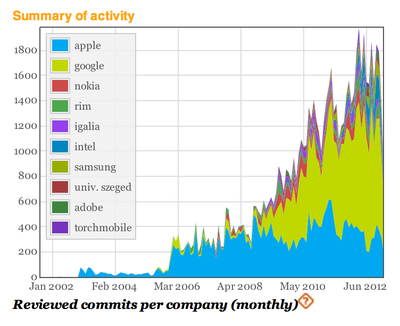
In fact, Google has been the most active contributor of WebKit in the recent years. This graph from Bitergia (above) shows Google's increasing number of "commits" to WebKit over the years. Google's efforts will now be directed at 'Blink'. Apple has made no public comments about the news.
Popular Stories
Software from an iPhone prototype running an early build of iOS 26 leaked last week, giving us a glimpse at future Apple devices and iOS features. We recapped device codenames in our prior article, and now we have a list of some of the most notable feature flags that were found in the software code.
In some cases, it's obvious what the feature flags are referring to, while some are more...
Last week, details about unreleased Apple devices and future iOS features were shared by Macworld. This week, we learned where the information came from, plus we have more findings from the leak.
As it turns out, an Apple prototype device running an early build of iOS 26 was sold, and the person who bought it shared the software. The OS has a version number of 23A5234w, and the first...
Apple is testing iOS 26.3, the next version of iOS 26 that will launch around January. Since iOS 26.3's testing is happening over the holidays, it is a smaller update with fewer features than we've seen in prior betas.
We've rounded up what's new so far, and we'll add to our list with subsequent betas if we come across any other features.
Transfer to Android
Apple is making it simpler...
Macworld's Filipe Espósito today revealed a handful of features that Apple is allegedly planning for iOS 26.4, iOS 27, and even iOS 28.
The report said the features are referenced within the code for a leaked internal build of iOS 26 that is not meant to be seen by the public. However, it appears that Espósito and/or his sources managed to gain access to it, providing us with a sneak peek...
The first foldable iPhone will feature a series of design and hardware firsts for Apple, according to details shared by the Weibo leaker known as Digital Chat Station.
According to a new post, via machine translation, Apple is developing what the leaker describes as a "wide foldable" device, a term used to refer to a horizontally oriented, book-style foldable with a large internal display....
Next year's iPhone 18 Pro and iPhone 18 Pro Max will be equipped with under-screen Face ID, and the front camera will be moved to the top-left corner of the screen, according to a new report from The Information's Wayne Ma and Qianer Liu.
As a result of these changes, the report said the iPhone 18 Pro models will not have a pill-shaped Dynamic Island cutout at the top of the screen....
Apple released the AirPods Max on December 15, 2020, meaning the over-ear headphones launched five years ago today. While the AirPods Max were updated with a USB-C port and new color options last year, followed by support for lossless audio and ultra-low latency audio this year, the headphones lack some of the features that have been introduced for newer generations of the regular AirPods and the ...
We have been covering iPhone 18 Pro, iPhone 17e, and iPhone Fold details from The Information's report about future iPhone models, and next up is the iPhone Air 2.
The report says that Apple aims to make the iPhone Air 2 more attractive in two ways.
First, Apple is apparently considering adding a second rear camera to the device, which would resolve a key limitation. The current iPhone...