Flashback Malware's Ad-Click Hijacking Detailed, Could Reap $10,000/Day
Antivirus firm Symantec has published a new blog post examining how the Flashback malware affecting hundreds of thousand of Macs has been generating revenue for its authors by hijacking users' ad clicks. According to the report, the widespread nature of the infection means that malware authors could have been generating up to $10,000 per day from the scheme at its peak based on previous analysis of malware click redirection.
The Flashback ad-clicking component is loaded into Chrome, Firefox, and Safari where it can intercept all GET and POST requests from the browser. Flashback specifically targets search queries made on Google and, depending on the search query, may redirect users to another page of the attacker's choosing, where they receive revenue from the click . (Google never receives the intended ad click.)
Symantec's work on the ad-click hijacking aspect of Flashback comes after Russian firm Dr. Web, which was responsible for the initial publicity about the malware, published its own report examining some of the early data on infected computers seeking to connect to command-and-control servers.
The report looks at nearly 100,000 connections that came in on April 13, finding that close to two-thirds of the infected machines identified themselves as running Mac OS X Snow Leopard, which was the last version of OS X to ship with Java enabled by default. OS X Lion does not include Java by default, and thus was responsible for only 11% of infections seen during the survey period.
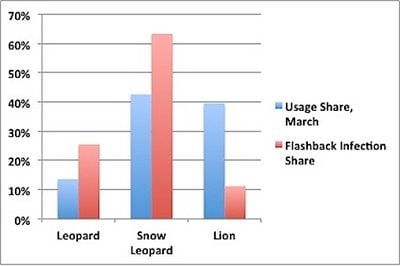
Flashback infection share vs. operating system usage share (Data via Dr. Web, Chart via Computerworld)As
noted by Computerworld, OS X Lion represents nearly 40% of OS X copies currently in use, suggesting that Apple's decision to remove Java from the default Lion install is indeed helping to limit infections on Apple's newest machines.
[W]hile Snow Leopard's and Leopard's infection rates are higher than their usage shares, the opposite's true of OS X 10.7, or Lion. The 2011 OS accounted for 39.6% of all copies of OS X used last month, yet represented only 11.2% of the Flashback-compromised Macs.
Dr. Web's data on OS kernel versions being reported from infected Macs also demonstrates that many Mac users do not keep their systems up-to-date, with roughly 25% of Snow Leopard and Lion systems seen in the survey reporting themselves as at least one version behind Apple's most recent updates (10.6.8 for Snow Leopard and 10.7.3 for Lion).
Popular Stories
Apple seeded the second iOS 26.2 Release Candidate to developers earlier this week, meaning the update will be released to the general public very soon.
Apple confirmed iOS 26.2 would be released in December, but it did not provide a specific date. We expect the update to be released by early next week.
iOS 26.2 includes a handful of new features and changes on the iPhone, such as a new...
Apple today released new firmware designed for the AirPods Pro 3 and the prior-generation AirPods Pro 2. The AirPods Pro 3 firmware is 8B30, up from 8B25, while the AirPods Pro 2 firmware is 8B28, up from 8B21.
There's no word on what's include in the updated firmware, but the AirPods Pro 2 and AirPods Pro 3 are getting expanded support for Live Translation in the European Union in iOS...
Google Maps on iOS quietly gained a new feature recently that automatically recognizes where you've parked your vehicle and saves the location for you.
Announced on LinkedIn by Rio Akasaka, Google Maps' senior product manager, the new feature auto-detects your parked location even if you don't use the parking pin function, saves it for up to 48 hours, and then automatically removes it once...
Macworld's Filipe Espósito today revealed a handful of features that Apple is allegedly planning for iOS 26.4, iOS 27, and even iOS 28.
The report said the features are referenced within the code for a leaked internal build of iOS 26 that is not meant to be seen by the public. However, it appears that Espósito and/or his sources managed to gain access to it, providing us with a sneak peek...
Apple has ordered 22 million OLED panels from Samsung Display for the first foldable iPhone, signaling a significantly larger production target than the display industry had previously anticipated, ET News reports.
In the now-seemingly deleted report, ET News claimed that Samsung plans to mass-produce 11 million inward-folding OLED displays for Apple next year, as well as 11 million...
Apple today released iOS 26.2, the second major update to the iOS 26 operating system that came out in September, iOS 26.2 comes a little over a month after iOS 26.1 launched. iOS 26.2 is compatible with the iPhone 11 series and later, as well as the second-generation iPhone SE.
The new software can be downloaded on eligible iPhones over-the-air by going to Settings >...
The AirTag 2 will include a handful of new features that will improve tracking capabilities, according to a new report from Macworld. The site says that it was able to access an internal build of iOS 26, which includes references to multiple unreleased products.
Here's what's supposedly coming:
An improved pairing process, though no details were provided. AirTag pairing is already...
Apple is about to release iOS 26.2, the second major point update for iPhones since iOS 26 was rolled out in September, and there are at least 15 notable changes and improvements worth checking out. We've rounded them up below.
Apple is expected to roll out iOS 26.2 to compatible devices sometime between December 8 and December 16. When the update drops, you can check Apple's servers for the ...
Apple today released macOS Tahoe 26.2, the second major update to the macOS Tahoe operating system that came out in September. macOS Tahoe 26.2 comes five weeks after Apple released macOS Tahoe 26.1.
Mac users can download the macOS Tahoe update by using the Software Update section of System Settings.
macOS Tahoe 26.2 includes Edge Light, a feature that illuminates your face with soft...