Safari AutoFill Security Issue Rears Its Head Once Again
Back in July, security researcher Jeremiah Grossman revealed a security issue that could allow malicious parties to take advantage of Safari's AutoFill feature to extract personal information from users' Address Book entries. At the time, Grossman reported that his report to Apple had gone essentially unacknowledged for nearly a month, but just six days later Apple released Safari 5.0.1 and 4.1.1 to address the problem.
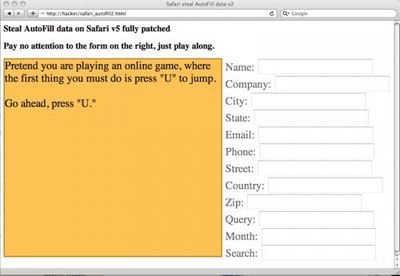
Screenshot of Grossman's proof-of-concept test of new AutoFill exploitGrossman
now reports that he has discovered another similar AutoFill security issue that, while requiring the malicious party to trick users into providing a pair of keystrokes rather than being completely automated as in the previous exploit, offers an even more efficient means for users' personal information to be obtained.
To perform our attack requires tiny bit of end-user trickery. Two button presses to be precise. A malicious website detects (ie: IP address) the country the victim is from. For our purposes here we'll assume the "US." The attacker invisibly (CSS transparency) sets up the aforementioned form and forces the keystroke focus into the country element. Notice how this is done in the video on the right side of the screen, which only visible for demonstration purposes. Next the attacker entices the victim to type "U" (first character of "US") and then press "TAB." And BAM! That's it! Data stolen.
Grossman relates that he notified Apple of the newly-discovered exploit via email on August 10th and again a few days later. One week after that, he received a phone call from an Apple product security engineer with whom he had a "productive chat" about how the original vulnerability report from June had been handled, only to discover at the end of the conversation that the engineer had no idea that Grossman had reported the second issue a week and half prior.
As with the earlier exploit, users can protect themselves by simply turning off the AutoFill option to automatically populate forms with information from their Address Book cards. Grossman notes, however, that he is unsure how Apple plans to address the vulnerability while still maintaining the convenience of the AutoFill feature. While Apple's previous patch allowed Safari to automatically differentiate from the automated JavaScript-simulated keystrokes from real keystrokes, thus thwarting the original exploit, the new exploit relies on tricking the user into actually entering the necessary keystroke, a tactic that could be more difficult to address.

Popular Stories
Apple is about to release iOS 26.2, the second major point update for iPhones since iOS 26 was rolled out in September, and there are at least 15 notable changes and improvements worth checking out. We've rounded them up below.
Apple is expected to roll out iOS 26.2 to compatible devices sometime between December 8 and December 16. When the update drops, you can check Apple's servers for the ...
Intel is expected to begin supplying some Mac and iPad chips in a few years, and the latest rumor claims the partnership might extend to the iPhone.
In a research note with investment firm GF Securities this week, obtained by MacRumors, analyst Jeff Pu said he and his colleagues "now expect" Intel to reach a supply deal with Apple for at least some non-pro iPhone chips starting in 2028....
Apple is actively testing under-screen Face ID for next year's iPhone 18 Pro models using a special "spliced micro-transparent glass" window built into the display, claims a Chinese leaker.
According to "Smart Pikachu," a Weibo account that has previously shared accurate supply-chain details on Chinese Android hardware, Apple is testing the special glass as a way to let the TrueDepth...
Apple's iPhone development roadmap runs several years into the future and the company is continually working with suppliers on several successive iPhone models at the same time, which is why we often get rumored features months ahead of launch. The iPhone 18 series is no different, and we already have a good idea of what to expect for the iPhone 18 Pro and iPhone 18 Pro Max.
One thing worth...
Apple's senior vice president of hardware technologies Johny Srouji could be the next leading executive to leave the company amid an alarming exodus of leading employees, Bloomberg's Mark Gurman reports.
Srouji apparently recently told CEO Tim Cook that he is "seriously considering leaving" in the near future. He intends to join another company if he departs. Srouji leads Apple's chip design ...
Apple today seeded the second release candidate version of iOS 26.2 to developers and public beta testers, with the software coming one week after Apple seeded the first RC. The release candidate represents the final version iOS 26.2 that will be provided to the public if no further bugs are found.
Registered developers and public beta testers can download the betas from the Settings app on...
You'd expect things to be starting to wind down for the holidays by now, but that doesn't seem to be the case yet in the world of Apple news, with Apple just about ready to release iOS 26.2 and other operating system updates to the public.
There was also a flurry of news this week about Apple executive departures, some expected and some not so expected, while we also learned that Apple and...
Apple's chipmaking chief Johny Srouji has reportedly indicated that he plans to continue working for the company for the foreseeable future.
"I love my team, and I love my job at Apple, and I don't plan on leaving anytime soon," said Srouji, in a memo obtained by Bloomberg's Mark Gurman.
Here is Srouji's full memo, as shared by Bloomberg:I know you've been reading all kind of rumors and...
A U.S. appeals court has upheld a temporary restraining order that prevents OpenAI and Jony Ive's new hardware venture from using the name "io" for products similar to those planned by AI audio startup iyO, Bloomberg Law reports.
iyO sued OpenAI earlier this year after the latter announced its partnership with Ive's new firm, arguing that OpenAI's planned "io" branding was too close to its...